
Evals Are the Moat: Why AI Products Defend on Evaluation, Not Models
Every AI product pitch, from the seed deck to the enterprise renewal call, makes some version of the same claim: our AI is better. Pressed on why, the answers gesture at the model. A proprietary fine-tune, a clever architecture, early access to a frontier release, a special relationship with a lab. Almost none of it survives contact with the facts of the market. The models are rented. The same handful of frontier systems sit behind nearly every serious AI product, available to any competitor with a credit card, at prices that get repriced downward every few months. A capability that a rival can acquire by changing one line in a configuration file is not an advantage. It is a subscription.
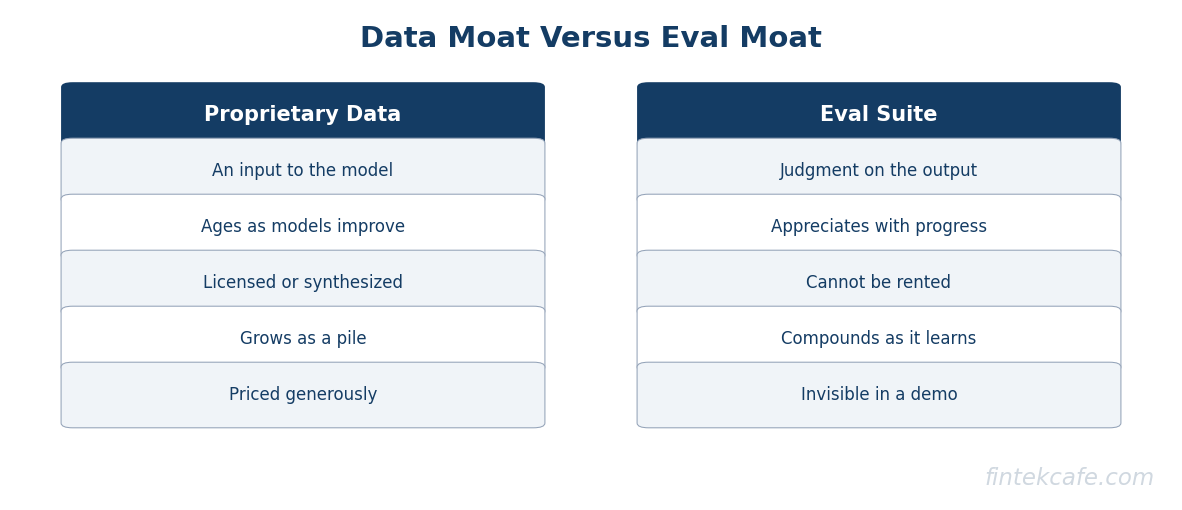
This creates a genuine puzzle for anyone allocating capital or setting product strategy in applied AI. If the intelligence layer is a commodity input, where does defensibility live? The fashionable answer for several years was proprietary data, and it has mostly disappointed. The contrarian thesis of this piece is that the durable moat in applied AI is the evaluation suite: the accumulated, domain-specific machinery for measuring whether AI output is actually good. It is the only asset in the stack that competitors cannot rent, it compounds while everything else in the stack depreciates, and it is systematically underpriced by the market for a revealing reason: it is invisible in a demo.
The Asset Nobody Demos
An evaluation suite, in the mature form that matters here, is not a test script. It is thousands of graded examples of what good and bad look like in one specific domain: the edge cases collected from production failures, the rubrics that encode why one answer is acceptable and a nearly identical one is not, the regression sets built from every incident, the scoring harness that runs all of it automatically against any candidate model or prompt change. Organizations that want the mechanics can start with the executive guide to AI evals; the strategic point here is different. The strategic point is what kind of asset this is.
Consider what a mature eval suite actually contains. When a wealth-management assistant is asked about a client nearing retirement with a concentrated stock position, there are answers that are technically accurate and commercially catastrophic, answers that are compliant but useless, and a narrow band of answers a senior adviser would sign. A suite that can distinguish those three categories, across thousands of scenarios, holding the accumulated judgment of the firm's best people and the scar tissue of its worst incidents, is not test infrastructure. It is the firm's definition of quality, compressed into an executable form. No frontier lab sells that, because no frontier lab has it. It can only be built by an organization that has seen its own edge cases, and it can only be built over time.
That is the first leg of the moat argument: rentability. Model access is rented by definition. Talent is rented at a lag, through hiring. Even proprietary data can increasingly be approximated, licensed, or synthesized. The eval suite is the one asset whose production function requires the one input competitors cannot buy, which is operating history in the specific domain with the specific customers.
This is a Premium Article
Sign up for a Premium membership to read this article and get full access to strategic intelligence on technology and business.
Already a member? Sign in
Related Articles
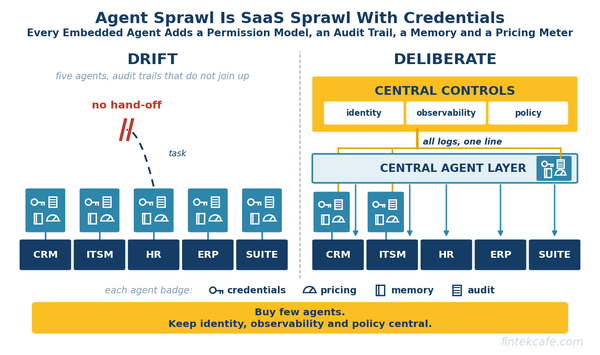
Every Software Vendor Now Sells an Agent, and Most Enterprises Should Buy Very Few of Them
Buying an agent from every system of record recreates SaaS sprawl one layer up. How CIOs should choose, and which controls must stay central.
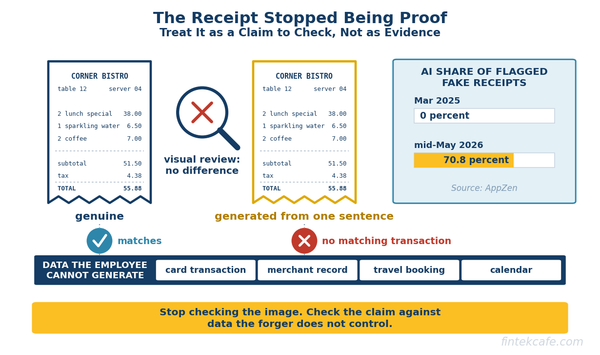
AI-Generated Fake Receipts: How Expense Fraud Changed and How Finance Teams Catch It
AI-generated fake receipts now beat visual review. How expense fraud changed, which detection still works, and the controls to use by company size.
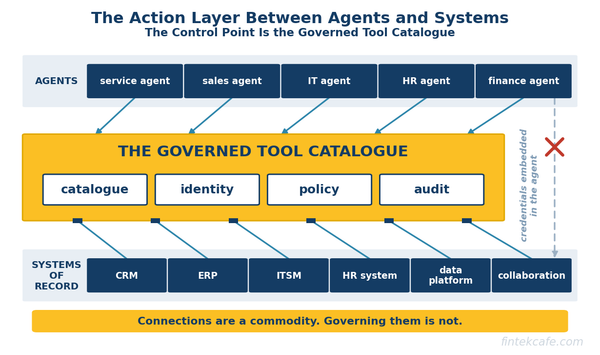
Integration Platforms Are the Quiet Winners of the Agent Era
Agents act through integrations. iPaaS and API vendors hold the connectors, credentials and audit trails, and MCP makes governing that layer worth more.