
How to Build an AI Center of Excellence That Actually Ships
Key Takeaways
- Most AI Centers of Excellence become PowerPoint factories because they lack delivery mandates and executive air cover.
- The hub-and-spoke model outperforms centralized and fully embedded alternatives for organizations with more than 500 employees.
- Budget ownership determines whether the CoE ships products or just publishes guidelines.
- A well-structured CoE should produce measurable business outcomes within its first 90 days, not a slide deck.
- The RACI framework prevents the governance bloat that kills momentum in the first year.
Why Most AI Centers of Excellence Fail
The concept sounds compelling on paper. Gather the smartest AI talent under one roof, give them a charter, and watch the transformation happen. In practice, the 2026 picture is unforgiving: roughly 70 percent of AI CoEs underdeliver within their first 18 months, and the cohort that launched between 2023 and 2025 has produced the clearest evidence yet of the failure pattern. The failure modes are predictable.
The first structural mistake is treating the CoE as a research lab rather than a delivery unit. When the charter says "explore AI opportunities" instead of "ship three production models by Q3," the team drifts toward experimentation without accountability. Organizations that have built successful CoEs consistently report that a delivery mandate changes everything.
The second mistake is placing the CoE too far from the business. A team that reports four levels below the CEO lacks the authority to secure data access, reallocate engineering resources, or push back on unrealistic timelines. Without executive sponsorship at the C-suite level, the CoE becomes an advisory body that business units can safely ignore.
The third mistake is staffing for prestige rather than impact. Hiring five PhD researchers and zero ML engineers produces impressive whitepapers and zero deployed models. The ratio matters more than the headcount.
The Governance Trap
Governance is necessary, but it can also become a convenient excuse for inaction. When every AI initiative requires approval from a 12-person committee that meets monthly, the organization has effectively built a system optimized for saying no. Effective AI governance operates more like a code review process: lightweight, fast, and embedded in the workflow rather than bolted on top.
Three Operating Models Compared
Choosing the right operating model is the single highest-leverage decision in building a CoE. Each model comes with distinct tradeoffs around speed, consistency, and talent retention.
Centralized Model
In a centralized model, all AI talent sits within one team. Business units submit requests, and the CoE prioritizes and delivers.
Strengths: Consistent standards, efficient talent utilization, easier knowledge sharing.
Weaknesses: The request queue becomes a bottleneck. Business units feel underserved. Prioritization fights consume leadership bandwidth. The CoE team lacks deep domain context.
Best for: Organizations with fewer than 500 employees or those in the earliest stages of AI adoption where standardization matters more than speed.
Fully Embedded Model
In this model, AI practitioners sit directly within business units. There is no central team.
Strengths: Deep domain expertise, fast iteration, strong alignment with business goals.
Weaknesses: Duplicated effort, inconsistent standards, fragmented tooling, isolation of talent. When the payments team and the risk team each build their own feature store, the organization pays twice for the same infrastructure.
Best for: Mature organizations where AI talent is abundant and business units have the technical sophistication to manage their own teams.
Hub-and-Spoke Model (Recommended)
The hub maintains shared infrastructure, governance, standards, and a talent pool. Spokes are embedded practitioners within business units who follow the hub's standards but report to business leadership.
Strengths: Balances speed with consistency. Business units get dedicated attention. The hub prevents duplication and maintains quality. Talent rotates between the hub and spokes, improving retention and cross-pollination.
Weaknesses: Requires careful coordination. The dotted-line reporting structure between the hub and spokes can create tension if roles are not clearly defined.
Best for: Mid-to-large organizations serious about scaling AI across multiple business units.
Model Comparison Table
| Dimension | Centralized | Embedded | Hub-and-Spoke |
|---|---|---|---|
| Speed to deploy | Slow (queue) | Fast | Moderate to fast |
| Standards consistency | High | Low | High |
| Domain expertise | Low | High | High |
| Talent retention | Moderate | Low | High |
| Infrastructure duplication | None | High | Low |
| Coordination overhead | Low | None | Moderate |
| Recommended org size | Under 500 | 5,000+ | 500 to 10,000 |
Staffing the CoE: Roles and Ratios
The composition of the team matters more than its size. A common mistake is hiring exclusively for data science when the bottleneck is almost always engineering and deployment.
Core Roles
CoE Lead / Head of AI: Sets strategy, manages stakeholder relationships, owns the budget, and reports to the C-suite. This person must be fluent in both technology and business outcomes. A pure technologist will lose the political battles. A pure business leader will make poor technical bets.
ML Engineers: Build, deploy, and maintain production models. For every data scientist on the team, plan for at least two ML engineers. The research-to-production gap is where most organizations lose momentum.
Data Engineers: Ensure clean, accessible, well-documented data pipelines. Without this role, data scientists spend 80 percent of their time on data preparation instead of model development.
AI Product Managers: Translate business problems into scoped AI projects with clear success metrics. This role prevents the "solution looking for a problem" pattern that plagues many CoEs.
Applied Researchers (optional): Investigate new techniques and evaluate emerging tools. Keep this group small. One or two researchers for every ten practitioners is a reasonable ratio.
MLOps / Platform Engineers: Build and maintain the infrastructure for model training, deployment, monitoring, and retraining. This role becomes critical once the organization has more than five models in production.
Recommended Staffing Ratios
For a team of 12 (a reasonable starting size for a mid-market organization):
- 1 CoE Lead
- 2 Data Scientists
- 4 ML Engineers
- 2 Data Engineers
- 1 AI Product Manager
- 2 MLOps Engineers
This ratio prioritizes delivery over research. Adjust based on organizational maturity: earlier-stage companies may need more data engineers, while more mature organizations may shift toward MLOps.
Budget Ownership: The Make-or-Break Decision
Where the budget lives determines what the CoE can actually do. Three patterns exist, and the differences in outcomes are significant.
CoE Owns the Budget
The CoE controls its own infrastructure spend, headcount, and project funding. Business units contribute requirements, not money.
Outcome: The CoE can invest in shared infrastructure and long-term capability building. Business units engage because the AI work is "free" from their perspective.
Risk: The CoE may pursue technically interesting projects that lack business impact. A strong product management function mitigates this.
Business Units Own the Budget
Business units fund specific AI projects. The CoE acts as a contractor.
Outcome: Strong business alignment because the people writing checks define the work. Every project has a clear sponsor.
Risk: Shared infrastructure is underfunded because no single business unit wants to pay for it. The CoE becomes a services organization rather than a strategic capability.
Shared Funding Model (Recommended)
The CoE receives central funding for infrastructure, platform, and talent development. Business units fund specific use cases from their own budgets.
Outcome: Shared capabilities get built and maintained. Business units have skin in the game for their own projects. The CoE maintains strategic independence while staying accountable to business outcomes.
This is the model that industry research consistently finds produces the best long-term results.
Reporting Lines That Work
The CoE must report high enough in the organization to have authority, but close enough to the business to stay relevant.
Reports to the CTO or CIO: Common and workable. The CoE benefits from technical leadership support and infrastructure access. The risk is that AI becomes viewed as a "technology thing" rather than a business capability.
Reports to the CEO or COO: Less common but increasingly effective. The CoE has maximum authority and cross-functional reach. This structure sends a clear signal about organizational priorities.
Reports to a business unit leader: Almost always a mistake. The CoE becomes captive to one division's priorities, and other business units disengage.
The recommended approach: The CoE Lead reports to the CTO or CEO with a dotted line to the CFO for budget oversight. This provides technical credibility, executive air cover, and financial accountability.
RACI Template for AI CoE Governance
Clear accountability prevents the committee-driven paralysis that kills CoEs. The following RACI framework covers the most common decision types.
| Decision | CoE Lead | Business Sponsor | Data Team | Legal/Compliance | Executive Sponsor |
|---|---|---|---|---|---|
| New use case approval | A | R | C | C | I |
| Data access requests | C | R | A | C | I |
| Model deployment to production | A | I | R | C | I |
| Ethical review and bias audit | R | C | C | A | I |
| Budget allocation (shared) | R | C | I | I | A |
| Budget allocation (BU-funded) | C | A | I | I | I |
| Vendor and tool selection | A | C | R | C | I |
| Talent hiring decisions | A | C | I | I | I |
| Decommissioning a model | R | A | R | C | I |
R = Responsible, A = Accountable, C = Consulted, I = Informed
The key principle: no decision should have more than one "A." When two people are accountable, neither is.
The First 90 Days: A Kickoff Plan That Produces Results
The first three months set the trajectory for the CoE's entire existence. Organizations that try to boil the ocean in this period fail. The following plan focuses on establishing credibility through delivery.
Days 1 to 30: Foundation
Week 1 to 2:
- Secure executive sponsorship and confirm the reporting structure.
- Define the CoE's mandate in one sentence. If the sentence contains the word "explore," rewrite it with a verb like "deliver," "deploy," or "reduce."
- Identify the first two business sponsors willing to commit a use case.
Week 3 to 4:
- Audit existing AI and ML initiatives across the organization. Most companies already have scattered efforts. Catalog them.
- Assess the current data infrastructure. Document what data is accessible, what requires new pipelines, and what has quality issues.
- Hire or assign the first three roles: CoE Lead (if not already in place), one ML Engineer, one Data Engineer.
- Set up the initial development environment and toolchain.
Deliverable by Day 30: A one-page charter document signed by the executive sponsor, two confirmed pilot use cases with business sponsors, and a working development environment.
Days 31 to 60: First Pilot
Week 5 to 6:
- Begin work on the highest-impact pilot use case. Choose the project with the best combination of business value, data readiness, and technical feasibility.
- Establish coding standards, model documentation templates, and a basic model registry.
- Set up the MLOps pipeline: version control, automated testing, deployment automation.
Week 7 to 8:
- Deploy the first model to a staging environment.
- Run initial validation with the business sponsor. Collect feedback on both the model output and the collaboration process.
- Begin scoping the second pilot use case.
- Publish the first internal communication about the CoE's progress. Visibility builds political capital.
Deliverable by Day 60: A model in staging with validated business metrics, a documented MLOps pipeline, and an internal newsletter or Slack update establishing the CoE's presence.
Days 61 to 90: Deliver and Scale
Week 9 to 10:
- Move the first pilot to production. Track business outcomes, not just model accuracy.
- Begin the second pilot use case.
- Conduct a retrospective on the first pilot: what worked, what took too long, what needs to change in the process.
Week 11 to 12:
- Present results to the executive sponsor with a clear narrative: problem, approach, outcome, next steps.
- Publish the first version of the AI governance framework (keep it to two pages maximum).
- Propose the Year 1 roadmap with three to five additional use cases, staffing plan, and budget requirements.
Deliverable by Day 90: One model in production with measured business impact, a governance framework, and a funded Year 1 roadmap.
What the First 12 Months Should Produce
By the end of the first year, a well-run CoE should have concrete, measurable results.
Quarter 1 (covered above): One model in production, governance framework, Year 1 roadmap approved.
Quarter 2: Two to three additional models in production. Shared infrastructure (feature store, model registry, monitoring) operational. First embedded spoke team established in the highest-priority business unit.
Quarter 3: Five to seven models in production. Second spoke team established. First model retrained and improved based on production feedback. Internal AI literacy training program launched for business stakeholders.
Quarter 4: Seven to ten models in production. Measurable business impact documented (revenue generated, costs reduced, or risks mitigated). Year 2 roadmap with expanded scope. At least one initiative that was not on the original roadmap, demonstrating the CoE's ability to respond to emerging opportunities.
Red Flags at the 12-Month Mark
If any of the following are true after 12 months, the CoE has a structural problem:
- Zero models in production.
- The governance framework is longer than 10 pages.
- Business units describe the CoE as "slow" or "academic."
- The CoE Lead cannot name the specific business outcomes of each deployed model.
- More than 40 percent of the team's time goes to data preparation because data engineering was underinvested.
Common Pitfalls and How to Avoid Them
The Pilot Purgatory Loop: The team completes pilot after pilot but never moves to production. Fix this by making "deployed to production" the definition of done for every project. A pilot that never ships is a failure, not a learning.
The Platform Rabbit Hole: The team spends six months building the "perfect" ML platform before delivering any business value. Build the minimum viable platform alongside the first pilot, then iterate based on real needs.
The Talent Hoarding Problem: The central team resists embedding practitioners in business units because it reduces headcount. The hub-and-spoke model only works if the hub genuinely supports the spokes. Measure success by the number of models in production across the organization, not by the size of the central team.
The Governance Creep: The governance framework grows from 2 pages to 20 as legal, compliance, and risk teams add requirements. Push back. Every additional governance step is a tax on speed. Keep the framework lean and add requirements only when there is evidence of actual harm, not theoretical risk.
Frequently Asked Questions
How large should an AI Center of Excellence be?
Start with 8 to 12 people for a mid-market organization (1,000 to 5,000 employees). Scale to 25 to 40 within the first two years based on demand. The key constraint is not headcount but the ratio of engineers to researchers. Aim for at least 2:1 in favor of engineering and operations roles.
Should the CoE build or buy AI tools?
Build the orchestration and governance layer. Buy the infrastructure (cloud compute, ML platforms, monitoring tools). Avoid building custom versions of commodity tools like feature stores or experiment trackers unless the organization has highly specific requirements that no vendor addresses.
How do you measure the ROI of an AI Center of Excellence?
Track three categories: revenue impact (new products, improved conversion, pricing optimization), cost reduction (automation, efficiency gains, reduced manual processes), and risk mitigation (fraud detection, compliance automation). Every model in production should have a business sponsor who owns the ROI calculation. The CoE tracks delivery metrics (time to production, model reliability), not business outcomes directly.
What is the difference between an AI CoE and a data science team?
A data science team builds models. An AI CoE builds the organizational capability to deploy, govern, and scale AI across the entire enterprise. The CoE includes data science but also encompasses engineering, operations, governance, and change management. Think of it as the difference between having a developer and having a software engineering organization.
When should a company NOT build an AI CoE?
Organizations with fewer than 200 employees rarely need a formal CoE. A small, cross-functional team with a clear mandate can accomplish the same goals with less overhead. Companies without clean, accessible data should invest in data infrastructure before standing up an AI team. The most common failure mode is hiring AI talent before the data foundation is ready.
How does the CoE handle competing priorities from multiple business units?
Use a scoring framework that weighs business impact (40 percent), data readiness (25 percent), technical feasibility (20 percent), and strategic alignment (15 percent). Publish the scoring criteria and the prioritized backlog transparently. When business units can see why a project was ranked higher or lower, political conflicts decrease significantly.
Internal Links
Related Articles
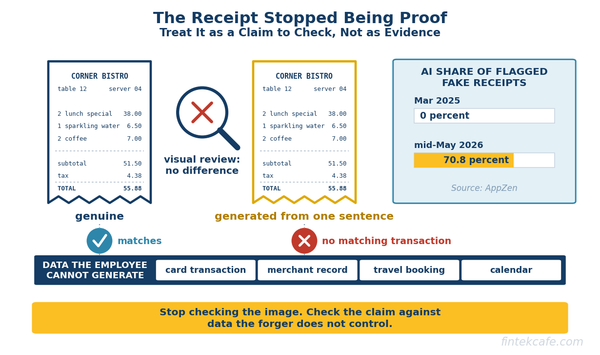
AI-Generated Fake Receipts: How Expense Fraud Changed and How Finance Teams Catch It
AI-generated fake receipts now beat visual review. How expense fraud changed, which detection still works, and the controls to use by company size.
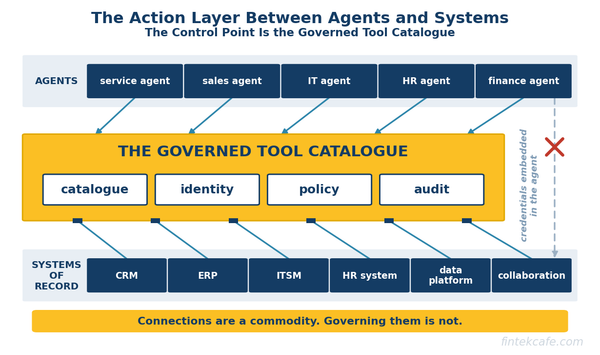
Integration Platforms Are the Quiet Winners of the Agent Era
Agents act through integrations. iPaaS and API vendors hold the connectors, credentials and audit trails, and MCP makes governing that layer worth more.
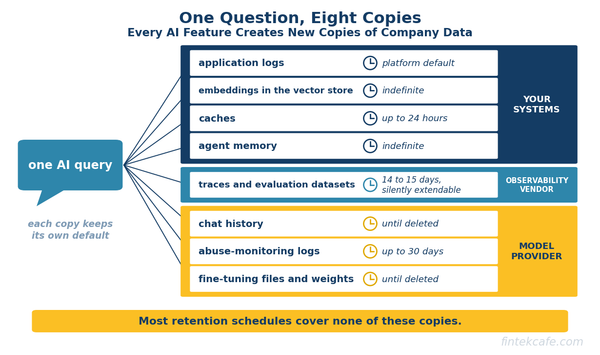
What Happens to Your Data Inside AI Systems: Retention, Deletion and the Copies Nobody Tracks
Every AI feature copies company data into prompts, logs, embeddings and memory. Where each copy lives, what vendors retain, and how to make deletion real.