
The Unit Economics of Fintech: CAC, LTV, and Why Most Startups Lose Money
In 2021, there were approximately 26,000 fintech startups globally. By the end of 2024, roughly two-thirds of those that raised venture capital had either shut down, been acqui-hired, or were operating as walking dead - burning through remaining cash with no viable path to profitability.
The fundamental problem was not product-market fit. Many of these companies had millions of users. The problem was unit economics. They acquired customers at costs that no reasonable lifetime value could justify.
This is the central paradox of consumer fintech: financial products are essential - everyone needs a bank account, a way to send money, insurance, credit - but essential does not mean profitable at the individual customer level. A neobank that spends $35 to acquire a customer who generates $12 per year in revenue will not fix that gap by acquiring ten million more customers. It will simply lose money at unprecedented scale.
Understanding unit economics by fintech vertical is not optional for anyone building, investing in, or competing with fintech companies. It is the difference between recognizing a sustainable business and a subsidized one.
The Core Framework: CAC, LTV, and the Ratio That Matters
Every fintech business, regardless of vertical, comes down to two numbers: what it costs to acquire a customer (CAC) and what that customer is worth over their lifetime (LTV). The ratio between them - LTV/CAC - determines whether the business is viable.
The widely cited benchmark is that LTV should be at least three times CAC, with CAC recovered within 12 to 18 months. In practice, very few consumer fintechs hit both targets simultaneously. The ones that do tend to be the ones that survive.
Customer Acquisition Cost (CAC) in fintech includes paid marketing spend (performance ads on Google, Meta, TikTok), referral bonuses (Chime's $100 referral, Cash App's $5-$30 referral bonuses), sign-up incentives (free stock from Robinhood, cashback from neobanks), and the fully loaded cost of onboarding (KYC verification, card issuance, account setup).
CAC varies enormously by segment. A consumer neobank targeting mass-market customers might acquire users for $20-50 through digital channels. A B2B payments company targeting mid-market merchants could spend $200-500 per customer. A wealth management platform targeting high-net-worth individuals routinely spends $500-1,000 or more per client.
Lifetime Value (LTV) is where the analysis gets genuinely complicated. It depends on average revenue per user (ARPU), gross margin on that revenue, and customer retention (churn rate). A customer who stays for ten years at $15/month is worth far more than one who stays for six months at $50/month. Retention is the multiplier that makes or breaks fintech economics.
The formula is straightforward: LTV = ARPU x Gross Margin / Monthly Churn Rate. The challenge is that each variable behaves differently across verticals.
This is a Premium Article
Sign up for a Premium membership to read this article and get full access to strategic intelligence on technology and business.
Already a member? Sign in
Related Articles

GPU Repatriation: The Utilization Math Deciding Where Inference Runs
Owned accelerators beat rented ones above a utilization threshold most teams never compute. The break-even math, and why idle GPUs are the expensive asset.
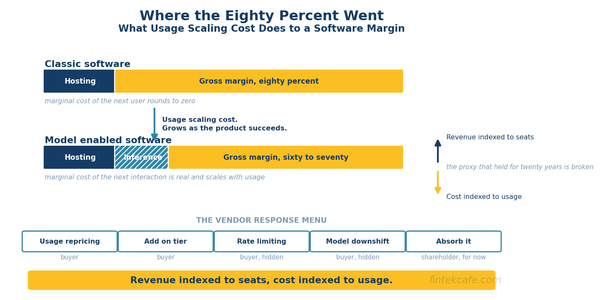
The SaaS Gross Margin Squeeze: AI COGS Are Breaking the Eighty Percent Model
Inference is a real, usage-scaling cost of goods sold. It is pulling software gross margins toward infrastructure territory, and buyers pay for it either way.

Trade Finance Explained: Letters of Credit, Factoring, and Supply Chain Finance
The $5 Trillion Infrastructure Nobody Talks About Every iPhone assembled in Zhengzhou, every container of Brazilian soybeans unloaded in Rotterdam, every batch of Vietnamese electronics shipped