
Platform vs Product: Why the Best Fintechs Become Platforms
In 2010, Stripe was a seven-line JavaScript snippet that let developers accept credit card payments. In 2025, Stripe processes over $1 trillion in annual payment volume and offers billing, invoicing, tax calculation, identity verification, treasury services, card issuing, fraud detection, corporate incorporation, climate carbon removal, and financial reporting - across 46 countries.
In 2009, Square was a white plastic dongle that plugged into the headphone jack of an iPhone and let a food truck accept card payments. In 2025, Block (Square's parent company) is a $40+ billion company spanning a point-of-sale ecosystem, Cash App with 57 million monthly active users, Afterpay's buy-now-pay-later network, TBD's open Bitcoin protocol, and TIDAL's music streaming service.
These are not stories of product companies that grew. These are stories of product companies that transformed into platforms - and the distinction is the most consequential strategic decision in fintech.
A product solves one problem well. A platform solves one problem and then creates the infrastructure for others to solve adjacent problems on top of it. The difference in outcomes is not incremental. It is exponential. Platforms capture more value, retain customers longer, grow faster, and trade at substantially higher valuation multiples than products.
Understanding why requires understanding the mechanics of platform economics, network effects, and aggregation theory as applied to financial services.
The Product Trap: Why Good Products Hit a Ceiling
Every successful fintech starts as a product. The product is excellent. It solves a real pain point better than incumbent alternatives. Customers love it. Revenue grows.
And then it stalls.
The product trap occurs when a company optimizes a single value proposition so effectively that there is nowhere left to go. The product reaches market saturation within its use case, competitors copy the features that made it distinctive, and growth decelerates toward the market's natural ceiling.
Consider the trajectory of a hypothetical payments-only company. It offers a clean API for online credit card processing. It charges 2.9% + $0.30 per transaction. It grows by acquiring more merchants. Eventually, every merchant in its target segment either uses the product or has evaluated and rejected it. Growth now depends on either expanding the addressable market (international, new merchant segments) or taking share from competitors through pricing - which compresses margins.
This is a fine business. It generates cash. But it will never generate the compounding returns that investors - and employees with stock options - expect.
The ceiling is structural. A single-product company earns a single revenue stream per customer. When that stream is tapped out, the only growth lever is more customers. More customers require more sales spend, which means CAC rises while ARPU stays flat. The LTV/CAC ratio declines as the company moves from early adopters (cheap to acquire, high engagement) to the mainstream market (expensive to acquire, lower engagement).
Platforms escape this trap entirely.
This is a Premium Article
Sign up for a Premium membership to read this article and get full access to strategic intelligence on technology and business.
Already a member? Sign in
Related Articles
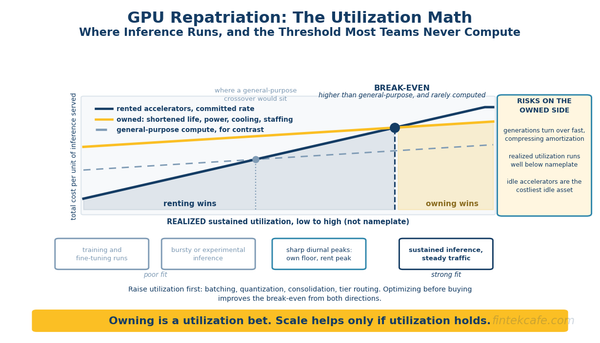
GPU Repatriation: The Utilization Math Deciding Where Inference Runs
Owned accelerators beat rented ones above a utilization threshold most teams never compute. The break-even math, and why idle GPUs are the expensive asset.
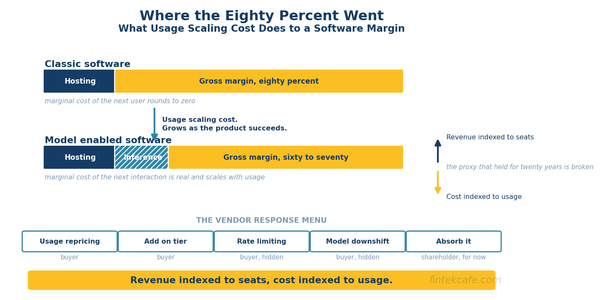
The SaaS Gross Margin Squeeze: AI COGS Are Breaking the Eighty Percent Model
Inference is a real, usage-scaling cost of goods sold. It is pulling software gross margins toward infrastructure territory, and buyers pay for it either way.
Trade Finance Explained: Letters of Credit, Factoring, and Supply Chain Finance
The $5 Trillion Infrastructure Nobody Talks About Every iPhone assembled in Zhengzhou, every container of Brazilian soybeans unloaded in Rotterdam, every batch of Vietnamese electronics shipped