
Market Microstructure: How Stock Exchanges Actually Work

When you place a market order to buy 100 shares of Apple on Robinhood, you probably assume your order goes to the New York Stock Exchange. It doesn't.
Your order goes to Citadel Securities. Or Virtu Financial. Or another market maker who has paid Robinhood for the privilege of executing your trade. The NYSE is one of 16 US stock exchanges and dozens of alternative trading venues - and for retail orders, it's often not the primary destination.
This is not a conspiracy. It's market microstructure - the set of rules, incentives, and technology that determines how orders get matched and prices get discovered. Understanding it is essential for anyone building trading technology, evaluating broker platforms, or making sense of what actually happened during the GameStop short squeeze.
The Order Book: The Foundation of Everything
Every liquid financial market is organized around an order book - a real-time list of all outstanding buy and sell orders, sorted by price.
Here is a simplified order book for a stock at a moment in time:
BIDS (buyers wanting to purchase):
- 200 shares at $99.97
- 500 shares at $99.95
- 1,000 shares at $99.90
ASKS (sellers willing to sell):
- 150 shares at $100.02
- 400 shares at $100.05
- 800 shares at $100.10
The highest bid is $99.97. The lowest ask is $100.02. The difference - $0.05 - is the bid-ask spread. This spread is not a fee. It's the cost of immediacy. If you want to buy right now, you pay $100.02. If you want to sell right now, you receive $99.97. The spread is the market maker's compensation for standing ready to trade at any moment.
A limit order adds to the order book. If you place a limit order to buy 100 shares at $99.97, your order joins the existing bids and waits there until a seller comes in at that price. A market order takes from the book immediately at the best available price.
Liquid markets have tight spreads - a few cents or fractions of a cent for large-cap stocks. Illiquid markets - small-cap stocks, exotic options, emerging market bonds - have wide spreads, which is why transaction costs are significantly higher for these instruments. Spread width is a direct measure of liquidity.
Market Makers: Who Provides Liquidity and Why
The order book doesn't fill itself. Someone has to be willing to buy when you want to sell, and sell when you want to buy. That's the market maker's job.
A market maker - Citadel Securities, Virtu Financial, Jane Street, or a specialized firm - continuously posts both bids and asks. They are always willing to buy at $99.97 and sell at $100.02. They profit from the spread: buy low, sell high, repeat millions of times per day across thousands of securities.
In practice, it's more complex. Market makers need to manage inventory risk - they can end up holding large positions if buyers or sellers are consistently more aggressive than the opposing side. A market maker who buys 50,000 shares of a stock that then drops 5% loses money. Managing this risk requires sophisticated models, fast technology, and continuous position monitoring.
The economic logic is simple: market makers earn a consistent small profit per trade (the spread) in exchange for taking on inventory risk and providing liquidity to everyone else. When markets are volatile, spreads widen - market makers demand more compensation for higher risk. When markets are calm and liquid, spreads compress to fractions of a cent.
This is why market making is now dominated by quantitative trading firms using algorithmic execution rather than human traders shouting on exchange floors. The economics require speed and scale that only algorithms can deliver consistently.
This is a Premium Article
Sign up for a Premium membership to read this article and get full access to strategic intelligence on technology and business.
Already a member? Sign in
Related Articles
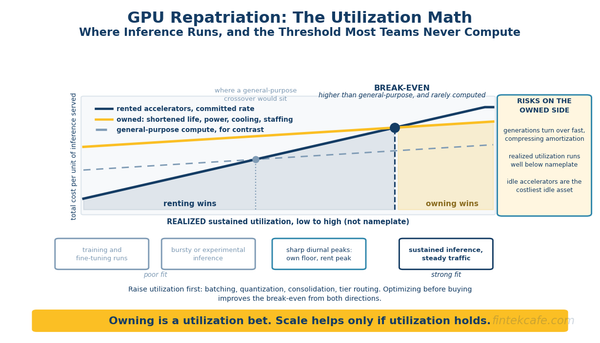
GPU Repatriation: The Utilization Math Deciding Where Inference Runs
Owned accelerators beat rented ones above a utilization threshold most teams never compute. The break-even math, and why idle GPUs are the expensive asset.
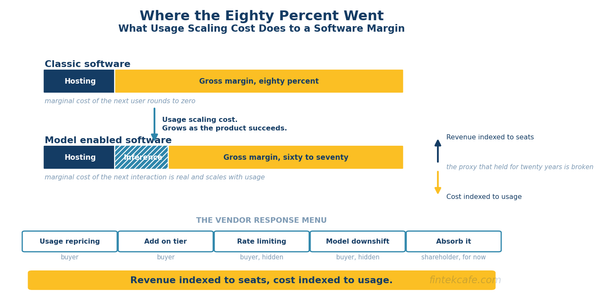
The SaaS Gross Margin Squeeze: AI COGS Are Breaking the Eighty Percent Model
Inference is a real, usage-scaling cost of goods sold. It is pulling software gross margins toward infrastructure territory, and buyers pay for it either way.
Trade Finance Explained: Letters of Credit, Factoring, and Supply Chain Finance
The $5 Trillion Infrastructure Nobody Talks About Every iPhone assembled in Zhengzhou, every container of Brazilian soybeans unloaded in Rotterdam, every batch of Vietnamese electronics shipped