
The Hidden Cost of LLM Inference in 2026: Why Token Pricing Is Misleading Enterprise Buyers
The enterprise procurement team responsible for choosing an LLM inference vendor in 2026 has been handed a comparison table. The columns are OpenAI, Anthropic, Google, and the open-weight serving stack on top of a hyperscaler. The rows are input token price, output token price, and context window. The numbers look directly comparable. They produce a clear winner on the spreadsheet, the contract is signed, and four to six months later the actual invoice arrives and is three to ten times the figure the spreadsheet implied. The vendor is not lying about the headline numbers. The numbers are real. The numbers are also not the cost of running the workload.
This is not a niche problem. Industry research across enterprise AI deployments through 2025 and into 2026 finds a consistent gap between budgeted and realized inference cost. The variance is large enough that several procurement teams have moved AI inference from the standard software-as-a-service line item into a separate cost-management discipline, more analogous to cloud FinOps than to traditional software licensing. The reason is that the per-token price is a useful unit of measurement and a misleading unit of comparison. The three cost drivers that the per-token comparison hides reshape the actual unit economics in ways the marketing pages do not surface, and they reshape the answer to which vendor wins under realistic workloads in 2026.
Hidden Cost Driver One: Input to Output Token Ratio Varies by an Order of Magnitude
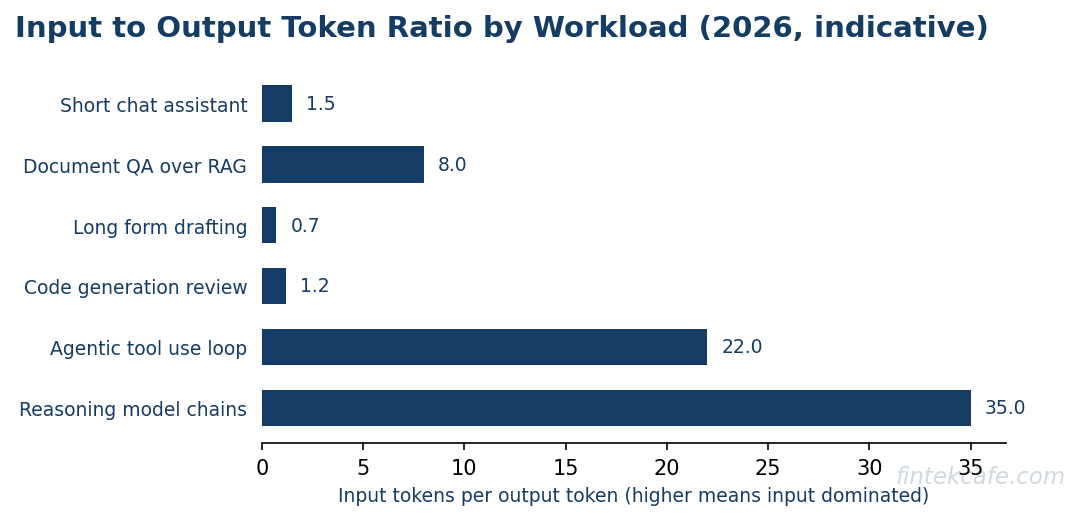
The first thing the per-token comparison hides is the workload's actual input-to-output ratio. Every vendor publishes two numbers: input tokens and output tokens. Input tokens are cheaper, often by a factor of three to five. The naive procurement assumption is that this factor is small enough to ignore. For most realistic enterprise workloads, the assumption is wrong, because the input-to-output ratio is not one-to-one. It is rarely even ten-to-one. For some of the most common enterprise patterns it is one hundred to one or higher.
Consider the input-to-output ratios across actual workload types, drawn from anonymized enterprise deployments reported in industry working groups during 2025 and 2026:
| Workload type | Typical input:output ratio | What dominates the bill |
|---|---|---|
| Chat assistant, conversational | 5:1 to 15:1 | Output tokens still material, input less so |
| Document Q and A with retrieval | 50:1 to 200:1 | Input tokens dominate, output is a small fraction |
| Code completion in IDE | 100:1 to 500:1 | Input context dominates, completion is brief |
| Summarization of long documents | 100:1 to 1000:1 | Input tokens are essentially the entire bill |
| Multi-step agent with tool calls | 20:1 to 80:1 per turn | Input grows with each turn as history accumulates |
| Classification or extraction from corpus | 200:1 to 2000:1 | Input dominates, output is a small structured field |
A vendor with an output-token price that is half the competitor's price and an input-token price that is double the competitor's price looks comparable on a side-by-side that uses an implicit one-to-one ratio. On a document Q-and-A workload with a one-hundred-to-one input-to-output ratio, that same vendor is roughly twice as expensive at the workload level. The decision flips based on the ratio. The procurement table did not show the ratio because the ratio depends on the workload, not on the vendor.
The implication for any serious enterprise procurement exercise is that the vendor comparison cannot be done on published prices alone. It has to be done on workload-weighted blended prices, where the weight is the actual measured input-to-output ratio of the workload that will run on the contract. Teams that have done this exercise rigorously find that the rank order of vendors changes between workload types. The optimal vendor for chat assistants is not the optimal vendor for document Q-and-A, and a single-vendor strategy across multiple workload types leaves money on the table that compounds over the contract term.
This is a Premium Article
Sign up for a Premium membership to read this article and get full access to strategic intelligence on technology and business.
Already a member? Sign in
Related Articles
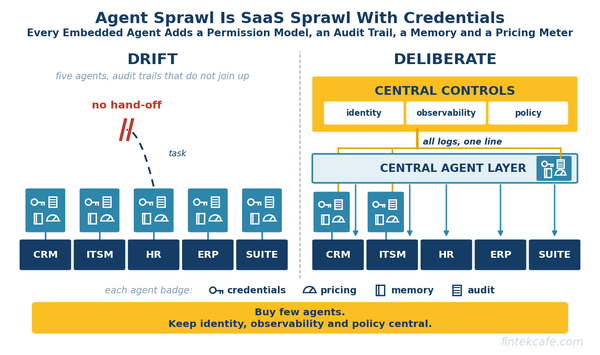
Every Software Vendor Now Sells an Agent, and Most Enterprises Should Buy Very Few of Them
Buying an agent from every system of record recreates SaaS sprawl one layer up. How CIOs should choose, and which controls must stay central.
AI-Generated Fake Receipts: How Expense Fraud Changed and How Finance Teams Catch It
AI-generated fake receipts now beat visual review. How expense fraud changed, which detection still works, and the controls to use by company size.
Integration Platforms Are the Quiet Winners of the Agent Era
Agents act through integrations. iPaaS and API vendors hold the connectors, credentials and audit trails, and MCP makes governing that layer worth more.