
Instant Payouts: How Uber, DoorDash, and Lyft Pay Drivers in Real Time
The Problem With Waiting Two Weeks
59 million Americans do gig work. According to McKinsey's 2023 American Opportunity Survey, that's 36% of the US workforce - driving for Uber, delivering for DoorDash, fixing things on TaskRabbit, writing on Upwork. For many of them, the work is daily. The pay cycle isn't.
The 14-day payroll cycle was designed for W-2 employees with predictable, pre-negotiated hours. It made operational sense in a world where payroll required paper checks, manual reconciliation, and batched bank processing. For salaried workers with savings buffers and benefits, a two-week wait is an inconvenience. For gig workers, many of whom live on thin margins and have no paid sick leave, no benefits, and no employment guarantee, it's a cash flow crisis.
This is the structural mismatch that forced Uber, DoorDash, and Lyft to build real-time payout infrastructure. Not because they wanted to. Because they had to - or risk losing drivers to competitors who would.
Instant payouts went from a driver retention experiment to a competitive weapon. Understanding the infrastructure behind them is essential for any product manager or business leader building in payments, gig platforms, or workforce management.
How Traditional Payroll Works (And Why It's Slow)
Traditional payroll runs on ACH - the Automated Clearing House network. Employers batch payroll instructions into files, submit them to their bank (the Originating Depository Financial Institution, or ODFI), and those files flow through FedACH or the Electronic Payments Network to employees' banks (the Receiving Depository Financial Institutions, or RDFIs).
The process works, but it's optimized for batch efficiency, not speed. Standard ACH settles on T+1 at best - next business day, assuming the file was submitted before the cutoff window. Same-Day ACH, introduced by Nacha between 2016 and 2018, gets this down to within hours - but still has cut-off windows (the last one is 4:45pm ET), still doesn't run on weekends, and still doesn't work on federal holidays.
For a salaried employee who earns the same amount every two weeks, this is fine. The amount is known in advance, the timing is predictable, and the employee can plan around it.
For a gig worker who drove 47 rides on Tuesday, delivered 23 orders on Wednesday, and did nothing Thursday because their kid was sick - the earnings are real, the timing is unpredictable, and a 14-day cycle means they might need to cover a car payment or grocery run with money they've already earned but cannot access.
This is why instant payouts exist. Not as a technology showcase - as a solution to a genuine liquidity problem that ACH's architecture was never designed to solve.
The Technical Infrastructure for Instant Payouts
There are three distinct rails that power instant payouts in the US today. They work differently, cost differently, and serve different use cases. Most people in the industry conflate them. They shouldn't.
Visa Direct and Mastercard Send
Push-to-debit is the dominant technology for gig economy instant payouts. Rather than pulling money out of a bank account (like ACH debit) or initiating a transfer between accounts, push-to-debit works by pushing funds directly to a debit card.
Visa Direct and Mastercard Send are the two push-to-debit networks. A platform like Uber sends a push-payment instruction through their acquiring bank - specifying the recipient's debit card number and the amount - and Visa routes that instruction to the issuing bank that holds the driver's debit card account. The issuing bank posts the credit to the cardholder's account. The whole process typically takes 30 minutes or less; in many cases, it's seconds.
Push-to-debit works because it runs on the existing Visa and Mastercard authorization and settlement networks - the same infrastructure that processes card purchases 24 hours a day, 365 days a year. That's the key operational advantage: no new bank integration required, no dependency on ACH processing windows, no weekday-only limitations.
The fee: typically $0.50–$1.99 per transaction, paid to the card network and split between the network (Visa/MC) and the issuing bank. This is orders of magnitude more expensive than ACH. But for gig platforms trying to differentiate on driver experience, the unit economics work - especially when you charge the fee to the driver.
RTP (The Clearing House) and FedNow
While push-to-debit dominates today, the more architecturally significant infrastructure is account-to-account real-time payments.
The Clearing House RTP network launched in 2017 and currently reaches over 60% of US bank accounts. The Federal Reserve's FedNow launched in July 2023 and has grown to over 1,000 participating institutions. Both networks process account-to-account transfers in seconds, 24/7/365, with immediate final settlement - meaning the funds are irrevocably moved, not just authorized. Both also run natively on ISO 20022, the structured payment-messaging standard now reshaping global payments rails, which means payouts can carry rich purpose codes and structured remittance data the legacy ACH and card rails could not.
The difference from push-to-debit: RTP and FedNow don't require a debit card number. They work bank-account to bank-account, using routing and account numbers. This makes them more flexible (works for any bank account, not just Visa/MC debit cards) but also harder to deploy at scale - the receiving bank needs to be connected to the network, and adoption, while growing fast, is still incomplete.
For instant payouts in gig economy platforms today, RTP and FedNow are emerging options but not yet the default. Visa Direct's near-universal debit card reach still gives it a practical advantage.
Same-Day ACH
Same-Day ACH deserves a mention because it's often lumped in with "instant payouts" by people who don't look closely. It isn't instant. Same-Day ACH settles within hours of submission, but only during business hours, only on weekdays, and only if the originator submits before a processing cut-off window.
For platforms that don't need seconds-level speed, Same-Day ACH is a reasonable option - it's dramatically cheaper than push-to-debit (Nacha's network fee is $0.052 per transaction) and adequate for workers who can wait a few hours rather than a few days. But it is not the infrastructure behind what Uber calls "Instant Pay" or DoorDash calls "Fast Pay." Those are push-to-debit products.
How Uber Instant Pay Works (Step by Step)
Uber Instant Pay is a push-to-debit product built on Visa Direct. Here's what actually happens when a driver cashes out.
A driver completes a shift and has $47 in available earnings sitting in their Uber driver account. They open the Uber Driver app, navigate to the earnings section, and tap "Cash Out." The minimum cashout amount is $1.00. Uber charges $0.85 per cashout.
When the driver confirms the cashout:
- Uber's internal systems verify the driver's available earnings balance and deduct the $0.85 fee.
- Uber sends a Visa Direct push-payment instruction to their acquiring bank - specifying the driver's debit card number (stored from the driver onboarding process), the payment amount ($46.15 after the fee), and the request for immediate disbursement.
- The acquiring bank formats the instruction into a Visa Direct message and submits it to VisaNet.
- VisaNet routes the payment instruction to the issuing bank that issued the driver's debit card.
- The issuing bank receives the credit instruction and posts the funds to the driver's debit card account.
- The driver sees a notification (from their bank, typically) that funds have arrived. This commonly happens within 30 minutes; in many cases within minutes.
Every party in this chain is compensated. Uber pays the network and issuing bank fees on the transaction - typically in the $0.40–$0.80 range at volume - and charges the driver $0.85, pocketing a margin. The acquiring bank, card network (Visa), and issuing bank all take cuts of the interchange-like economics. At Uber's scale, Visa Direct volume discounts mean Uber's net cost is significantly below the $0.85 they charge.
The driver gets their money. Uber retains a small margin. The payment infrastructure gets compensated. This is the economic model that makes instant payouts sustainable.
The Cost Structure - Who Actually Pays
The economics of instant payouts vary significantly by platform. Some pass the fee entirely to workers. Others absorb part of it. A few absorb all of it as a driver acquisition cost.
| Platform | Product Name | Fee to Driver | Network Used | Typical Speed |
|---|---|---|---|---|
| Uber | Instant Pay | $0.85 per cashout | Visa Direct | Within 30 min (often seconds) |
| DoorDash | Fast Pay | $1.99 per cashout | Visa Direct | Within 30 min |
| Lyft | Express Pay | $0.50 per cashout (debit) / 1.5% (bank) | Visa Direct / ACH | Within 30 min (debit) / same day (bank) |
| Instacart | Instant Cashout | $0.50 per cashout | Visa Direct | Within 2 hours |
| Grubhub | Instant Cash Out | $0.50 per cashout | Visa Direct | Within 30 min |
DoorDash's $1.99 fee is the obvious outlier. It's nearly 2.5x what Uber charges and 4x what Instacart and Grubhub charge. There are a few explanations. DoorDash's volume on Visa Direct is lower than Uber's, meaning they receive less favorable pricing from the network. DoorDash also has less leverage in negotiations with Visa given the relative size of their instant payout volume. And frankly, if drivers are willing to pay $1.99 because the product still delivers real value (cash in hand now vs. Wednesday), DoorDash has no immediate pricing pressure to change it.
The platforms that charge $0.50 - Instacart, Grubhub - are either accepting lower margins on the product or have negotiated better network rates. For worker retention purposes, lower fees are a meaningful competitive signal.
The question of who "really" pays is more nuanced than the fee schedule suggests. At $0.85 per cashout, if a high-frequency Uber driver cashes out daily, that's $25/month - a real cost. Some drivers optimize by batching cashouts to weekly. Others pay daily because the cash flow value exceeds the fee. The platform made this tradeoff rational by setting the fee low enough that the math works for many workers.
Earned Wage Access: The Next Evolution
Gig economy instant payouts are just one expression of a broader shift in how Americans access earned income. Earned Wage Access (EWA) is extending the same logic into traditional W-2 employment.
DailyPay, Payactiv, and Rain are the leading EWA providers. The model: employers partner with an EWA platform, which integrates with the employer's HR and payroll system to verify hours worked and earnings accrued. Employees can then access a portion of their already-earned wages before the official pay date - typically for a small fee ($1.99–$3.99 per transaction) or via an employer-subsidized subscription model.
Technically, EWA products are not loans. The worker is accessing money they've already earned but not yet received. There's no interest, no credit check, no debt created. The EWA provider advances the funds and recovers them on payday when the employer's payroll ACH hits. DailyPay reports that employers using their product see 36% lower turnover among hourly employees - which is the employer ROI that justifies the integration cost.
The regulatory picture is unsettled. The CFPB has been examining whether EWA products constitute credit under the Truth in Lending Act. In 2023, the CFPB issued an advisory opinion suggesting that some EWA products - specifically those that charge fees, even flat fees - may be subject to TILA disclosure requirements. This is an active regulatory front. Providers like DailyPay and Payactiv have been lobbying for explicit EWA carve-outs at the state level, with mixed success.
The underlying infrastructure mirrors gig instant payouts: Visa Direct push-to-debit for speed, ACH for lower-cost same-day delivery when speed is less critical. The distribution is different - through employer HR partnerships rather than platform apps - but the payments plumbing is identical.
What This Means for the Payments Industry
Here is the position worth stating clearly: instant payouts are not a premium feature on a permanent cost curve. They are a transitional product on a closing window.
The fundamental problem with charging $0.85–$1.99 for instant payouts is that it only persists as long as real-time bank infrastructure remains incomplete. Visa Direct's fee exists because it provides value that the ACH network can't match - 24/7 availability, seconds-level speed, universal debit card reach. Remove those advantages and the fee collapses.
FedNow is removing those advantages. Launched in July 2023 with fewer than 100 participating institutions, FedNow has grown to over 1,000 banks and credit unions as of early 2026. The network is now reachable for a substantial share of US bank account holders, and the Federal Reserve has explicitly committed to universal access as a policy goal. FedNow transactions are free to end users by design. The cost to institutions is a small per-transaction fee, far below what Visa Direct charges.
As FedNow adoption expands, the business case for charging workers $1.99 to access their own earned wages weakens considerably. A gig platform with FedNow connectivity could offer instant payouts at near-zero marginal cost - making fee-based instant payouts a competitive liability rather than a monetizable feature.
The platforms that charge for instant payouts today are monetizing a window that is closing. The smart ones are already treating instant payouts as a driver retention cost to absorb, not a revenue line to defend. The Clearing House RTP network and FedNow together reaching critical mass - probably within three to five years - will make instant payouts table stakes for any platform that pays a distributed workforce. The fee will disappear. The expectation will remain.
For product managers in this space, the implication is direct: build your worker payment product on an abstraction layer that can route across Visa Direct, RTP, and FedNow depending on cost and coverage. Don't architect yourself into a single-rail dependency. The infrastructure is converging. Your product stack should too.
Key Takeaways
- Instant payouts became competitive infrastructure, not a nice-to-have, because 14-day ACH pay cycles create genuine cash flow crises for gig workers who earn daily.
- Push-to-debit (Visa Direct, Mastercard Send) is the dominant technology today - funds hit a debit card in seconds to 30 minutes, 24/7/365, at a cost of $0.50–$1.99 per transaction.
- Uber charges $0.85 per cashout, DoorDash charges $1.99, and Lyft charges $0.50 - the variation reflects network volume discounts and strategic choices about whether instant pay is a margin line or a retention investment.
- Earned Wage Access (EWA) extends the same logic to W-2 workers through employer partnerships - DailyPay, Payactiv, and Rain integrate with HR systems so employees can access earned wages before payday. The CFPB is actively examining whether EWA products constitute credit.
- FedNow and RTP are the infrastructure that will commoditize instant payouts - as these account-to-account real-time rails expand, Visa Direct's fee premium erodes and instant payouts become effectively free.
- Platforms charging for instant payouts today are monetizing a closing window - within three to five years, real-time payout capability will be table stakes, the fees will disappear, and the expectation of instant access to earned wages will be permanent.
Related Reading
Related Articles
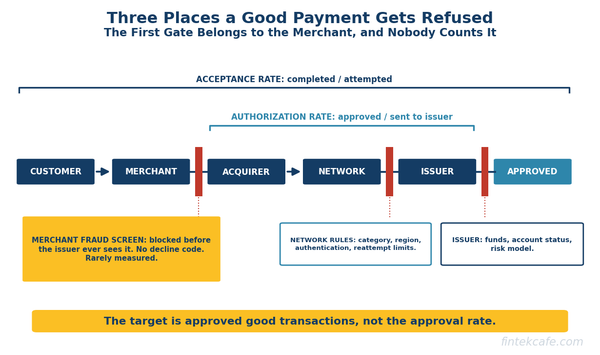
Why Card Payments Get Declined, and How Merchants Raise Their Approval Rate
Why card payments get declined, soft vs hard declines, and the levers that raise authorization rates without letting fraud and chargebacks rise with them.
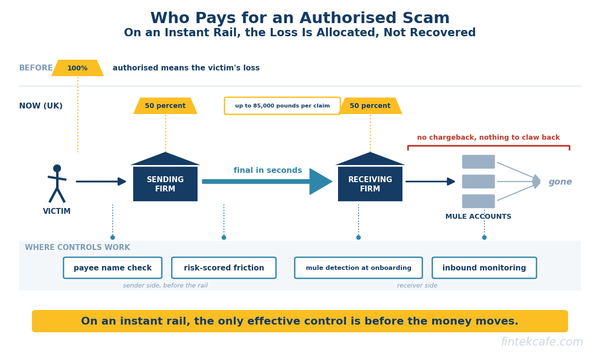
Scam Reimbursement Is Becoming a Cost of Running Instant Payments
Mandatory APP scam reimbursement turns fraud into a line in instant-payment unit economics, and the receiving firm now pays half. What it costs, and who.
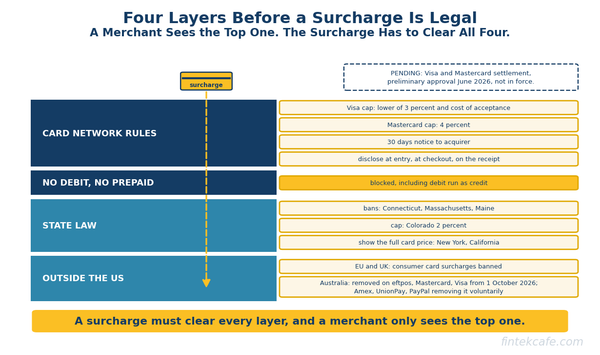
Credit Card Surcharging: When Passing On Card Costs Is Legal, and When It Costs More Than It Saves
Credit card surcharge rules differ by network, state and country. When a surcharge is legal, what it does to sales, and cheaper ways to cut card costs.