
How to Read a Fintech S-1: What the IPO Filing Actually Tells You
The S-1 is the single most honest document a company ever produces. Not because companies want to be honest in it - they do not. But because the SEC requires them to be. Every material risk must be disclosed. Every related-party transaction must be revealed. Every customer concentration, regulatory threat, and financial weakness must be documented in language reviewed by securities lawyers whose job is to ensure the company cannot be sued for omission.
The pitch deck tells you the story management wants you to hear. The S-1 tells you the story the lawyers made them tell.
For anyone evaluating fintech companies - whether as an investor, a competitor, a potential employee, or a product manager trying to understand the market - the S-1 is an unmatched source of information. It contains the complete financial history, the business model explained in regulatory detail, the risk factors that keep the CEO up at night, and the unit economics that determine whether the company will survive.
The problem is that S-1 filings are 200-400 pages long, written in dense legal language, and designed to bury the most important information in sections that most people skip. This guide will show you which sections to read carefully, which to skim, and what to look for in each - using real examples from Affirm, Coinbase, and Marqeta's IPO filings.
The Structure of an S-1
Every S-1 follows the same structure, mandated by the SEC. Knowing the structure lets you skip to the sections that matter.
| Section | What It Contains | Priority |
|---|---|---|
| Prospectus Summary | High-level overview of business, offering details, financial highlights | Skim - it is the marketing pitch |
| Risk Factors | Everything that could go wrong, legally required to be comprehensive | Read carefully - the most honest section |
| Use of Proceeds | How the company plans to use the IPO money | Skim - usually "general corporate purposes" |
| Management's Discussion and Analysis (MD&A) | Management's explanation of financial results, trends, and drivers | Read carefully - the analytical core |
| Business | Detailed description of products, markets, competition, regulation | Read carefully - the operating manual |
| Financial Statements | Audited income statement, balance sheet, cash flow statement, footnotes | Read carefully - the actual numbers |
| Management and Governance | Executive bios, compensation, board composition | Skim - useful for governance red flags |
| Related-Party Transactions | Deals between the company and its insiders | Read - watch for conflicts of interest |
| Shares Eligible for Future Sale | Lock-up periods, insider selling timelines | Read if you plan to invest - affects post-IPO trading |
Let us go through each critical section and what to look for.
Risk Factors: The Honest Part
The risk factors section is where the company's lawyers force management to admit everything that could go wrong. It is written defensively - the goal is to ensure that if any of these risks materializes, the company can point to the S-1 and say "we told you so," avoiding securities fraud liability.
This defensive purpose is precisely what makes it valuable. Management cannot spin the risk factors. They must be specific, material, and comprehensive.
What to look for:
Customer concentration risk. Marqeta's S-1 revealed that Block (Square) accounted for 70% of Marqeta's net revenue in 2020 and 73% in the first quarter of 2021. This single disclosure explained more about Marqeta's business risk than anything else in the filing. When one customer is 70%+ of your revenue, that customer has enormous leverage over pricing, terms, and the direction of your product roadmap.
After the IPO, this risk materialized exactly as the S-1 warned. When Block renegotiated its contract with Marqeta in 2023, the terms were less favorable, and Marqeta's stock dropped over 40% on the announcement. Anyone who read the risk factors knew this was the central vulnerability.
Regulatory risk. Affirm's S-1 disclosed that it operated under a complex web of state lending licenses and that changes in state or federal consumer lending regulations could materially affect its business. Specifically, Affirm disclosed that the CFPB could issue new rules governing BNPL products - which the CFPB subsequently did, issuing an interpretive rule in 2024 classifying BNPL providers as credit card issuers under the Truth in Lending Act.
Coinbase's S-1 contained extensive risk factor disclosures about regulatory uncertainty for crypto assets, including the risk that the SEC might classify certain cryptocurrencies as securities. This risk materialized in 2023 when the SEC filed an enforcement action against Coinbase alleging exactly that.
Unit economics risk. Affirm's S-1 disclosed that it had never been profitable and that its losses were increasing. More importantly, the risk factors disclosed that Affirm's funding model - securitizing consumer loans and selling them to investors - depended on favorable capital market conditions. In a rising rate environment, Affirm's funding costs would increase while consumer demand for BNPL might not support higher prices.
How to read between the lines: The order of risk factors matters. SEC guidance suggests that companies list risk factors in order of significance. The first five risk factors in any S-1 are typically the ones management and their lawyers consider most material. Read them first.
This is a Premium Article
Sign up for a Premium membership to read this article and get full access to strategic intelligence on technology and business.
Already a member? Sign in
Related Articles
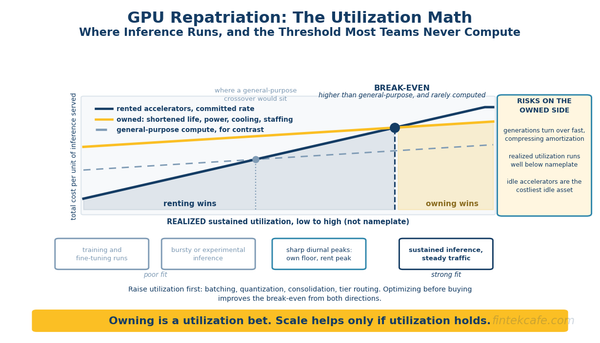
GPU Repatriation: The Utilization Math Deciding Where Inference Runs
Owned accelerators beat rented ones above a utilization threshold most teams never compute. The break-even math, and why idle GPUs are the expensive asset.
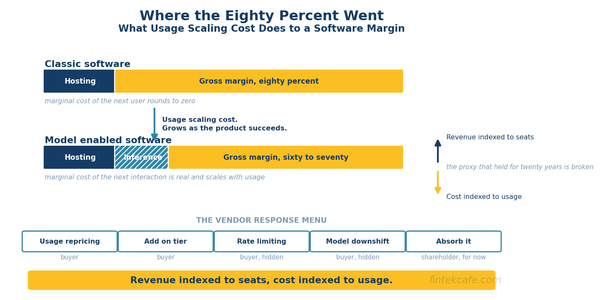
The SaaS Gross Margin Squeeze: AI COGS Are Breaking the Eighty Percent Model
Inference is a real, usage-scaling cost of goods sold. It is pulling software gross margins toward infrastructure territory, and buyers pay for it either way.
Trade Finance Explained: Letters of Credit, Factoring, and Supply Chain Finance
The $5 Trillion Infrastructure Nobody Talks About Every iPhone assembled in Zhengzhou, every container of Brazilian soybeans unloaded in Rotterdam, every batch of Vietnamese electronics shipped