
How to Present an AI Strategy to Your Board of Directors
You have 20 minutes. The board wants to know three things: What will AI do for the business? What will it cost? What happens if it goes wrong?
Most AI presentations fail because they answer the wrong questions. They explain transformers and large language models. They show proof-of-concept demos. They talk about what AI can do instead of what it will do for this company, this quarter, with this budget.
This guide gives you a concrete framework for building and delivering an AI strategy presentation that gets board approval. It includes a slide-by-slide outline, the questions boards actually ask, and the mistakes that kill proposals before they start.
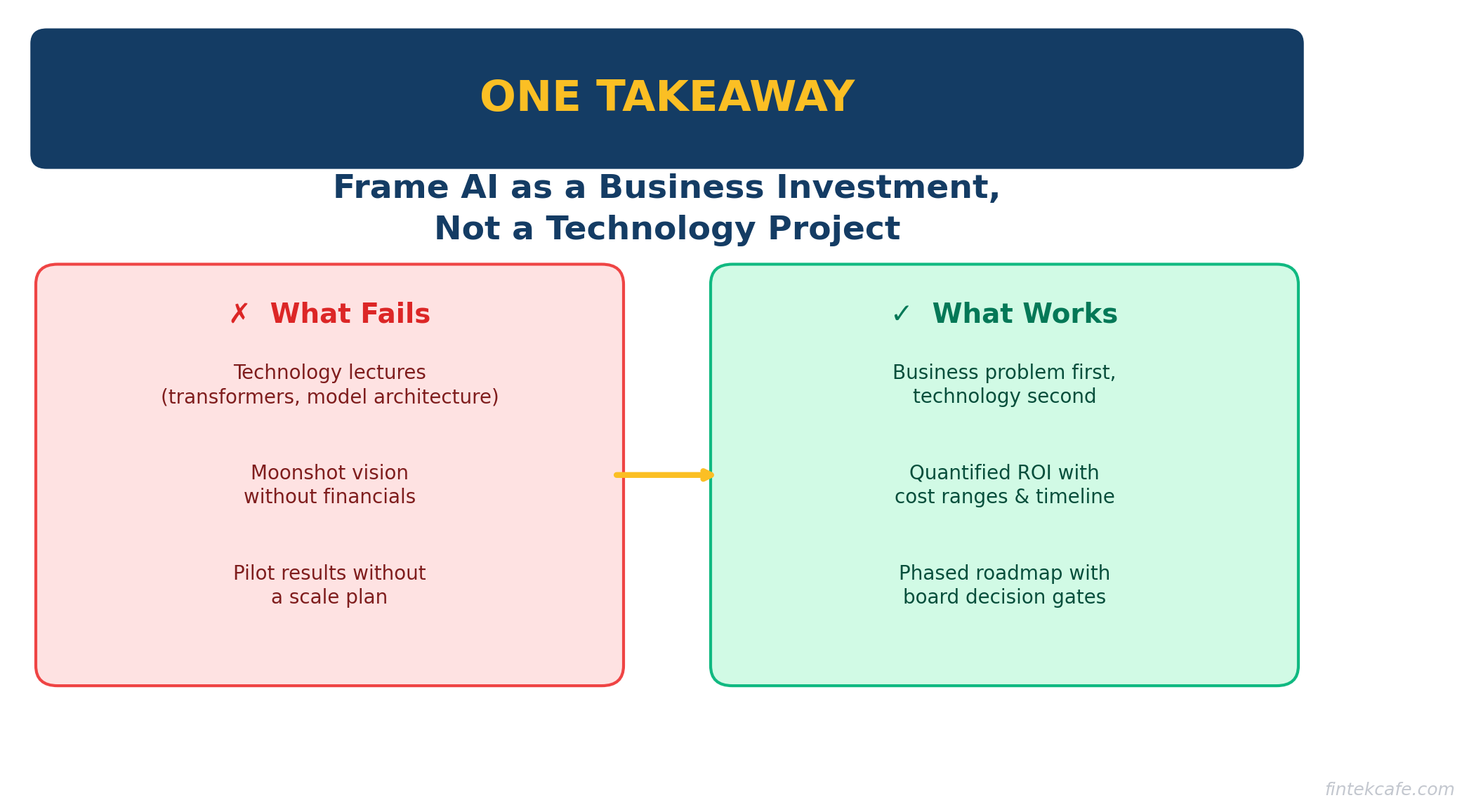
Why Most AI Board Presentations Fail
The most common failure mode is not a bad strategy. It is a bad presentation.
Board members are not engineers. Many are not even technologists. They are fiduciaries responsible for shareholder value, risk oversight, and long-term strategy. When you walk in talking about fine-tuning models and inference costs, you have already lost the room.
Here are the three patterns that kill AI presentations:
The Technology Lecture
The CTO spends 15 minutes explaining how AI works. Slides full of architecture diagrams and model comparisons. The board nods politely. When it is time for questions, someone asks, "So what does this mean for revenue?" and the CTO has two minutes left.
The Moonshot Without Numbers
The presentation is all vision. "AI will transform how we serve customers." "We will be an AI-first company." No costs. No timeline. No measurable outcomes. The board sees risk without reward and tables the discussion.
The Pilot That Never Scales
The team has run a successful proof of concept. They present the results and ask for funding to scale. But they cannot answer basic questions about total cost of ownership, organizational readiness, or what happens when the pilot encounters edge cases in production. The board approves a smaller follow-up study instead of full deployment.
Each of these failures shares a root cause: the presenter framed AI as a technology decision instead of a business decision.
What Boards Actually Want to Hear
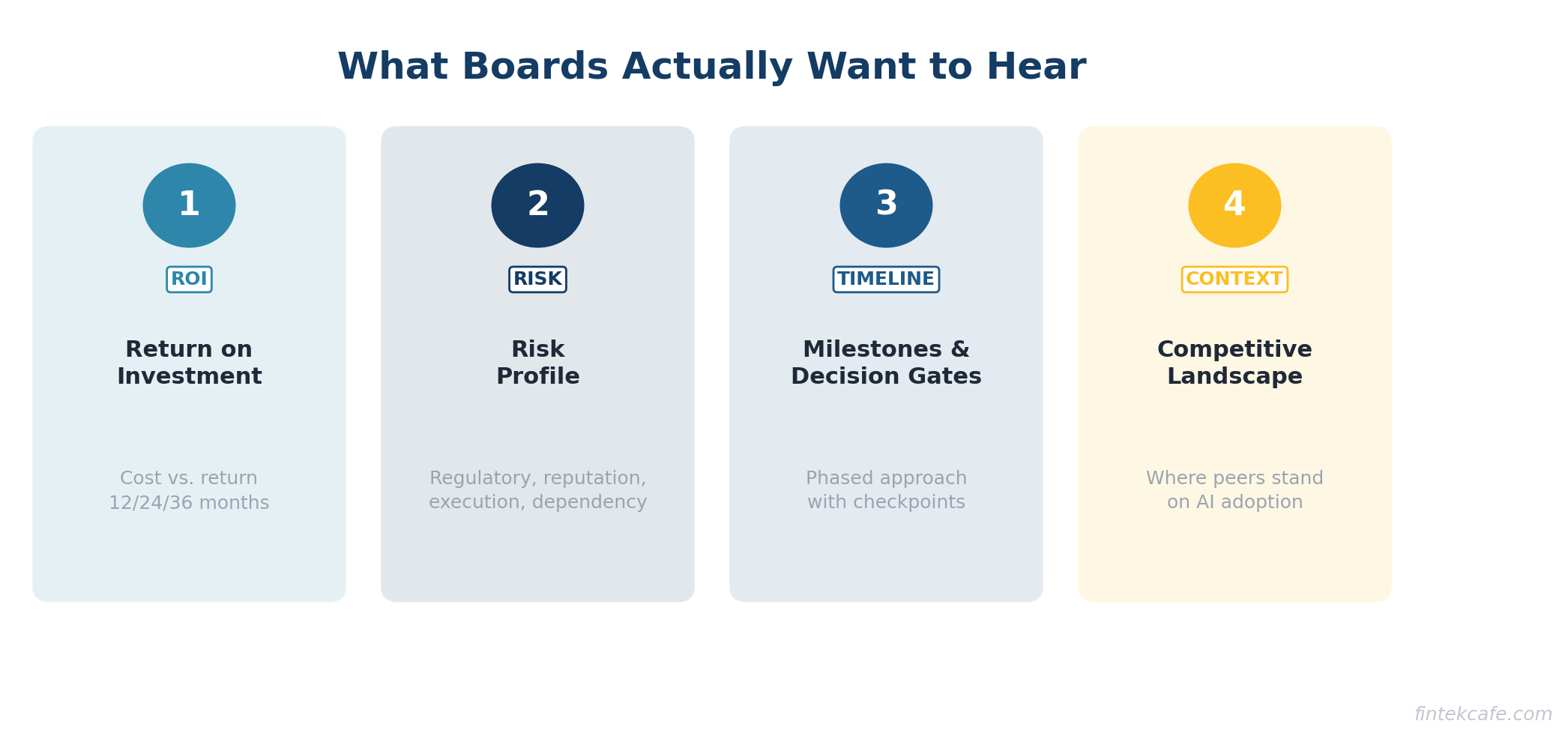
Before you build a single slide, understand what the board is evaluating. It is not the technology. It is the investment.
Return on Investment
Boards think in returns. They want to know what the company will spend, what it will get back, and when. Ideally you can express this as a ratio: "For every dollar invested, we expect X dollars in return within Y months."
If you cannot quantify the return, frame it as cost avoidance or risk reduction. "This investment reduces our fraud losses by an estimated $3M annually" is a clear statement a board can act on.
Risk Profile
Every investment carries risk. Boards do not expect zero risk. They expect you to have identified the risks and prepared mitigations. The risks they care about most with AI:
- Regulatory risk. Will this run afoul of emerging AI regulation? Are we in a regulated industry with specific AI requirements?
- Reputational risk. What happens if the AI makes a visible mistake? What is our liability exposure?
- Execution risk. Does the team have the skills to deliver? What is our track record with similar projects?
- Dependency risk. Are we locked into a single vendor? What happens if costs increase or the vendor changes terms?
Timeline and Milestones
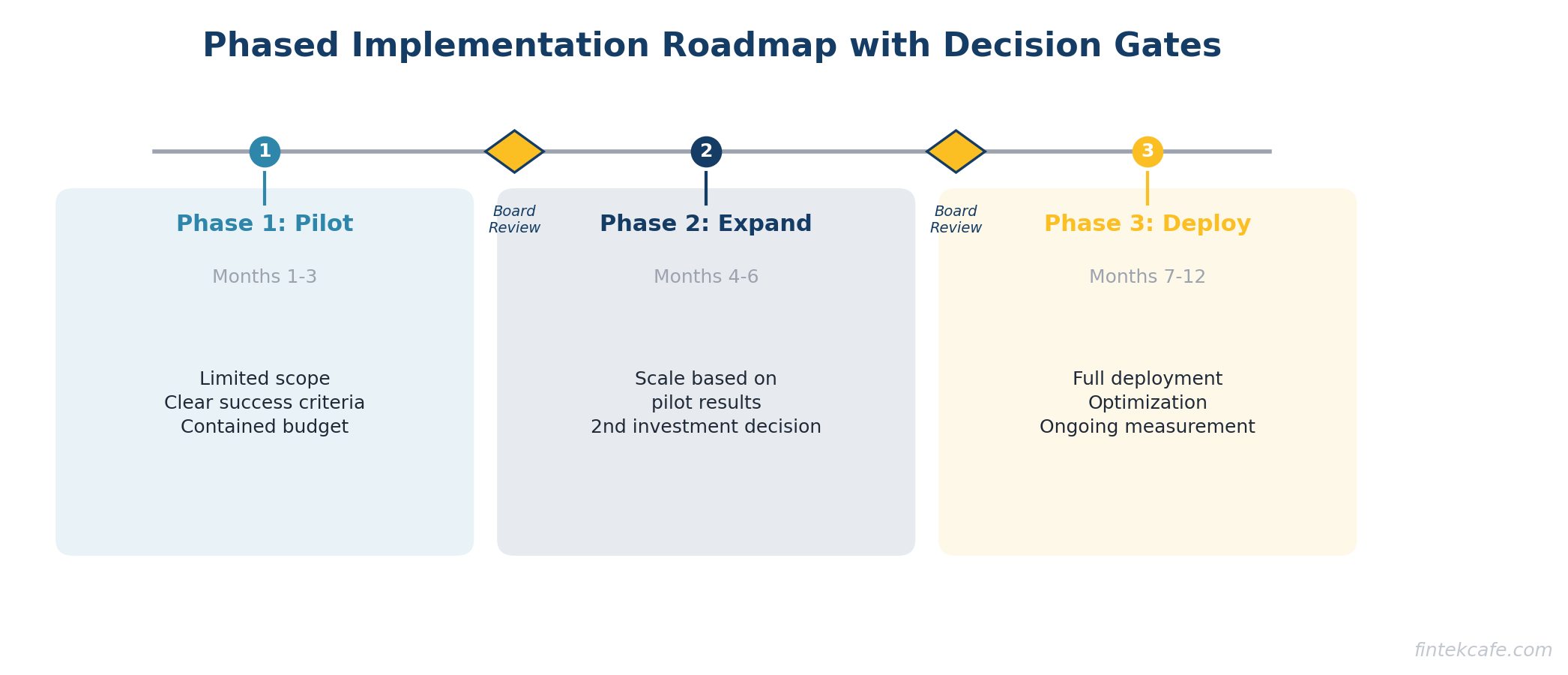
Boards want to see a phased approach with clear decision points. They do not want to approve a two-year project with no checkpoints. Show them where you will evaluate progress and where they will have the opportunity to continue, adjust, or stop.
Competitive Context
Where do your competitors stand on AI? Are you catching up, keeping pace, or pulling ahead? Boards pay close attention to competitive dynamics. If your top three competitors have already deployed AI in the area you are proposing, that is a powerful motivator.
The Slide-by-Slide Framework
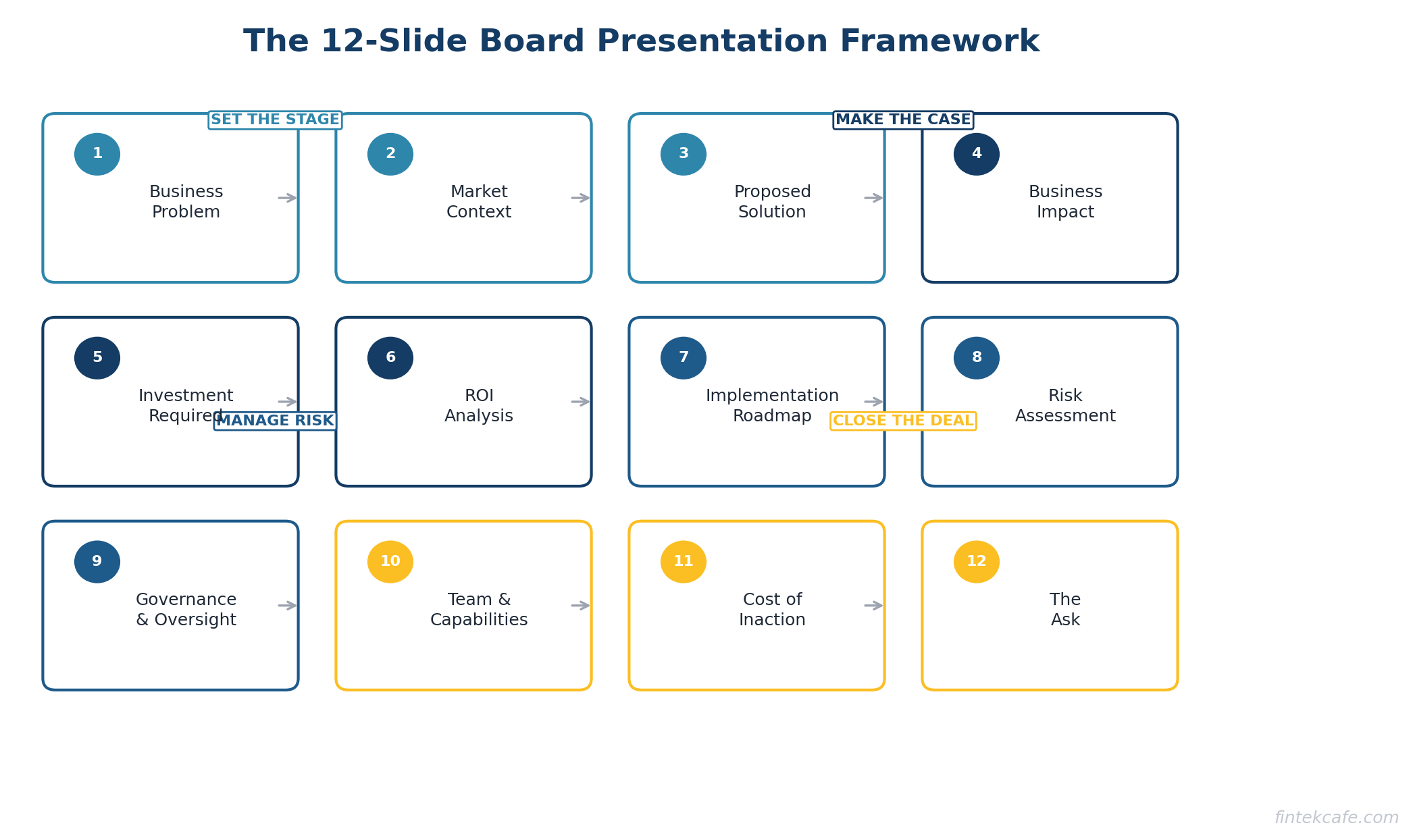
Here is a 12-slide framework that works across industries. Adjust the emphasis based on your board's priorities, but keep the structure.
Slide 1: The Business Problem (Not the Technology)
Open with the problem, not the solution. "Our customer support costs have grown 28% year-over-year while satisfaction scores have declined. Our competitors are resolving 40% of tickets without human intervention. We are resolving 0%."
Do not mention AI on this slide. Establish the problem as a business priority first.
Slide 2: The Market Context
Show what is happening in your industry. Which competitors are deploying AI? What are analysts saying? Include two or three data points from trusted sources (Gartner, McKinsey, industry-specific research). This is not about hype. It is about showing that inaction carries risk.
Slide 3: The Proposed Solution (One Paragraph)
Now introduce your AI strategy in plain language. One paragraph. No jargon. "We propose deploying an AI-powered customer support system that handles routine inquiries, routes complex issues to specialists, and learns from every interaction. Phase one focuses on our top five ticket categories, which represent 60% of volume."
Slide 4: Expected Business Impact
Quantify everything you can. Revenue impact, cost reduction, efficiency gains, customer satisfaction improvement. Use ranges, not point estimates. "We expect to reduce support costs by $1.2M to $1.8M annually while improving first-response time from 4 hours to under 10 minutes."
Slide 5: Investment Required
Total cost of ownership over three years. Break it down: technology costs, personnel (new hires or reallocation), training, infrastructure, ongoing maintenance. Boards hate surprises. Include a 15-20% contingency buffer and say so explicitly.
Slide 6: ROI Analysis
Show the math. Investment vs. return over 12, 24, and 36 months. Include a breakeven point. If possible, compare this ROI to other recent investments the board has approved. "This project has a projected 18-month payback period, comparable to our CRM migration approved last year."
Slide 7: Implementation Roadmap
A phased timeline. Three to four phases, each with clear deliverables and decision gates. The board should see exactly where they will review progress and have the option to adjust course.
- Phase 1 (Months 1-3): Pilot with limited scope. Measurable success criteria defined upfront.
- Phase 2 (Months 4-6): Expand based on pilot results. Second investment decision point.
- Phase 3 (Months 7-12): Full deployment and optimization.
Slide 8: Risk Assessment and Mitigation
A simple table. Risk on the left, likelihood and impact in the middle, mitigation on the right. Cover regulatory, reputational, execution, and technical risks. The board does not expect you to eliminate risk. They expect you to have thought about it seriously.
Slide 9: Governance and Oversight
How will you govern AI within the organization? Who is responsible? What review processes are in place? This is increasingly important as AI regulation evolves. If you have or plan to establish an AI ethics review process, mention it here.
Slide 10: Team and Capabilities
Who will execute this? Do you have the talent in house, or do you need to hire or contract? Be honest about gaps. "We have strong data engineering capability. We need to hire two ML engineers and one AI product manager. We have budgeted for this in the investment slide."
Slide 11: What Happens If We Do Nothing
This slide often drives the decision. Quantify the cost of inaction. Rising costs, competitive disadvantage, missed opportunities. Make the status quo feel like a choice, not a default.
Slide 12: The Ask
Be specific. "We are requesting $2.4M over 18 months to execute phases one through three, with a board review checkpoint at the end of phase one before committing to phase two funding." Tell the board exactly what you need them to approve.
The Questions You Will Get (And How to Answer Them)
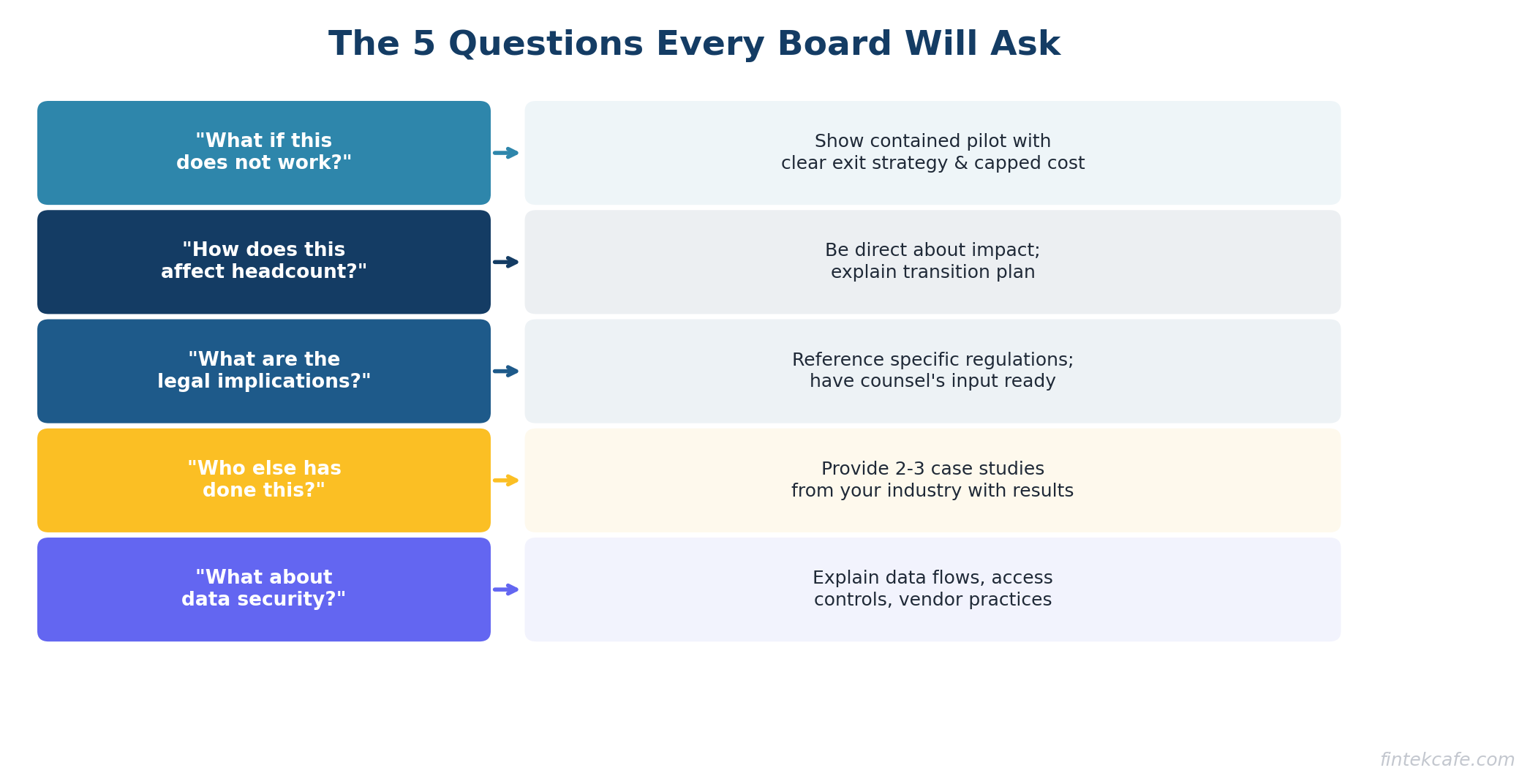
Prepare for these. Every one of them comes up.
"What if this does not work?"
Have a clear exit strategy. "Phase one is designed as a contained pilot. If we do not hit our success metrics by month three, we stop. Our total exposure at that point is $400K, not $2.4M."
"How does this affect headcount?"
Be direct. If AI will reduce headcount, say so and explain how you will manage the transition. If it will redeploy people to higher-value work, explain specifically what that means. Do not be vague. Boards see through "no jobs will be lost" when the math says otherwise.
"What are the ethical and legal implications?"
Reference specific regulations that apply to your industry. Mention your governance framework. If you are in financial services, healthcare, or any regulated industry, this question will get significant attention. Have your general counsel's input before the meeting.
"Who else has done this?"
Have two or three case studies ready. Ideally from your industry, ideally with quantified results. "Company X deployed a similar system and reduced support costs by 35% within six months." Cite the source.
"What about data security?"
Explain where data goes, who has access, and how you protect it. If you are using a third-party AI provider, explain their data handling practices. If you are keeping data on-premise, explain why and the cost implications.
Common Mistakes to Avoid
Starting With Technology Instead of Business Outcomes
The board does not care about your model architecture. They care about what it does for the business. Lead with outcomes, support with technology only when asked.
Presenting a Single Scenario
Show best case, base case, and worst case. A single projection looks naive. Three scenarios show rigor and honesty.
Underestimating Costs
Include everything: licensing, compute, personnel, training, change management, ongoing maintenance. The fastest way to lose board trust is to come back six months later asking for more money because you forgot to budget for data preparation.
Ignoring Change Management
AI projects fail more often from organizational resistance than from technical problems. Address how you will manage the human side of the transition. Training plans, communication strategies, and executive sponsorship all belong in your presentation.
Not Having a Clear Ask
End with a specific request. Dollar amount, timeline, and approval structure. "We would like the board's support" is not an ask. "$2.4M over 18 months with a phase-gate review at month three" is an ask.
Real Examples That Worked
The Insurance Company CFO
A mid-market insurance company CFO presented an AI strategy focused entirely on claims processing. She opened with the cost per claim ($47) and the industry benchmark ($31). She showed that AI-assisted claims triage could close the gap within 12 months. She requested $1.8M with a six-month checkpoint. The board approved unanimously because the business case was undeniable and the risk was contained.
The key: she never mentioned machine learning, neural networks, or any technical terms. She talked about claims, costs, and competitive position.
The Retail CTO
A national retailer's CTO proposed an AI-driven inventory optimization system. He brought the CFO as co-presenter. Together they walked through the $12M in annual write-downs from overstock and the $8M in lost sales from stockouts. The AI system's projected impact was a 25-30% reduction in both. Total investment: $3.2M over two years.
The key: the CTO brought the CFO as an ally. When the board asked financial questions, the CFO answered. This showed organizational alignment, not just a technology initiative.
The Bank's Chief Risk Officer
A regional bank's CRO presented an AI fraud detection system. She framed it entirely around risk: the bank's fraud losses had increased 40% in two years. She showed the regulatory pressure building around real-time fraud detection. She presented the AI system as a compliance and risk management investment, not a technology project.
The key: she matched the framing to the board's primary concern. For a bank board, risk and compliance always get attention.
After the Presentation: Maintaining Momentum
Getting board approval is the beginning, not the end.
Send a Follow-Up Within 48 Hours
Summarize the decision, the approved budget, the timeline, and the next checkpoint date. Get it in writing. Board members sit on multiple boards and will forget details quickly.
Report Progress at Every Board Meeting
Even a one-slide update at each subsequent meeting keeps the project visible and builds confidence. Show metrics against the targets you promised. If you are behind, explain why and what you are doing about it.
Hit Your First Milestone Early
Nothing builds board confidence like delivering on your first commitment. Set an achievable phase one target and hit it. This earns you credibility and smoother approvals for subsequent phases.
Key Takeaways
- Frame AI as a business investment, not a technology project. Lead with the problem and the financial impact, not the technology.
- Quantify everything: costs, returns, risks, and the cost of doing nothing. Use ranges, not single-point estimates.
- Show a phased roadmap with clear decision gates so the board can adjust course without being locked in.
- Prepare for the five questions every board asks: What if it fails? What about headcount? What are the legal risks? Who has done this before? How is data protected?
- Bring allies. Co-presenting with the CFO or another executive signals organizational alignment.
- Avoid the three fatal mistakes: technology lectures, moonshot pitches without numbers, and pilots without scale plans.
Frequently Asked Questions
How long should the presentation be?
Keep it to 15-20 minutes of presentation with 20-30 minutes for questions. Boards have packed agendas. If you cannot make your case in 20 minutes, you do not understand it well enough.
Should I include a live demo?
Generally, no. Demos can fail, they eat time, and they shift the conversation to technology. If the board asks for one, offer to schedule a separate session. In the boardroom, use screenshots or a short recorded video if you must show the product.
When should I bring this to the board — before or after a pilot?
Ideally, bring a two-part proposal. Request pilot funding first (smaller ask, lower risk), then return with results and a request for full deployment funding. This gives the board a track record to evaluate.
How do I handle a board member who is skeptical about AI?
Listen to their specific concern. It is usually about risk, cost, or hype. Address it with data, not enthusiasm. "I understand the concern about unproven technology. That is why we have designed a $400K pilot with clear success criteria before committing to the full $2.4M" is more persuasive than "AI is transforming every industry."
What if my company has no AI experience?
Be transparent. Show how you will build capability: hiring plans, partnerships with experienced vendors, advisory relationships. Boards respect honesty about gaps far more than false confidence.
How often should I update the board on AI initiatives?
Include a progress update at every regular board meeting — quarterly at minimum. Keep it to one or two slides: metrics vs. targets, budget vs. spend, key decisions ahead. Over-communication builds trust.
Internal Links
Related Articles
How to Build an AI Strategy: A Step-by-Step Framework
A practical step-by-step framework for building an enterprise AI strategy, from maturity assessment to pilot selection, governance, and scaling.
The Real Reason Your AI Pilot Succeeded But Production Failed
87% of AI projects never reach production. The pilot-to-production gap isn't a technology problem. It's an organizational design failure.
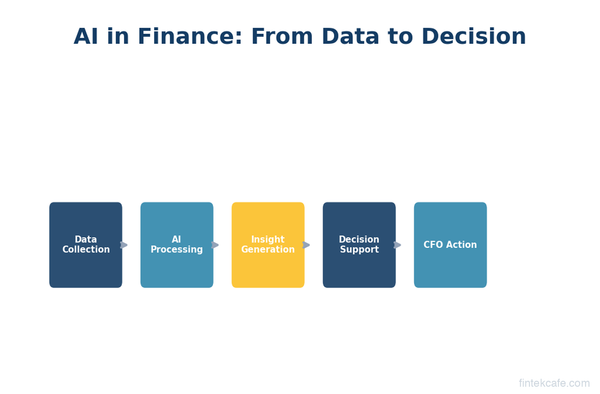
The CFO's Guide to AI: What Finance Leaders Actually Need to Know
A practical AI guide for CFOs. ROI frameworks, budget allocation, vendor evaluation, and why finance leaders who ignore AI will be replaced by those who don't.