
The Real Reason Your AI Pilot Succeeded But Production Failed
Your AI pilot worked. The demo was impressive. The accuracy numbers looked great. The executive sponsor nodded approvingly. The board deck included a slide about "AI transformation."
Then you tried to deploy it in production. And it fell apart.
You're not alone. Gartner estimates that 87% of AI projects never make it to production. Not because the technology failed. The technology worked fine in the lab. The project failed because the organization wasn't designed to bridge the gap between a controlled experiment and an operational system.
I'm going to make a claim that will annoy data scientists: the pilot-to-production gap is not primarily a technology problem. It's an organizational design problem. The companies that cross this gap successfully don't have better models or better data scientists. They have better organizational structures, clearer ownership, and more honest conversations about what production actually requires.
Pilots Are Designed to Succeed
This is the uncomfortable truth that nobody in the AI industry wants to say out loud: AI pilots are structurally designed to succeed.
Not because anyone is being dishonest. The problem is subtler than that. A pilot operates in conditions so favorable that success is almost guaranteed, and those conditions bear almost no resemblance to production.
The data is curated. The pilot team selects a dataset that represents the problem well. They clean it, label it, handle edge cases manually, and ensure the training data is high-quality. Production data hasn't been curated by anyone. It's messy, incomplete, inconsistent, and full of edge cases that nobody anticipated because they were excluded from the pilot dataset.
The team is dedicated. A pilot has a focused team of 3-5 people whose only job is making it work. They're motivated, experienced, and fully allocated. In production, the model is maintained by whoever has time, which is usually nobody. The original team has moved on to the next pilot. The model sits in production with no dedicated owner.
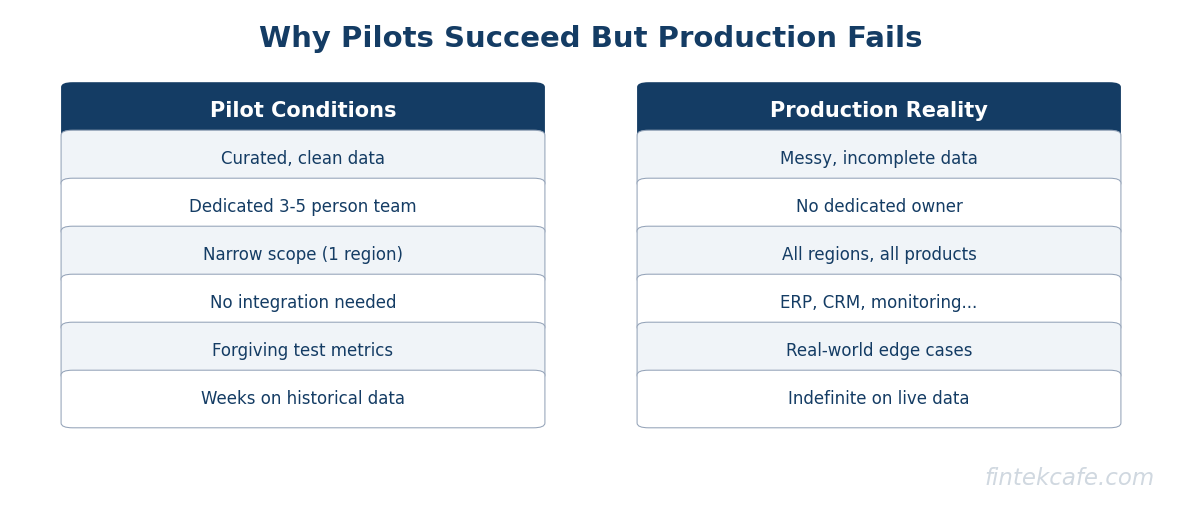
The scope is narrow. A pilot solves one version of the problem, in one region, for one product line, with one data source. Production means handling all versions, all regions, all products, and all data sources simultaneously. A fraud detection pilot that works beautifully on US credit card transactions may fail completely on international debit transactions because the fraud patterns are entirely different.
There's no integration burden. The pilot runs as a standalone notebook or a separate application. Nobody has to connect it to the ERP, the CRM, the data warehouse, the monitoring system, or the customer-facing application. In production, integration consumes more engineering time than the model itself. Every system boundary is a potential failure point.
The success criteria are forgiving. Pilot accuracy is measured on the curated test set. Production accuracy is measured on real-world outcomes, which include data distributions the model has never seen, adversarial inputs (fraudsters adapting to the model), and edge cases that the test set didn't contain.
A pilot operating under these conditions would have to be actively terrible to fail. The question was never whether the pilot would succeed. The question is whether anything about the pilot's success predicts production viability. Usually, the answer is no.
This is a Premium Article
Sign up for a Premium membership to read this article and get full access to strategic intelligence on technology and business.
Already a member? Sign in
Related Articles
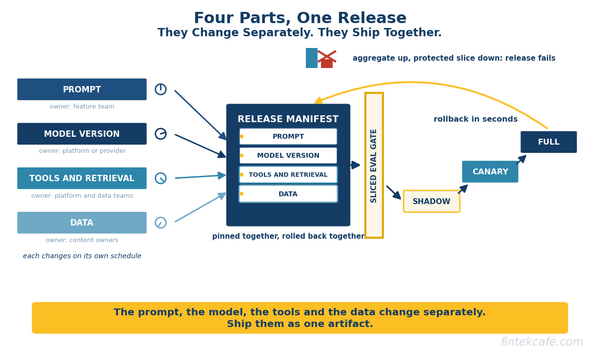
LLM Release Management: How to Ship Prompt and Model Changes Without Breaking Production
An LLM feature has four parts that change on their own. Release them as one versioned artifact behind an eval gate. The rules, tables and build order.
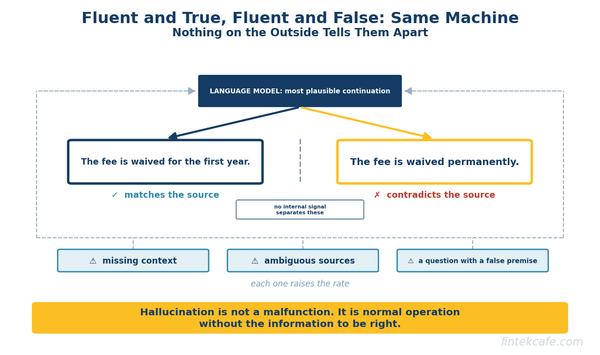
AI Hallucinations: Why Models Make Things Up, and Which Controls Actually Reduce It
Why LLMs hallucinate, the three kinds of AI hallucination, and which controls actually reduce it, ranked by cost and matched to the cost of an error.
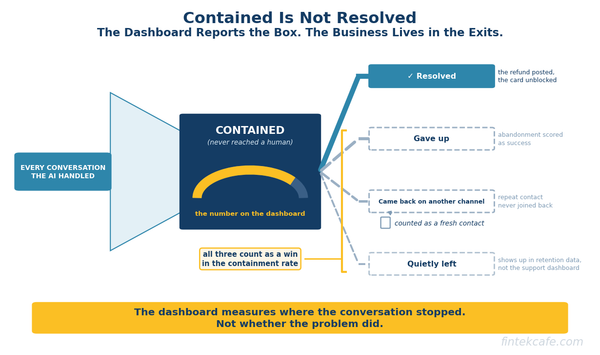
AI Support Deflection Rates Are Measuring the Wrong Thing
Deflection counts every chat that never reached a human, including the customer who gave up. What to measure instead, and what to ask vendors.