
The GPU Glut Is Coming: Why AI Compute Economics Are About to Invert
For two years the operating assumption across enterprise technology has been that compute is scarce and getting scarcer. Accelerators were allocated, not purchased. Cloud providers gated access behind committed-spend agreements. Boards approved multi-year capacity reservations on the theory that locking in supply at any price beat being shut out of the AI race entirely. The scarcity was real, and the premium it commanded shaped vendor pricing, infrastructure strategy, and capital allocation across the industry.
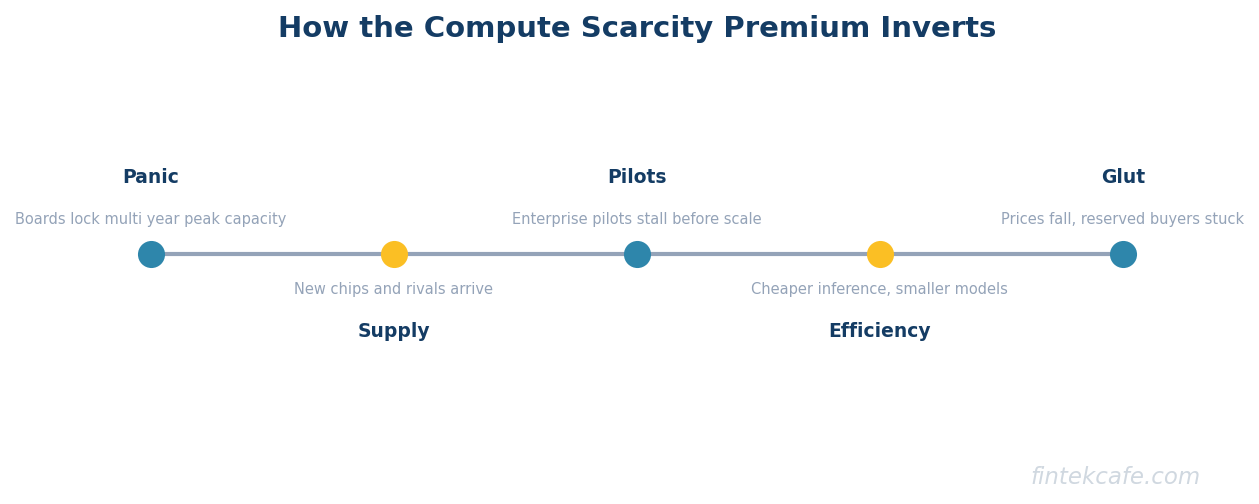
That assumption is about to invert. Three forces are converging. A wave of new accelerator supply, from the incumbent leader's expanded production through credible competitors and the hyperscalers' own custom silicon, is arriving roughly on schedule. The multi-year capacity reservations made at the peak of the panic are coming online as usable inventory. And enterprise AI revenue, the demand that was supposed to absorb all of that capacity, is arriving slower and smaller than the build-out assumed. When supply accelerates while demand decelerates, the scarcity premium does not erode gently. It compresses, and the firms that locked in long capacity at peak prices are the ones most exposed when it does.
The contrarian thesis is straightforward: the compute-scarcity premium that has governed AI infrastructure decisions is a peak that has already passed, and the strategic mistake of the next budget cycle will not be failing to secure enough capacity. It will be having secured too much, at the wrong price, on terms too rigid to unwind. What follows is the supply picture, the demand reality, what a glut does to cloud GPU pricing and reserved contracts, and what CTOs and CFOs should renegotiate before the next cycle locks in.
The Supply Build-Out Was Designed for a Demand Curve That Did Not Show Up
Supply decisions in semiconductors are made years ahead of the revenue they serve, against forecasts, and the forecasts that drove the current build-out were drawn at the moment of maximum fear. Foundry capacity was reserved, advanced packaging lines were expanded, and the entire supply chain was scaled to a demand curve that assumed enterprise AI adoption would compound steeply and continuously. Capacity ordered against that curve does not arrive when demand is verified. It arrives on the schedule the fabrication process dictates, which is now.
Three supply streams are landing at once. The dominant accelerator vendor has expanded output substantially and moved to a faster product cadence, which has the secondary effect of pushing prior-generation hardware into the secondary market at a discount as buyers chase the newest parts. Credible competing accelerators have reached the point of being deployable for real workloads rather than benchmarks, which gives buyers an alternative and erodes the single-vendor pricing power that defined the scarce period. And the hyperscalers have invested heavily in their own custom silicon, which both adds capacity and changes their incentive: a provider running its own chips for its own largest workloads has every reason to fill the merchant accelerators it also rents out, because idle inventory earns nothing.
The result is that the supply side is converging on abundance precisely as the demand side is being revised down. This is the classic setup for a capacity glut: long-lead-time supply committed against a peak forecast, delivered into a market whose actual consumption has softened. The hardware does not know the revenue did not materialize. It arrives anyway, and it has to be sold or rented or it sits depreciating.
This is a Premium Article
Sign up for a Premium membership to read this article and get full access to strategic intelligence on technology and business.
Already a member? Sign in
Related Articles
Integration Platforms Are the Quiet Winners of the Agent Era
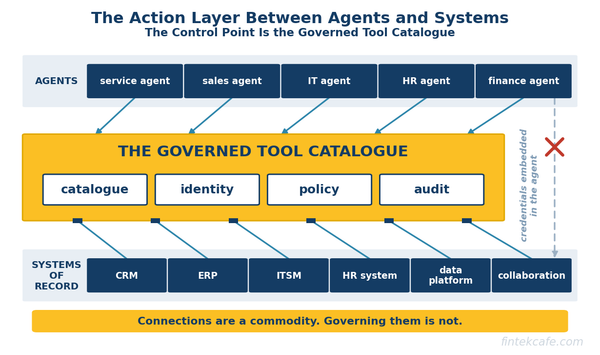
Agents act through integrations. iPaaS and API vendors hold the connectors, credentials and audit trails, and MCP makes governing that layer worth more.
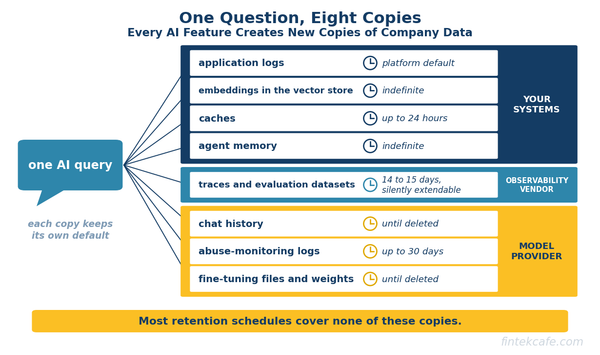
What Happens to Your Data Inside AI Systems: Retention, Deletion and the Copies Nobody Tracks
Every AI feature copies company data into prompts, logs, embeddings and memory. Where each copy lives, what vendors retain, and how to make deletion real.
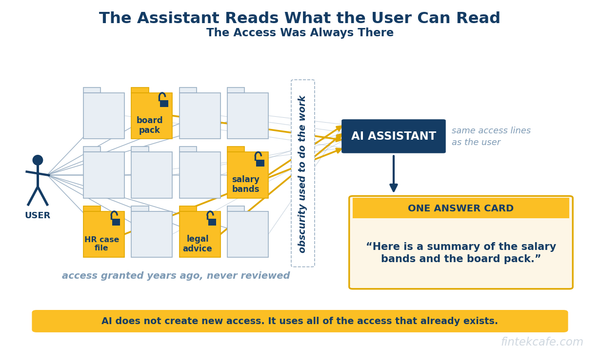
Data Classification: The Step Every Enterprise AI Rollout Skips, and What It Costs Later
Why AI assistants expose overshared data, how data classification fixes it, what to label first, and a 90-day plan for executives.