
Data Privacy in Financial Services: GDPR, CCPA, and What Comes Next
In May 2023, Meta was fined $1.3 billion by the Irish Data Protection Commission for transferring European user data to the United States in violation of GDPR. It was the largest data privacy fine in history.
Financial institutions looked at that number and flinched. Not because they were surprised by the fine - Meta had been warned repeatedly - but because the underlying legal question applies to every financial services company that operates across borders: when European and American data protection rules conflict, compliance with one often means violation of the other.
This is not an edge case. It is the defining challenge of data privacy in financial services.
Financial data is the most sensitive category of personal data. Transaction histories reveal where you eat, what you earn, who you support politically, whether you gamble, what medications you take, and whether your marriage is intact. A bank account is more revealing than a diary. And unlike a diary, your financial data is held by institutions that are legally required to keep it, share it with regulators, and in many cases, analyze it for fraud and money laundering.
The result is a set of irreconcilable tensions: privacy laws that demand data minimization and deletion collide with financial regulations that require data retention and surveillance. Consent frameworks designed for social media do not translate to financial services where processing is often legally mandated. Cross-border data transfer rules assume that data can stay in one jurisdiction, while modern financial infrastructure operates globally by design.
For anyone building, operating, or investing in financial services, understanding these tensions is not optional. Data privacy compliance is now a structural cost of doing business - and getting it wrong carries penalties that can threaten a company's existence.
The Three Regulatory Pillars
Three data privacy frameworks dominate the global financial services landscape. Each emerged from a different legal tradition, applies different standards, and creates different obligations. Understanding the differences matters because most financial services companies must comply with all of them simultaneously.
GDPR (European Union, 2018)
The General Data Protection Regulation is the most comprehensive data privacy law ever enacted. It applies to any organization that processes personal data of EU residents, regardless of where the organization is based. A fintech headquartered in San Francisco that serves a single customer in Berlin must comply with GDPR.
For financial services, GDPR's key provisions are:
Lawful basis for processing. Financial institutions cannot process personal data without a legitimate legal basis. Six legal bases exist under GDPR Article 6, but financial services companies typically rely on three: contractual necessity (processing required to fulfill the account agreement), legal obligation (processing required by financial regulation, such as AML/KYC), and legitimate interest (processing that serves a justified business purpose, balanced against the individual's privacy rights).
Consent - the basis most people associate with GDPR - is rarely the primary basis for financial data processing. This is important because consent can be withdrawn at any time, and a bank cannot stop processing your transaction data simply because you withdraw consent. The processing is necessary for the contract and required by law.
Data minimization. GDPR Article 5 requires that personal data be "adequate, relevant, and limited to what is necessary" for the stated purpose. For a bank, this creates immediate tension: fraud detection systems work better with more data, not less. A machine learning model trained on ten years of transaction history is more accurate than one trained on two years. But GDPR says you should only keep what is necessary - and "necessary for optimal fraud detection" is not the same as "necessary" in the regulatory sense.
Right to erasure (Right to be forgotten). Under GDPR Article 17, individuals can request deletion of their personal data. But Article 17(3)(b) provides an exception for processing necessary for compliance with legal obligations. Financial services companies in the EU are required under the Anti-Money Laundering Directive (AMLD) to retain transaction records and customer identification data for at least five years after the business relationship ends - ten years in some member states.
So when a customer exercises their right to erasure, the financial institution must determine, record by record, which data can be deleted (marketing preferences, web browsing history, non-essential profiling data) and which must be retained (transaction records, KYC documents, suspicious activity reports). This is operationally complex and legally treacherous.
Maximum fines. Up to 4% of global annual turnover or 20 million euros, whichever is greater. For a bank like JPMorgan ($162 billion in revenue in 2024), the theoretical maximum fine is $6.5 billion.
This is a Premium Article
Sign up for a Premium membership to read this article and get full access to strategic intelligence on technology and business.
Already a member? Sign in
Related Articles
What Is ISO 20022? The Payments Standard Quietly Reshaping Global Banking
ISO 20022 is the payments rails replacement that few outside operations discuss. The standard, the cutover, and what enterprises must do now.

The Stablecoin Endgame: Why Banks Are Quietly Building What They Said Was a Threat
Banks called stablecoins reckless for five years. JPM Coin, Citi Token Services, Project Agora: incumbents quietly built the rails themselves.
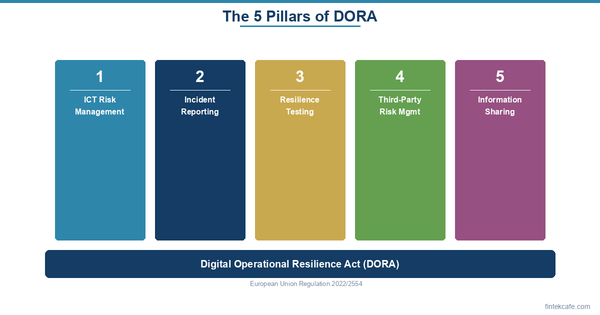
Fintech Regulation Is About to Get Serious: What the EU's DORA Means for Everyone
The EU's DORA regulation is the most significant fintech regulatory shift since PSD2. Most companies aren't ready. Here's what it means and what to do about it.