
The Real Cost of AI Infrastructure: What Nobody Tells You Before You Build
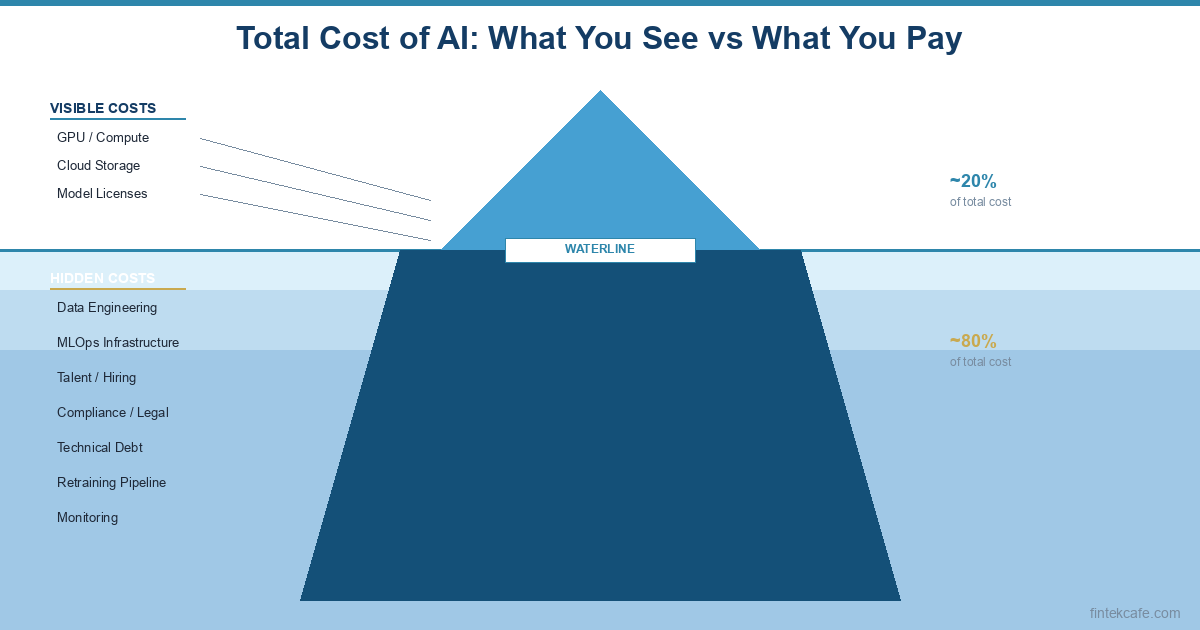
In early 2024, a mid-market insurance company decided to build its own AI infrastructure. The leadership team estimated 2.4 million for the first year: GPU servers, a small ML team, and cloud compute for training. Eighteen months and 8.1 million later, the company had one model in production, running inference at three times the cost of an equivalent API call to a commercial provider. The CTO who championed the project is gone. The infrastructure is being quietly decommissioned.
This story is not unusual. It is, increasingly, the norm.
A RAND Corporation study found that the vast majority of enterprise AI projects fail to deliver business value, and a significant contributor is infrastructure cost overruns that destroy the economic case for the project before the model ever reaches production. Gartner's research on AI infrastructure spending tells a similar story: organizations consistently underestimate the total cost of ownership by 2-4x.
The problem is not that building AI infrastructure is impossible. It's that the true cost is systematically misunderstood, and the people making the investment decisions are working from budgets that bear no resemblance to reality.
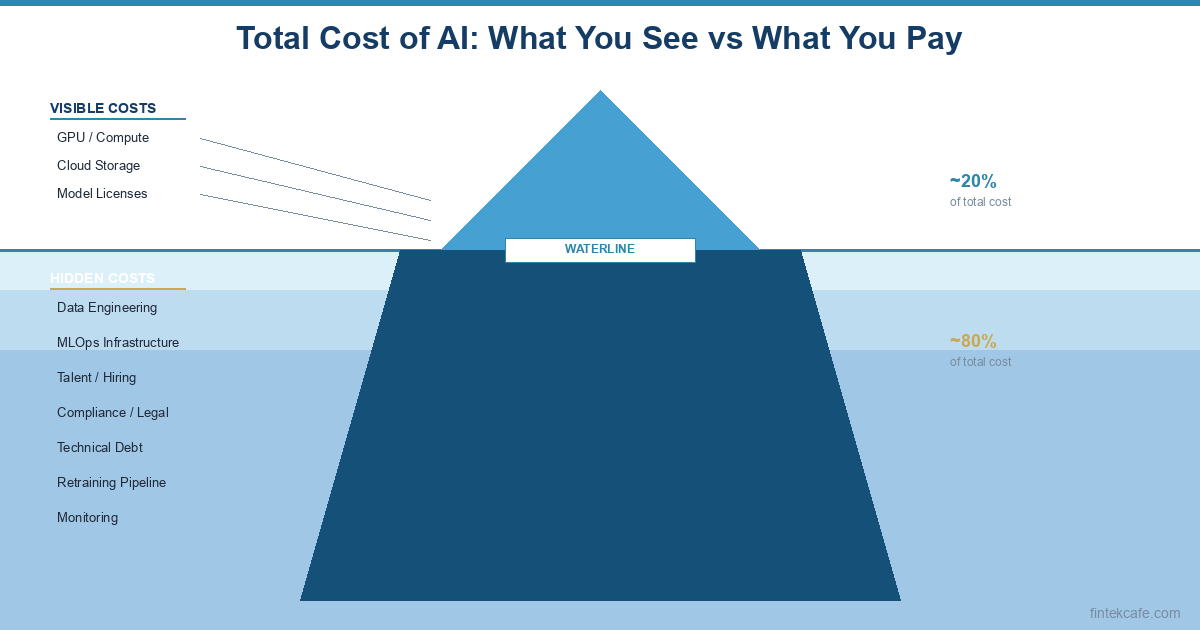
Here is what the actual cost picture looks like, with the line items that never make it into the initial proposal.
The GPU Myth: Why Everyone Thinks They Need H100s
The first budget conversation about AI infrastructure almost always starts with GPUs. And the first mistake is almost always the same: someone declares that the company needs NVIDIA H100s (or the latest equivalent) because that is what the frontier labs use.
NVIDIA's H100 GPUs cost roughly 30,000-40,000 per unit at list price, with real-world procurement often exceeding that due to demand. A meaningful training cluster requires multiple nodes. A single DGX H100 system (eight GPUs) costs around 300,000. Companies routinely propose clusters of four to eight of these systems as a starting point.
But here is the question that nobody asks: what are you actually doing with these GPUs?
Most enterprise AI workloads are not training frontier models from scratch. They are fine-tuning existing models, running inference on pre-trained models, or training relatively modest models on structured business data. These workloads do not require H100s. Many of them run perfectly well on NVIDIA A10G or L4 GPUs that cost a fraction of the price, or even on optimized CPU inference for smaller models.
The mismatch between what companies buy and what they need is staggering. A 2024 analysis by Semianalysis found that the majority of enterprise GPU purchases were oversized for their actual workloads. Companies bought training hardware for inference workloads. They bought cutting-edge GPUs for tasks that could run on hardware two generations older at one-fifth the cost.
The GPU purchasing decision should start with a detailed workload analysis, not a spec sheet comparison. But that analysis rarely happens because the people making the hardware decisions are engineers who want the best tools, not financial analysts who understand utilization economics.
Training vs. Inference: The Cost Everyone Gets Backwards
The AI industry's public narrative is dominated by training costs. OpenAI reportedly spent over 100 million training GPT-4. Meta invested billions in compute for Llama. These numbers are eye-catching and widely cited. They also create a dangerous misconception.
Training a model is a one-time cost (or periodic, if retraining on new data). Inference, the cost of actually running the model in production to serve predictions, is an ongoing cost that scales with usage. For most enterprises, inference costs will dwarf training costs within the first year of production deployment.
Consider a straightforward example. A financial services company fine-tunes a large language model for document processing. The fine-tuning costs 50,000 in compute. Reasonable. But the model processes 500,000 documents per month, running inference continuously across business hours. The inference compute bill is 35,000 per month, or 420,000 per year. Within 14 months, inference has cost 8x more than training.
This ratio is not unusual. Researchers at Stanford's HAI group have estimated that for many production AI systems, inference represents 80-90% of the total compute cost over a three-year period.
The implications for infrastructure planning are significant. The initial budget proposal focuses on training compute because that is the visible, dramatic number. The inference cost is either underestimated or omitted entirely, because the team does not yet know the production query volume. By the time inference costs become clear, the budget is already committed and the sticker shock arrives as a line item that nobody approved.
Every AI infrastructure budget should model inference costs at three scenarios: expected volume, 2x expected volume, and 5x expected volume. If the economics don't work at the expected volume, the project shouldn't proceed. If they break at 2x, the success scenario will bankrupt the project.
This is a Premium Article
Sign up for a Premium membership to read this article and get full access to strategic intelligence on technology and business.
Already a member? Sign in
Related Articles
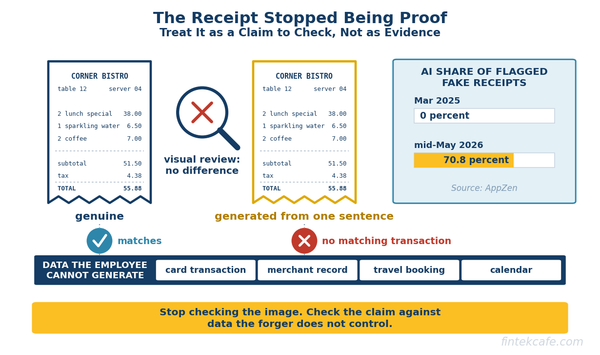
AI-Generated Fake Receipts: How Expense Fraud Changed and How Finance Teams Catch It
AI-generated fake receipts now beat visual review. How expense fraud changed, which detection still works, and the controls to use by company size.
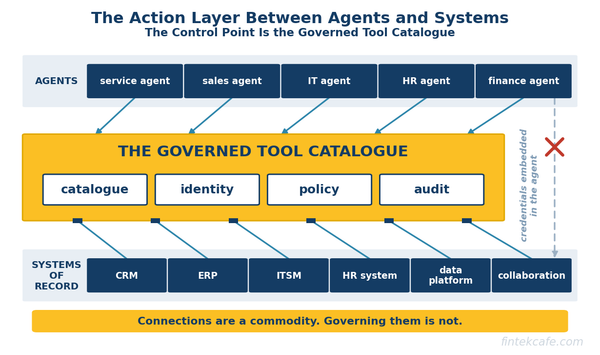
Integration Platforms Are the Quiet Winners of the Agent Era
Agents act through integrations. iPaaS and API vendors hold the connectors, credentials and audit trails, and MCP makes governing that layer worth more.
What Happens to Your Data Inside AI Systems: Retention, Deletion and the Copies Nobody Tracks
Every AI feature copies company data into prompts, logs, embeddings and memory. Where each copy lives, what vendors retain, and how to make deletion real.