
Open Banking Failed Its Promise - Here's What Actually Works
Open Banking was supposed to be the most significant disruption to financial services since the invention of the ATM. Regulators in Europe (PSD2), the UK (Open Banking Implementation Entity), Australia (Consumer Data Right), and Brazil (Open Finance) mandated that banks open their data to third-party providers through standardized APIs. The promise: a wave of innovation as fintech companies built new products on top of bank data, giving consumers unprecedented control over their financial lives.
That was the pitch. The reality, seven years after PSD2 took effect, is far more modest.
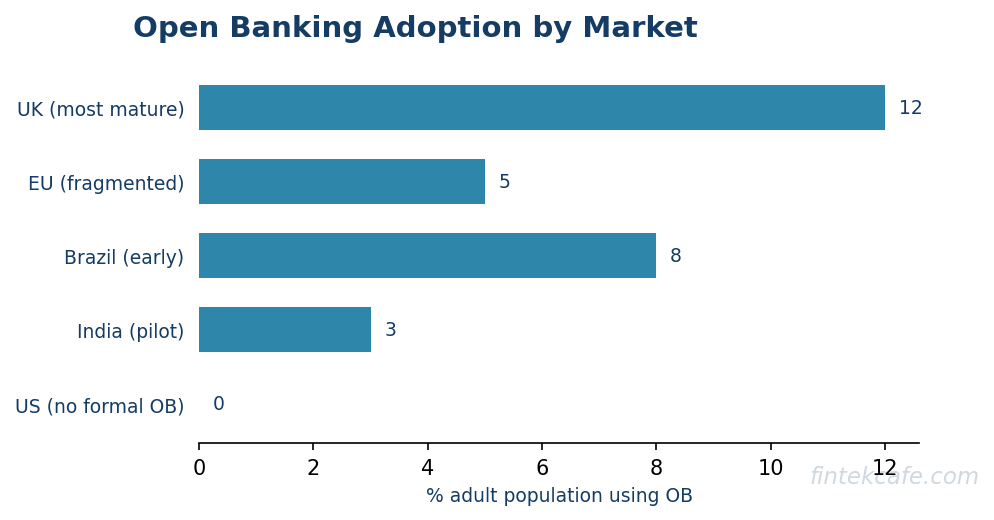
In the UK, the most mature open banking market, roughly 7 million consumers use open banking-connected services. That sounds impressive until you realize the UK has 57 million adults with bank accounts. Adoption is around 12%. In the EU, it's worse. Open banking usage is fragmented across 27 member states, each with different API implementations, different bank interpretations of PSD2, and different levels of reliability. In the US, open banking doesn't formally exist yet. Screen scraping through Plaid and similar providers remains the primary method of accessing bank data, which is the financial data equivalent of duct tape.
Consumer awareness is dismal. A survey by Mastercard found that 76% of European consumers hadn't heard of open banking. Among those who had, most couldn't explain what it does. The "consumer empowerment" narrative that regulators championed has not materialized in any measurable way.
Open Banking, as regulators envisioned it, has failed its promise.
But here's where the story gets interesting: the real value of open banking is emerging in places that regulators never intended, and the winners look nothing like what anyone predicted.
What Went Wrong
Open Banking's disappointing adoption isn't a single failure. It's a cascade of structural problems that compounded each other.
Banks had every incentive to comply minimally. PSD2 required banks to provide APIs. It didn't require banks to make those APIs good. The regulation said "provide access." It didn't say "provide fast, reliable, well-documented, developer-friendly access." Banks built APIs that technically met the regulatory requirement while being as difficult to use as possible. Slow response times. Frequent downtime. Inconsistent data formats. Poor documentation. Aggressive rate limiting. The APIs existed. They just weren't usable for building reliable products.
This was rational behavior. Open banking asks banks to give competitors access to their most valuable asset (customer data) for free. No business voluntarily enables its own disruption. Banks complied with the letter of the law and undermined the spirit of it.
The consumer experience is terrible. To connect a third-party app to your bank account via open banking, you're redirected to your bank's website, asked to log in (often with a separate authentication flow), approve the connection, and get redirected back. This process fails frequently (redirect breaks, session times out, bank's authentication system has issues). When it works, it's confusing. When it fails, the consumer blames the third-party app, not the bank.
Compare this to Plaid's experience in the US (before open banking): enter your bank username and password in the app, and you're connected. Yes, screen scraping is technically inferior and has security concerns. But the user experience is dramatically simpler. Consumers choose convenience over architectural purity every time.
Nobody built the killer app. Open banking was supposed to enable a wave of innovative financial products. Seven years later, the most common use cases are: account aggregation (seeing all your accounts in one place), payment initiation (paying directly from your bank account), and credit decisioning (sharing bank data for loan applications). These are useful but incremental improvements, not the revolution regulators promised.
Account aggregation existed before open banking (Mint launched in 2006). Payment initiation is marginally better than card payments for certain use cases but not transformatively so. Credit decisioning improves loan approval speed but doesn't fundamentally change the lending experience.
The "Spotify of banking" or "Google Maps of finance" that open banking evangelists promised hasn't appeared. The reason is straightforward: access to bank data alone doesn't create transformative products. You also need a compelling value proposition, distribution, trust, and a business model. Open banking provided the data access. Nobody provided the rest.
Fragmentation killed cross-border potential. In the EU, each of the 27 member states implemented PSD2 differently. Banks in Germany built different APIs than banks in France, which built different APIs than banks in Spain. A fintech trying to build a pan-European product needs to integrate with hundreds of different API implementations, each with different authentication flows, data formats, and reliability levels. The promise of a unified European financial data layer remains theoretical.
This is a Premium Article
Sign up for a Premium membership to read this article and get full access to strategic intelligence on technology and business.
Already a member? Sign in
Related Articles
How Card Issuing Works: The Stack Behind Every Fintech Card Program
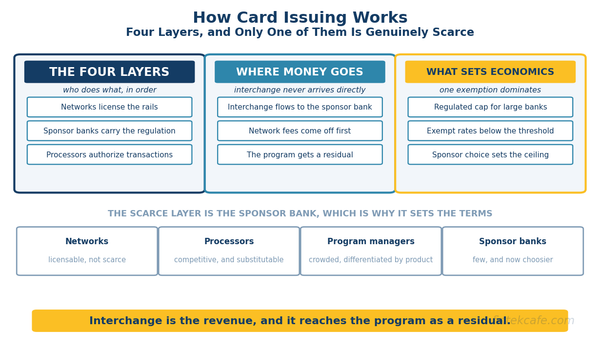
The four layers behind every fintech card: network, sponsor bank, issuer processor, program manager. Who earns what, and what it takes to launch.
Embedded Finance in 2026: How Non-Banks Became Financial Companies
Non-banks now embed accounts, payments, lending, and cards. A guide to the BaaS stack, who holds liability, the shakeout, and the unit economics.
Open Banking in the US: What Section 1033 and the CFPB Final Rule Mean for Banks and Fintechs
Section 1033 sets the US open-banking trajectory through 2030. A framework for what it mandates and what it changes for banks, fintechs, and aggregators.