GameStop and Short Squeeze

Background
Most of you have probably heard about the GameStop (NYSE: GME) stock episode that made headlines. Here is what happened, step by step.
There was a high level of short interest in GME stock. Retail investors on the Reddit forum "wallstreetbets" noticed this heavy short interest. They started buying the stock, which pushed the price up and forced a "short squeeze."
This squeeze caused retail brokerage firms like Robinhood to halt trading on certain stocks. They needed to meet collateral requirements set by the stock clearinghouse. Robinhood raised capital to meet these requirements and later allowed its customers to trade these stocks again.
The new U.S. administration and the SEC are closely watching the situation for any foul play, such as "pump and dump" schemes.
That summary gives you the big picture. Now let's break down the key concepts involved.
Short selling
First, let's understand short selling.
When you buy a stock at $10, your potential gain is unlimited (if the company keeps doing well). Your maximum loss is only $10 (the price you paid).
Short selling flips this around. Your maximum gain is $10 (if the stock drops to $0, since a stock can never go below zero). But your potential loss is unlimited (if the stock keeps rising).
How does one get into a Short position?
When an investor "shorts" a stock, they borrow shares from a broker and sell them right away. This creates a margin position.
Let's say an investor shorts a stock at $10. They then wait for the price to drop. When the stock falls to $6, the investor buys shares to "cover" the short position. The investor pockets the $4 difference as profit.
Short Squeeze
Now that we understand short selling, let's look at the short squeeze. This is the process that caused stock prices like GME and AMC to skyrocket.
For any asset, the market has "longs" (people betting the price will go up) and "shorts" (people betting the price will go down).
In a short squeeze, the number of long positions increases. This reduces the number of shares available to buy. The price goes up even though nothing has changed in the actual business. For example, GME did not change its business model, but the stock price still surged.
As the price rises, short sellers get nervous because they may receive a "margin call" from their broker. So they rush to buy shares to cover their short positions. Now both longs and shorts are buying at the same time. This creates a perfect storm that pushes the stock price even higher.
What is a margin call?
Short sellers must keep a minimum amount of money in their account, called the maintenance margin. As the stock price rises, the broker will ask them to either buy back the shares (cover the position) or add more funds to their margin account.
Here is an example. Say you short 100 shares at $1 each. The total short sale value is $1,000. The initial margin is typically 150% of the short sale value, which is $1,500. So you need at least $1,500 in your account to open this short position.
Once the position is open, there is an ongoing maintenance margin requirement. Let's use 25% for this example.
If the stock jumps to $2, the short sale value becomes $2,000. The maintenance margin is 25% of $2,000 = $500. The total margin requirement is now $2,500. You get a "margin call" for $1,000 ($2,500 minus your original $1,500).
If the stock drops to $0.50, the short sale value becomes $500. The maintenance margin is 25% of $500 = $125. The total margin requirement is $500 + $125 = $625. Since $625 is less than the $1,500 already in your account, you will not get a margin call.
Short interest as a percent of Float or Shares Outstanding
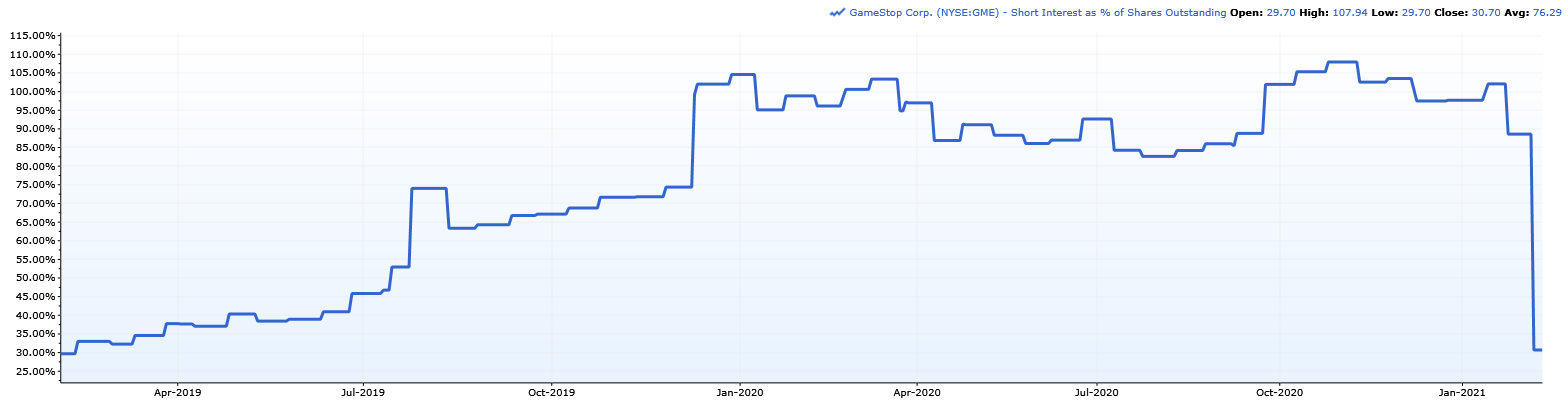
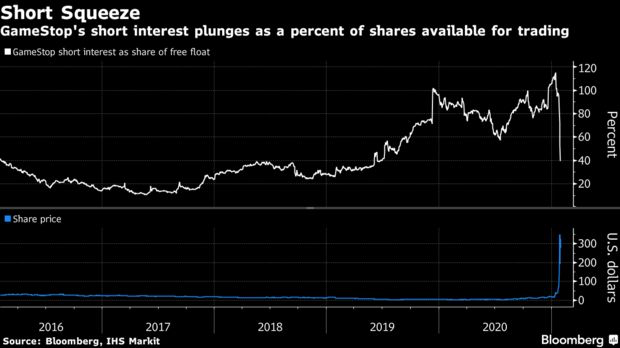
Now that we understand the short squeeze and margin calls, let's review short interest as a percentage of total shares outstanding and as a percentage of float. These metrics were closely watched during the GME saga.
Shares outstanding = Shares issued minus treasury stock (shares the company has repurchased).
You can find this number on a company's balance sheet.
Short interest as a percentage of shares outstanding is the ratio of shorted shares to total shares outstanding.
And,
Float (total shares available to the general public) = Shares outstanding minus restricted and closely held shares (stocks owned by company insiders).
Short interest as a percentage of float is the ratio of shorted shares to floating shares.
For example, GME had 69.7M shares outstanding. The float was about 68% of that, which equals 47.3M shares.
During mid-January, the short interest as a percentage of float was around 117%. This meant investors had shorted more shares than the total float.
Why did retail brokerage firms halt trading on GME?
The Depository Trust & Clearing Corp (DTCC) is the central clearinghouse for U.S.-traded stocks. Retail brokers like Robinhood must keep a "collateral" deposit with the DTCC. This is because of the "T+2" rule, which means there is a two-day lag between exchanging cash and receiving the actual shares.
Think of it as similar to a margin call for individual investors, but this one is between retail brokers and the DTCC.
The DTCC recognized the risks from the short squeeze and ordered brokerage firms to increase their collateral. Robinhood had to come up with nearly $3 billion in collateral.
So what's next?
The SEC and the federal government launched investigations to find out if any individuals carried out a coordinated "pump and dump" scheme. They want to determine whether bad actors drove the price up, took profits, and then dumped the stock.
In conclusion, this was a financial event that no one expected. At least our open and free market showed resilience and did not collapse. Learning from incidents like these and making necessary changes will make our markets even stronger.
Related Articles

How Central Bank Digital Currencies Will Change Finance
What are CBDCs and how will they change banking? A complete guide to central bank digital currencies, from China's digital yuan to the EU's digital euro.