
Why Your RAG System Is Lying to You (And What To Do About It)
Retrieval-Augmented Generation was supposed to solve hallucination. Attach a knowledge base to a large language model, retrieve relevant context before generating a response, and the model stops making things up. That was the pitch.
The reality is less reassuring. Enterprise RAG pipelines fail silently and frequently. The retrieval returns the wrong chunk. The correct chunk exists but never gets retrieved. The model receives partial context and confidently fills in the gaps with fabricated details. The system returns an answer that looks authoritative, cites real documents, and is still wrong.
This is worse than a model that openly hallucinates. An obvious hallucination gets caught. A RAG system that returns plausible, well-sourced, incorrect answers gets trusted. Decisions get made. The error propagates.
The organizations deploying RAG systems without rigorous evaluation frameworks are not reducing hallucination risk. They are laundering it.
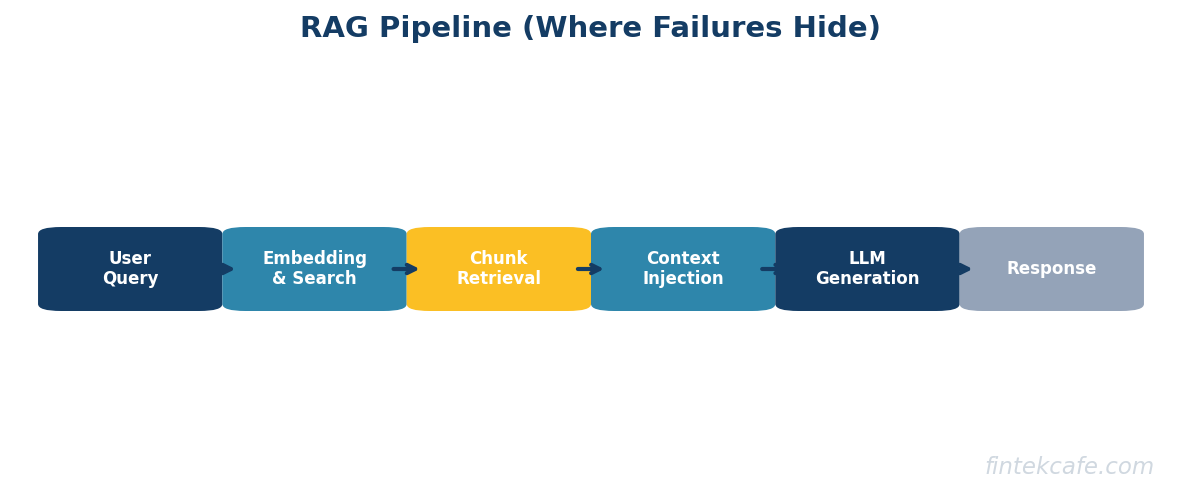
The Four Failure Modes
RAG failures are not random. They follow predictable patterns that trace back to specific architectural decisions. Understanding these patterns is the first step toward building systems that actually work.
1. Retrieval Miss
The most fundamental failure: the correct information exists in the knowledge base, but the retrieval system does not return it. The query and the relevant document use different terminology, describe the same concept from different angles, or are separated by an abstraction gap that embedding similarity cannot bridge.
A compliance team asks about "customer onboarding requirements for high-risk jurisdictions." The relevant policy document uses the phrase "enhanced due diligence procedures for elevated-risk geographies." The semantic overlap is obvious to a human reader. The embedding model scores it below the similarity threshold, and the chunk never appears in the context window.
The model then answers the question using whatever marginally related chunks it did retrieve. The response is coherent, uses appropriate compliance language, and provides an answer that is confidently wrong.
Retrieval misses are the hardest failure to detect because the system behaves exactly as designed. It retrieves, it generates, it returns an answer. Nothing errors out. Nothing looks broken. The only signal is that the answer is wrong, and detecting that requires knowing the right answer already.
2. Context Bloat
The opposite problem: the retrieval system returns too many chunks, and the relevant information gets diluted in a sea of marginally related content.
Most RAG implementations retrieve a fixed number of chunks (typically five to twenty) based on similarity scores. When the knowledge base is large and the query is broad, many chunks will clear the similarity threshold. The model receives a context window packed with tangentially related information and must determine which pieces are actually relevant to the specific question.
Large language models handle this poorly. Research consistently shows that models struggle with information buried in the middle of long contexts. The relevant chunk at position twelve out of fifteen gets less attention than the irrelevant chunk at position one. The model anchors on the most prominent information, not the most relevant.
Context bloat turns a retrieval problem into a reasoning problem, and reasoning over long, noisy contexts is precisely where current models are weakest.
3. Chunk Boundary Corruption
Knowledge bases are split into chunks because embedding models and context windows have size limits. The chunking strategy determines where documents get cut, and those cuts routinely destroy the information the system needs.
A financial regulation document states a rule in one paragraph and its three exceptions in the next. The chunking algorithm splits them into separate chunks. The retrieval system returns the rule chunk but not the exceptions chunk. The model generates a response that correctly states the rule and fails to mention the exceptions that make the rule applicable.
Worse, the model has no way to know that exceptions exist. The chunk it received is internally complete and coherent. There is no indication that critical context was severed at the boundary. The answer looks correct and comprehensive because, within the limited context provided, it is.
Tables, multi-step procedures, conditional logic, and cross-referenced sections are all vulnerable to chunk boundary corruption. The more structured and interdependent the source content, the more likely that chunking will destroy the relationships that make the information meaningful.
4. Prompt Leakage
The system prompt, retrieval instructions, and injected context create a complex prompt that the model must navigate. In many RAG implementations, the boundary between "retrieved context" and "generation instructions" is ambiguous, and the model bleeds information across these boundaries.
Retrieved content that contains instructional language can override system prompt behavior. A knowledge base article that says "always recommend product X for this use case" gets treated as an instruction rather than a fact to report. Conversely, system prompt instructions can contaminate the model's interpretation of retrieved content, causing it to filter or reframe information to match its behavioral guidelines.
Prompt leakage is particularly dangerous in multi-turn conversations where the context window accumulates retrieved chunks from multiple queries. Earlier retrievals can influence the interpretation of later ones, creating compound errors that are nearly impossible to trace.
This is a Premium Article
Sign up for a Premium membership to read this article and get full access to strategic intelligence on technology and business.
Already a member? Sign in
Related Articles
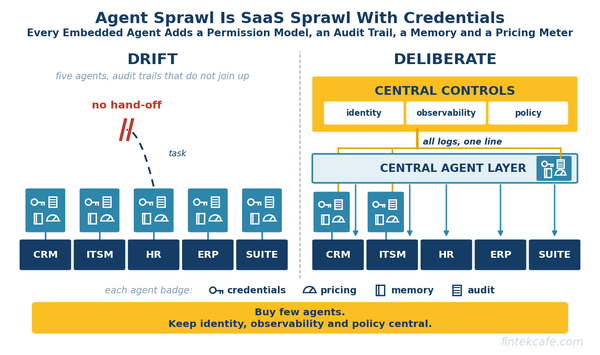
Every Software Vendor Now Sells an Agent, and Most Enterprises Should Buy Very Few of Them
Buying an agent from every system of record recreates SaaS sprawl one layer up. How CIOs should choose, and which controls must stay central.
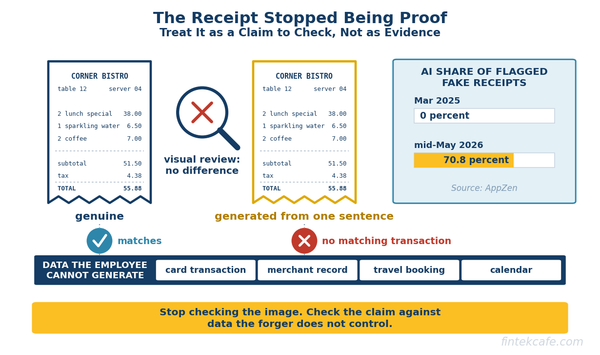
AI-Generated Fake Receipts: How Expense Fraud Changed and How Finance Teams Catch It
AI-generated fake receipts now beat visual review. How expense fraud changed, which detection still works, and the controls to use by company size.
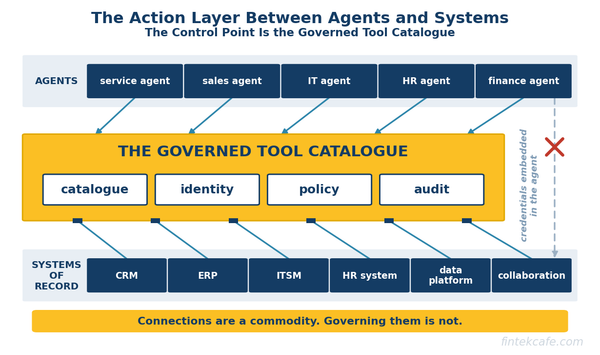
Integration Platforms Are the Quiet Winners of the Agent Era
Agents act through integrations. iPaaS and API vendors hold the connectors, credentials and audit trails, and MCP makes governing that layer worth more.