
The Coming Shakeout in Embedded Finance
Two years ago, every venture capital pitch deck in fintech contained the same thesis: embedded finance would turn every company into a fintech company. The plumber would offer invoice financing. The yoga studio would issue debit cards. The e-commerce platform would underwrite merchant loans. The total addressable market slide showed a number north of 7 trillion by 2030.
The reality that is emerging looks nothing like the pitch. Roughly 80% of embedded finance projects launched between 2021 and 2024 have been quietly killed, scaled back, or frozen. The companies that survive the shakeout will look very different from what the market expected. Understanding why requires examining three structural problems that the embedded finance thesis either ignored or actively obscured.
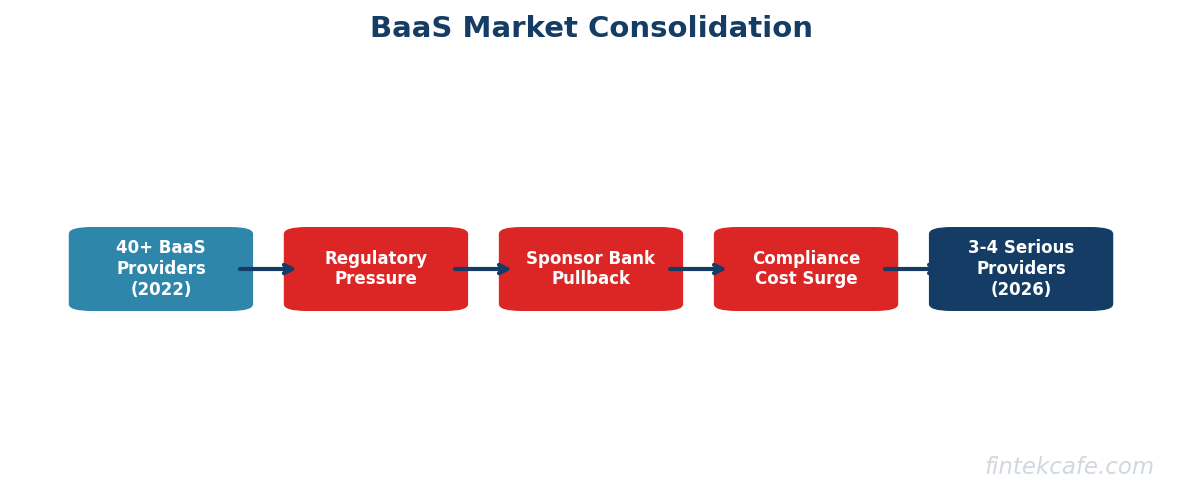
The BaaS Layer Is Consolidating to Rubble
Banking-as-a-Service was the infrastructure layer that made embedded finance possible. Companies like Synapse, Unit, Treasury Prime, and Bond provided the APIs that let non-bank companies offer bank accounts, issue cards, and move money without obtaining their own banking license. The pitch: plug in an API, become a bank.
The Synapse collapse in 2024 exposed the fragility of this model. When Synapse failed, its fintech partners lost access to their customers' funds. The FDIC had to intervene. Customers of companies like Yotta and Juno discovered that their "bank accounts" were not, in fact, protected the way they assumed. The total shortfall between what Synapse's records showed and what partner banks held was reportedly in the range of 65 to 85 million.
This was not a one-off failure. It was a structural consequence of the BaaS model. The multi-layered stack, where a fintech sits on top of a BaaS middleware provider that sits on top of a sponsor bank, creates reconciliation complexity that compounds with scale. Every layer introduces latency, data translation, and potential discrepancies. When things go wrong, the question of who holds the money and who owns the ledger becomes existential.
The Regulatory Response
Regulators noticed. The FDIC, OCC, and Federal Reserve have issued guidance that effectively forces sponsor banks to treat their fintech partners as direct extensions of their own compliance obligations. The consent orders against Evolve Bank, Cross River, and Blue Ridge Bank in 2023 and 2024 signal a clear regulatory direction: sponsor banks cannot outsource compliance to middleware providers and claim ignorance when things fail.
The practical effect is that sponsor banks are dramatically reducing the number of fintech partnerships they maintain. A bank that partnered with forty fintechs through a BaaS provider is now cutting that number to five or ten, keeping only the relationships where the economics justify the compliance overhead. The banks that remain in the sponsor business are raising prices, demanding more operational control, and requiring direct relationships with the end fintechs rather than accepting intermediation through a BaaS layer.
This consolidation is not temporary. It reflects a permanent repricing of risk. The surviving BaaS providers will be the ones that can absorb regulatory burden and demonstrate operational rigor. The market is consolidating toward three or four providers with genuine banking relationships, compliance infrastructure, and the scale to amortize regulatory costs. Everyone else is getting squeezed out.
Who Survives the BaaS Consolidation
| Provider Type | Position | Outlook |
|---|---|---|
| Bank-owned BaaS (Column, Fifth Third) | Direct banking license, control over ledger | Strongest. Regulatory alignment built in. |
| Well-capitalized middleware (Unit, Treasury Prime) | Strong bank partnerships, compliance investment | Viable if they can absorb rising compliance costs |
| Thin middleware (most pre-2024 entrants) | API wrapper with limited compliance | Exits, acqui-hires, or quiet shutdown |
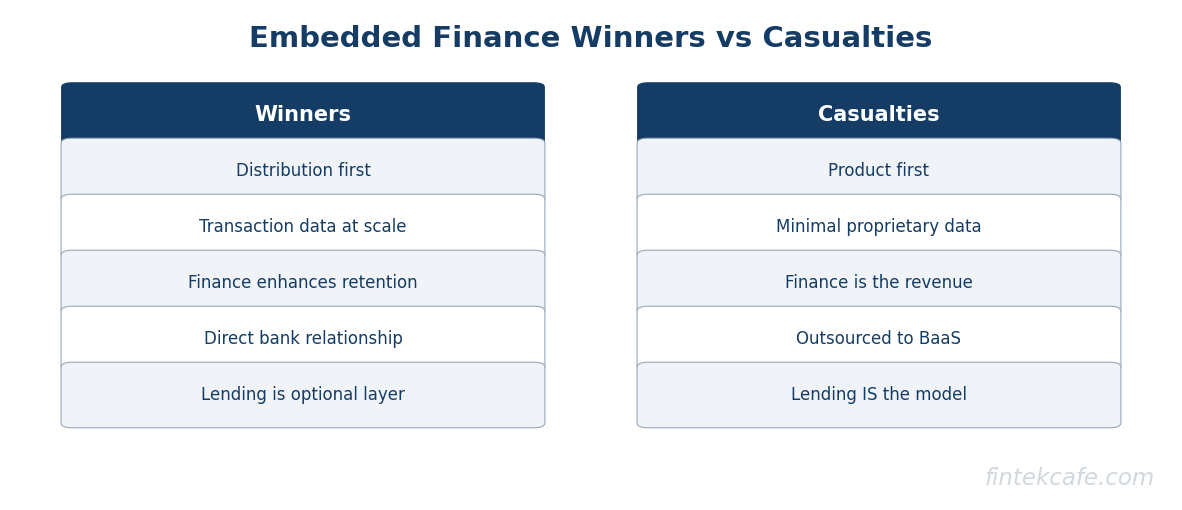
| Vertical SaaS with embedded finance (Toast, Shopify) | Distribution advantage, finance as feature | Winners. Finance enhances core product. |
This is a Premium Article
Sign up for a Premium membership to read this article and get full access to strategic intelligence on technology and business.
Already a member? Sign in
Related Articles
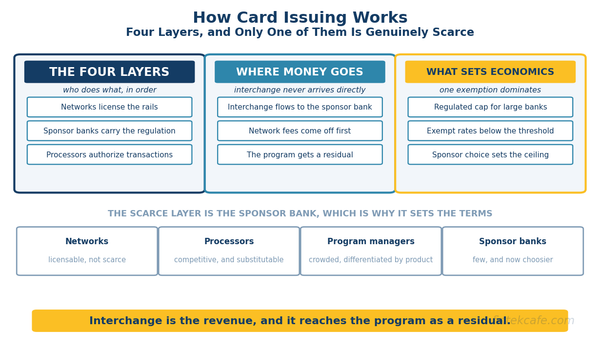
How Card Issuing Works: The Stack Behind Every Fintech Card Program
The four layers behind every fintech card: network, sponsor bank, issuer processor, program manager. Who earns what, and what it takes to launch.
Embedded Finance in 2026: How Non-Banks Became Financial Companies
Non-banks now embed accounts, payments, lending, and cards. A guide to the BaaS stack, who holds liability, the shakeout, and the unit economics.
Open Banking in the US: What Section 1033 and the CFPB Final Rule Mean for Banks and Fintechs
Section 1033 sets the US open-banking trajectory through 2030. A framework for what it mandates and what it changes for banks, fintechs, and aggregators.