
Why Most Fintech Partnerships Fail: The Integration Trap
The press release writes itself. Two logos side by side. A quote from each CEO about "transforming the customer experience." A vague reference to "millions of customers" who will benefit. The stock price bumps 2-3% on the news.
Eighteen months later, the partnership has delivered less than a fifth of projected revenue. The integration is half-finished. The roadmaps have diverged. The executive sponsors who championed the deal have moved on to other priorities. Nobody writes a press release about that.
This pattern repeats with remarkable consistency across fintech. Industry data suggests that 70-80% of fintech partnerships deliver less than 20% of their projected revenue within the first two years. The announced partnership is a press release, not a business outcome. Understanding why requires examining three structural failures that most organizations never see coming.
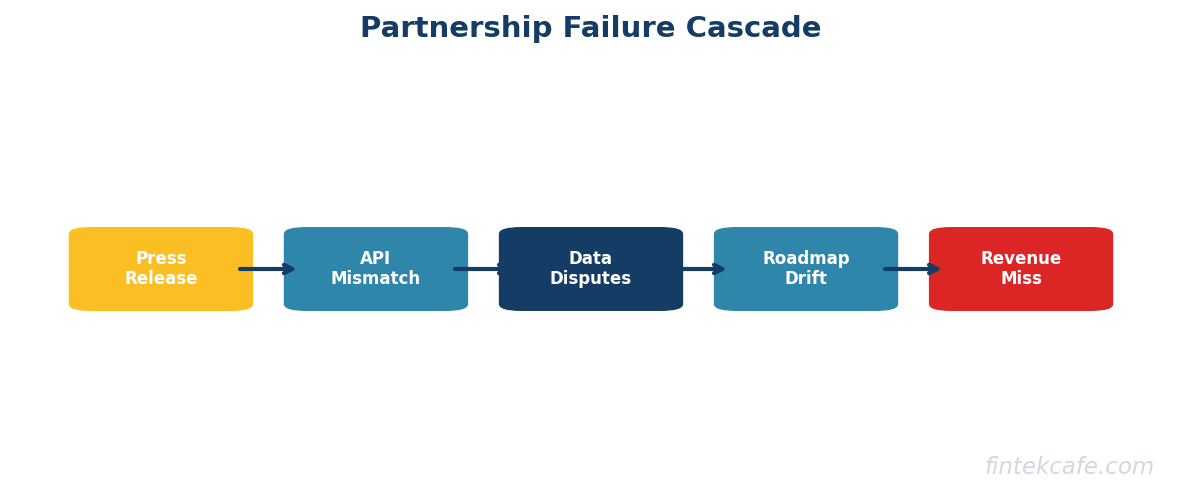
The Integration Trap
The most common failure mode is also the most predictable: the technology doesn't work together the way the business teams assumed it would.
The API Mismatch Problem
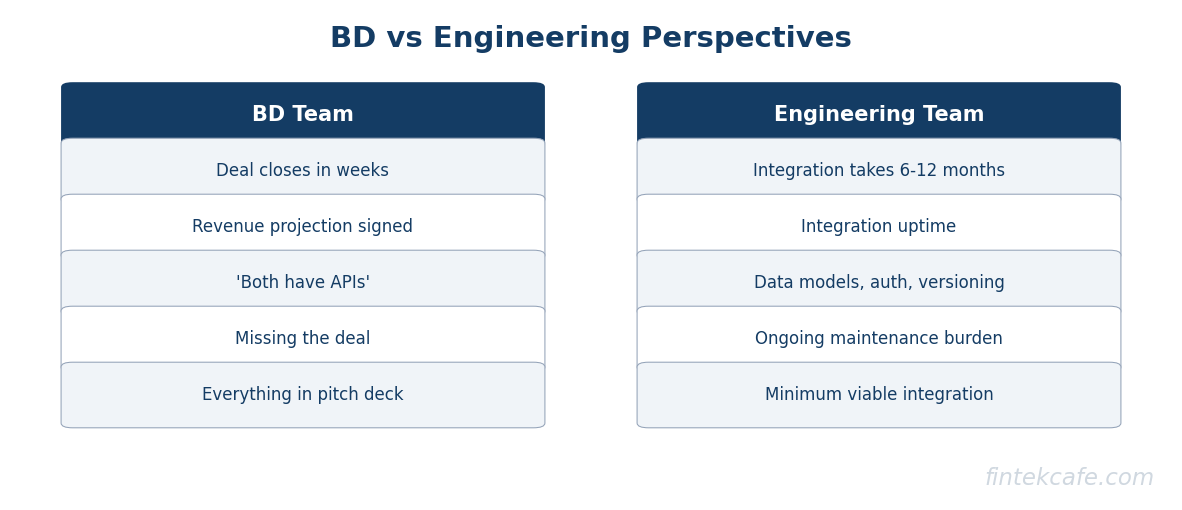
Partnership discussions happen between business development teams. Integration happens between engineering teams. These two groups have fundamentally different definitions of "compatible."
When a BD team says "our APIs are compatible," they typically mean "both companies have APIs." When an engineering team evaluates that same integration, they discover mismatched data models, incompatible authentication schemes, different error handling philosophies, conflicting rate limits, and versioning strategies that assume different upgrade cadences.
The Goldman Sachs and Apple Card partnership illustrates this at scale. The strategic logic was compelling: Apple's distribution combined with Goldman's banking license. But the integration reality was far more complex. Goldman had to build an entirely new consumer banking technology stack from scratch. Apple's design requirements demanded capabilities that Goldman's existing infrastructure couldn't support. The card launched, but the cost of building and maintaining the integration reportedly exceeded what Goldman had projected by a wide margin, contributing to cumulative losses that industry analysts estimated north of one billion in pre-tax costs.
This isn't a Goldman-specific problem. It's a structural feature of cross-company integrations. Each company's technology stack reflects years of architectural decisions, trade-offs, and accumulated technical debt. Connecting two such stacks is never as simple as "call this API endpoint."
The Data Ownership Problem
Every partnership requires data to flow between organizations. Every organization has legitimate reasons to control its data. These two facts create a tension that partnership agreements consistently fail to resolve.
Consider a common fintech partnership: a bank partners with a fintech lending platform. The bank provides customer data for underwriting. The fintech provides the lending technology. Simple enough on paper.
In practice, the questions multiply. Who owns the enriched data created during underwriting? Can the fintech use aggregate patterns learned from the bank's customers to improve its models for other partners? What happens to customer data if the partnership ends? Who bears liability for a data breach that occurs in the integration layer between the two systems?
These questions rarely get answered in the initial partnership agreement because the business teams negotiating the deal don't know enough about the technical architecture to ask them. The answers emerge later, during integration, when engineering teams discover that resolving data ownership requires architectural changes that neither side budgeted for.
The Roadmap Drift Problem
Two companies with a partnership agreement still have independent product roadmaps. Over time, those roadmaps diverge. Features that the integration depends on get deprioritized. Breaking changes get introduced. Deprecation timelines don't align.
The Synapse collapse in 2024 represents the extreme case. Synapse provided banking-as-a-service infrastructure that dozens of fintech companies depended on. When Synapse's roadmap drifted from what its partners needed, and then the company itself failed, the integration dependencies became catastrophic. Partner fintechs couldn't access their customers' funds. The entire chain of partnerships built on Synapse's infrastructure unraveled.
Most roadmap drift is less dramatic but equally corrosive. A partner company decides to sunset an API version that the integration depends on, giving six months' notice for a migration that requires twelve months of engineering work. A key feature gets reprioritized because the partner's core business needs it more than the partnership does. A new security requirement forces architectural changes that break the integration.
The fundamental problem: partnership agreements describe a moment in time, but technology stacks evolve continuously. Every partnership is slowly decaying from the moment the integration goes live.
This is a Premium Article
Sign up for a Premium membership to read this article and get full access to strategic intelligence on technology and business.
Already a member? Sign in
Related Articles
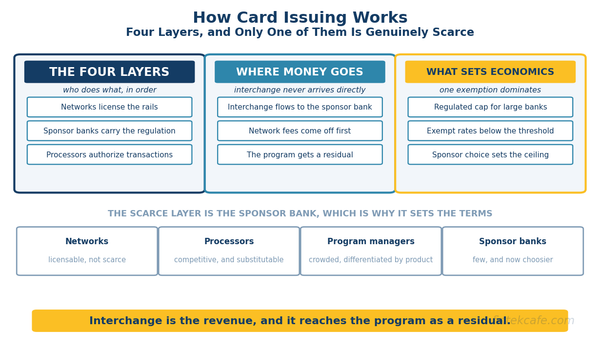
How Card Issuing Works: The Stack Behind Every Fintech Card Program
The four layers behind every fintech card: network, sponsor bank, issuer processor, program manager. Who earns what, and what it takes to launch.
Embedded Finance in 2026: How Non-Banks Became Financial Companies
Non-banks now embed accounts, payments, lending, and cards. A guide to the BaaS stack, who holds liability, the shakeout, and the unit economics.
Open Banking in the US: What Section 1033 and the CFPB Final Rule Mean for Banks and Fintechs
Section 1033 sets the US open-banking trajectory through 2030. A framework for what it mandates and what it changes for banks, fintechs, and aggregators.