
The API Economy Is a Lie: Why Most Platform Companies Are Just Vendors
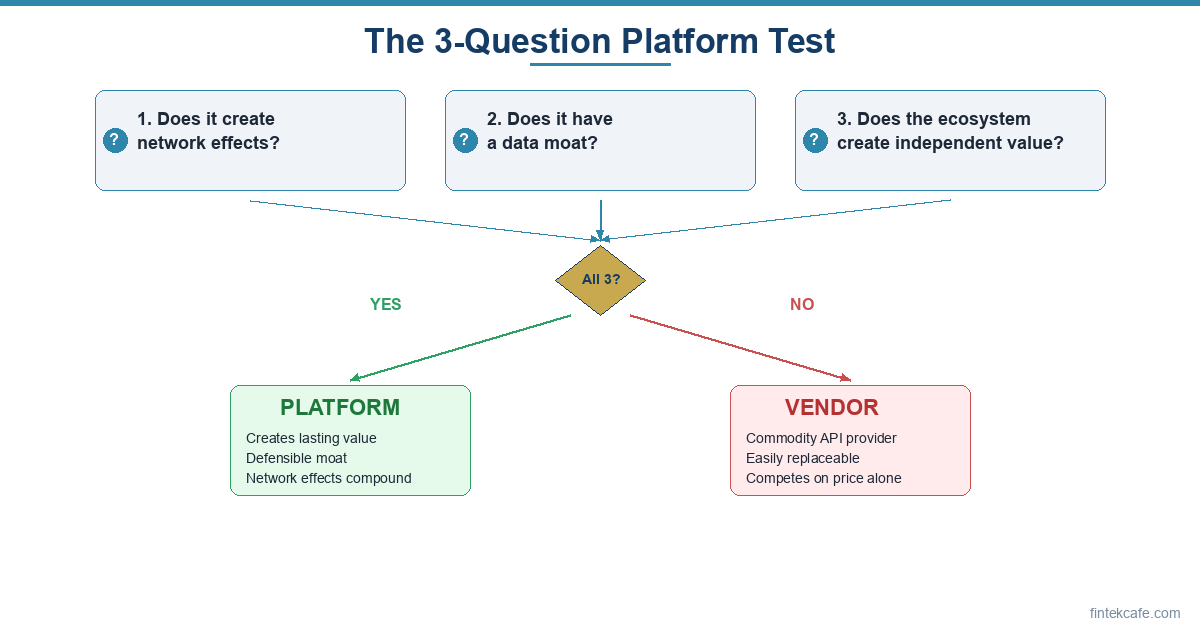
Every enterprise pitch deck in fintech contains the same slide. It shows an architecture diagram with the company's product in the middle, surrounded by arrows pointing to partners, integrations, and third-party developers. The word "platform" appears in 72-point font. The word "ecosystem" appears at least three times.
The pitch goes something like this: "We're not just a product - we're a platform. Our API enables a thriving ecosystem of developers and partners who build on top of our infrastructure. We're creating the next layer of financial services."
This is, in the vast majority of cases, nonsense.
Most companies that claim to be platforms are vendors. They sell software. The fact that their software has an API doesn't make them a platform any more than having a phone number makes them a telecom company. The API is an interface, not a business model.
This distinction matters enormously. It determines valuation, strategy, competitive dynamics, and ultimately whether the company survives. And the industry's persistent confusion about it has led to billions in misallocated capital and thousands of failed strategies.
What a Platform Actually Is
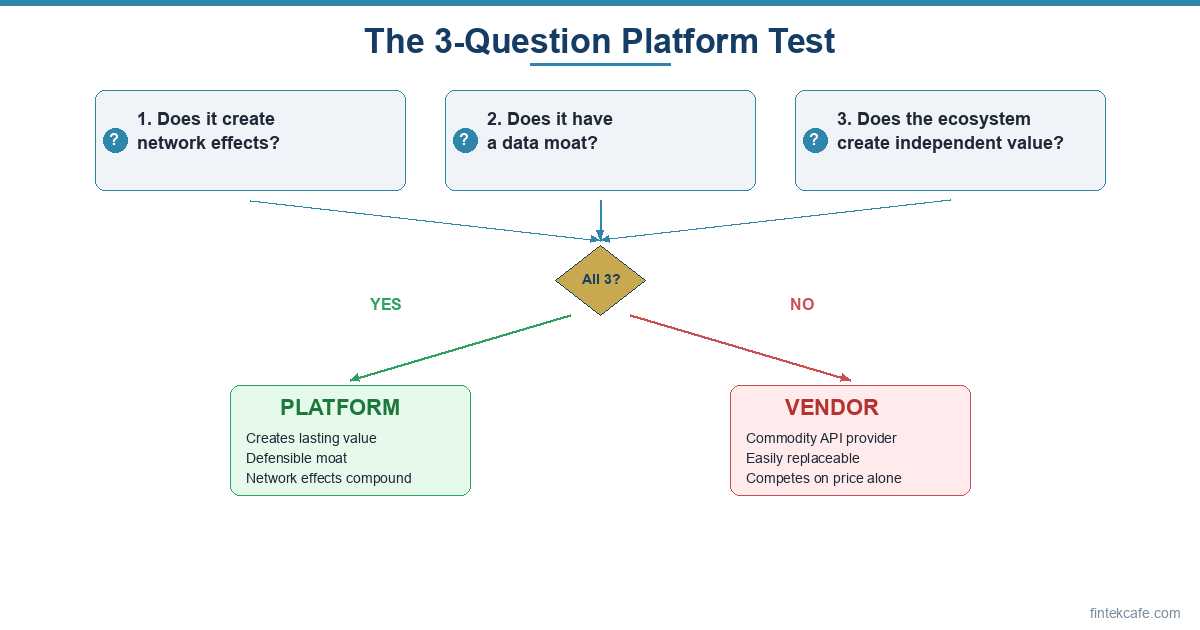
The academic definition is straightforward: a platform is a business that creates value by facilitating interactions between two or more groups of participants. The platform doesn't create the primary value itself - it enables others to create value, and it captures a portion of that value.
The practical test is even simpler: does the third-party ecosystem create more value than the platform company itself?
AWS is a platform. The applications built on AWS generate orders of magnitude more revenue than AWS itself. AWS creates the conditions for value creation, and captures a fraction of that value through infrastructure fees.
Stripe is a platform. The businesses processing payments through Stripe generate far more economic value than Stripe does. Stripe enables those transactions and captures a percentage.
Apple's App Store is a platform. The apps in the store generate vastly more consumer value than Apple's own apps. The platform's value lies in the ecosystem it enables.
Now consider the typical "API-first" fintech startup. It has an API. Customers integrate with it. Partners build connections to it. But strip away the language, and what's actually happening? The company is selling a product - data aggregation, identity verification, payment processing, whatever - and the API is just the delivery mechanism. The "ecosystem" is a list of customers who happen to connect via API instead of logging into a dashboard.
That's not a platform. That's a vendor with good documentation.
The Revenue Test
There's a simple test: look at where the revenue comes from.
For a true platform, revenue comes from enabling transactions or interactions between participants. AWS charges for compute that others use to build products. The App Store takes a cut of transactions between developers and consumers. Stripe takes a percentage of payments between merchants and customers.
For a vendor pretending to be a platform, revenue comes from selling a product to customers. The API is the delivery mechanism, but the value proposition is: "We do X, and you pay us for it." There's no meaningful third-party ecosystem creating independent value.
Consider a fintech company that provides bank account verification via API. Customers integrate the API, send verification requests, and pay per request. The company calls itself a "platform" because it has an API and multiple customers use it. But this is just a SaaS product with a REST interface. There are no third-party developers building products on top of it. There's no ecosystem of interactions being facilitated. It's a vendor.
This is a Premium Article
Sign up for a Premium membership to read this article and get full access to strategic intelligence on technology and business.
Already a member? Sign in
Related Articles
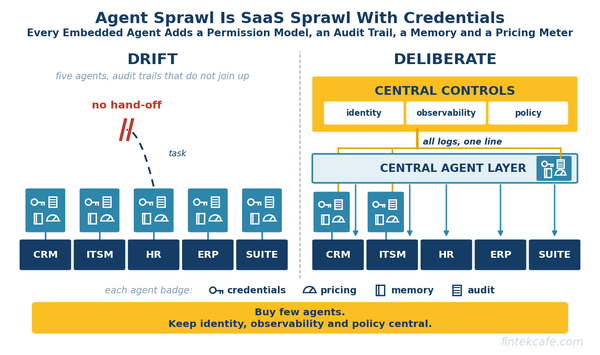
Every Software Vendor Now Sells an Agent, and Most Enterprises Should Buy Very Few of Them
Buying an agent from every system of record recreates SaaS sprawl one layer up. How CIOs should choose, and which controls must stay central.
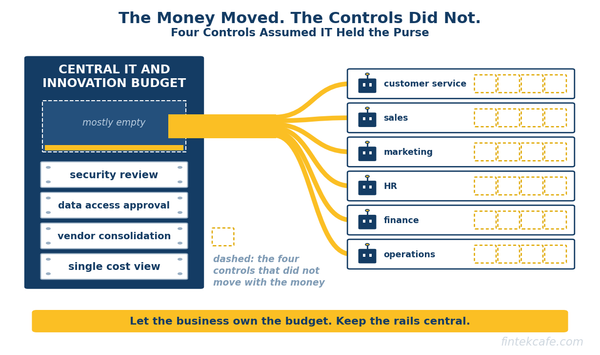
The AI Budget Is Moving From IT to the Business Lines, and Governance Has Not Followed
AI spend is moving from central IT to business lines. That ties cost to outcomes but breaks controls built for an IT-held purse. The model that works.
Enterprise Search Is Back, and This Time It Decides Which AI Assistant Wins
Enterprise search failed for twenty years. Now the permission-aware index behind every AI assistant is the control point, and its owner wins.