
The $400 Billion Mistake: Why Corporate Treasury Is Fintech's Biggest Untapped Market
Here's something that should bother you if you work in fintech.
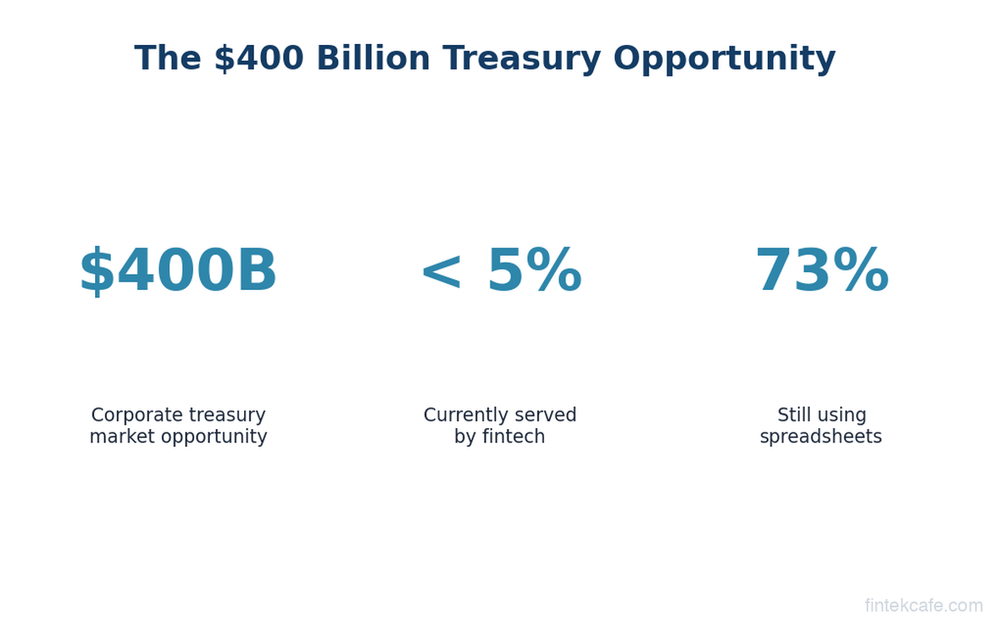
A Fortune 500 treasurer managing $8 billion in cash across 40 countries, 12 banks, and 6 currencies probably did some portion of their daily work today in Microsoft Excel. Not as a supplement. As the primary tool.
They downloaded CSV files from multiple bank portals. They copy-pasted transaction data into a spreadsheet. They manually reconciled intercompany payments. They might have called their FX dealer on the phone to hedge a €200 million exposure. Then they emailed a summary to their CFO.
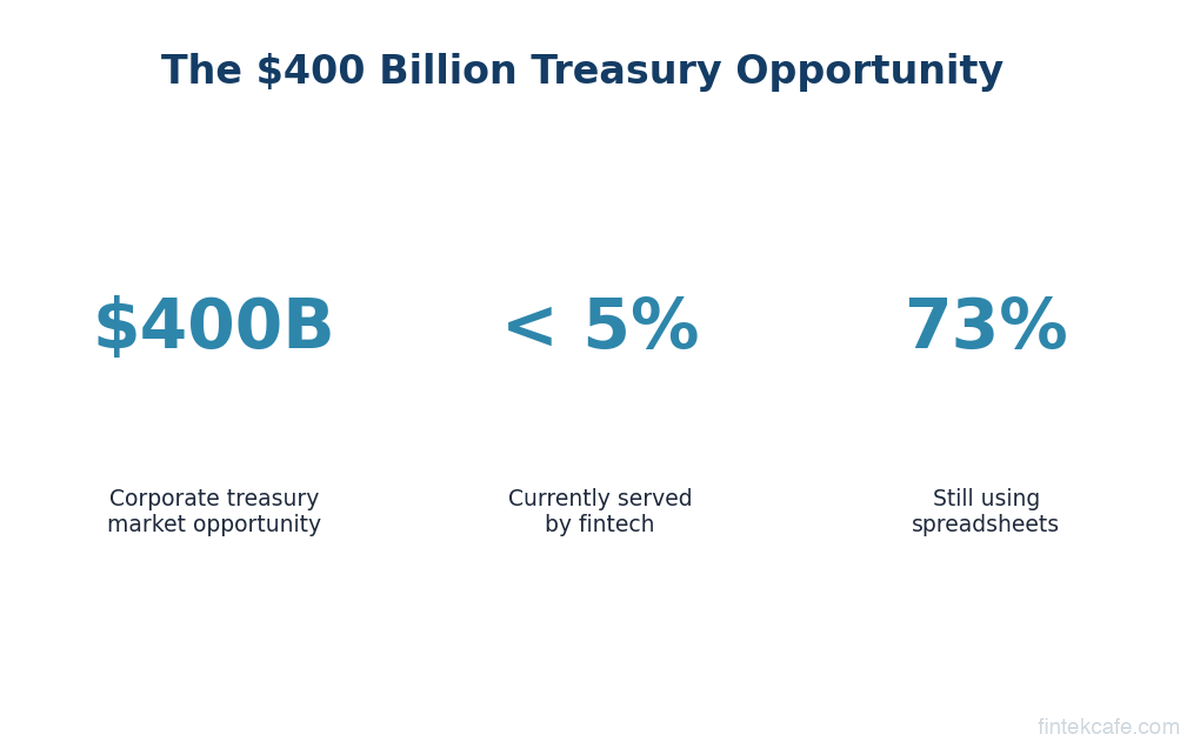
This is not an exaggeration. This is not a startup founder's fantasy about how "legacy" industries work. This is the actual daily workflow of people responsible for managing trillions of dollars of corporate cash globally.
While the rest of fintech has been fighting over consumer payments, neobanking, and SMB lending, corporate treasury has been sitting there in plain sight: a $400 billion+ market running on tools from 1995, largely ignored by the best minds in financial technology.
That's starting to change. And the companies that figure this out will be worth more than Stripe.
What Corporate Treasury Actually Does
Before we talk about why treasury tech is broken, let's talk about what treasurers actually do. Most people in fintech have a vague sense that "treasury" involves "managing cash." The reality is far more complex and far more interesting.
Cash visibility. A large multinational might have hundreds of bank accounts across dozens of banks in dozens of countries. The treasurer needs to know, ideally in real-time, how much cash is in each account, in each currency, in each entity. This sounds trivial. It is not. Banks don't use the same data formats. They don't update at the same times. Some provide APIs. Many still rely on SWIFT MT940 messages or, incredibly, manual reporting. Getting a single, accurate, real-time view of global cash is one of the hardest problems in corporate finance.
Cash forecasting. Once you know where your cash is, you need to predict where it's going. When will receivables come in? When are payables due? What are the tax obligations in each jurisdiction? What's the capital expenditure schedule? A bad cash forecast means either sitting on idle cash (opportunity cost) or facing a liquidity shortfall (existential crisis). Most companies forecast cash using spreadsheets. The accuracy is, predictably, terrible.
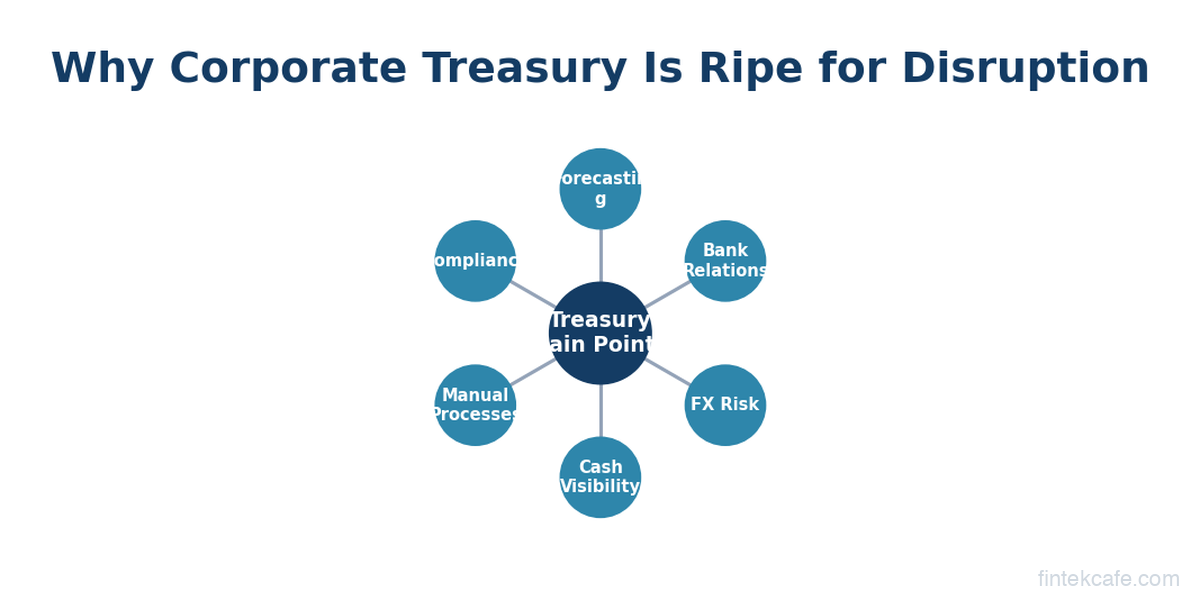
FX risk management. If your company operates in multiple currencies, you're constantly exposed to exchange rate fluctuations. A 2% move in EUR/USD on a $500 million European revenue stream is a $10 million impact. Treasurers hedge these exposures using forwards, options, and swaps. The process involves analyzing exposure data (often manually compiled), calling or messaging bank dealers for quotes, executing trades, and then tracking the hedges against the underlying exposures. Most of this is done through Bloomberg terminals, phone calls, and spreadsheets.
Intercompany flows. Large companies have dozens or hundreds of legal entities that transact with each other. The US subsidiary buys components from the Irish manufacturing entity. The Singapore treasury center lends to the Brazilian operation. These intercompany flows need to be priced correctly (transfer pricing rules), settled efficiently, and reconciled. For many multinationals, intercompany reconciliation is a full-time job for entire teams. Some companies settle intercompany balances only quarterly because the process is so painful.
Bank relationship management. A Fortune 500 company might work with 20+ banks globally. Each bank charges different fees for different services in different markets. Analyzing whether you're getting a fair deal requires aggregating fee data across banks and comparing it to benchmarks. Most companies don't do this analysis because the data is too fragmented. Banks love this. Opacity is profitable.
Investment of surplus cash. When a company has excess cash, it needs to invest it safely (money market funds, short-term bonds, commercial paper). The treasurer manages this portfolio, balancing yield, liquidity, and counterparty risk. The tools for this are slightly better than the rest of treasury (Bloomberg and specialized portals exist), but the integration with the rest of the treasury workflow is typically nonexistent.
This is a simplified overview. Real corporate treasury also involves debt management, bank account administration, payment factory operations, guarantee management, and regulatory compliance (SOX controls, sanctions screening). It's a massive, complex domain.
This is a Premium Article
Sign up for a Premium membership to read this article and get full access to strategic intelligence on technology and business.
Already a member? Sign in