
Stablecoins Explained: USDT, USDC, and the Future of Digital Dollars
In May 2022, TerraUSD — a stablecoin with an $18.7 billion market cap and supposedly pegged to the US dollar — went from $1.00 to $0.02 in four days. $40 billion in value evaporated. It wiped out savings of retail investors across Asia, triggered a crypto credit crisis, and sent multiple crypto hedge funds and lenders into bankruptcy.
One month before the collapse, TerraUSD was being held up as a breakthrough in decentralized finance.
Not all stablecoins are created equal. Understanding the difference — between coins backed by real assets and those backed by algorithms and hope — is essential for anyone working at the intersection of finance and technology. Stablecoins are no longer a crypto curiosity. They are becoming serious payment infrastructure.
What Makes a Dollar "Stable"
A US dollar stays close to $1.00 because the Federal Reserve and US Treasury manage monetary policy, the US government accepts taxes in dollars, and the global economy denominate vast quantities of trade in dollars. The dollar's stability is backed by institutional authority, legal frameworks, and the collective trust of everyone who uses it.
A stablecoin wants to maintain the same price stability without those institutional foundations. Every stablecoin mechanism is an answer to the same question: what substitute for institutional authority will we use to keep this thing at $1.00?
The three approaches that have emerged are fiat collateral (hold actual dollars), crypto collateral (hold more volatile assets than the target value, but hold more than enough), and algorithms (use token issuance and burning to adjust supply). These approaches vary enormously in their risk profiles, as TerraUSD made clear.
Fiat-Backed Stablecoins: USDT vs USDC
The simplest approach: put one dollar in a bank account for every stablecoin token you issue.
USDC is issued by Circle and Coinbase. For every USDC in circulation, Circle holds an equivalent amount in cash and short-term US Treasury bonds, held by regulated US financial institutions and subject to monthly attestation by an independent accounting firm. The reserve composition is public.
In March 2023, when Silicon Valley Bank collapsed and Circle had $3.3 billion of USDC reserves held there, Circle disclosed this immediately. USDC briefly traded at $0.87 before recovering when Circle committed to making depositors whole from its own balance sheet. The system held because the reserves were real — and the transparency to verify them was in place.
USDT (Tether) is the dominant stablecoin by market cap — over $100 billion in circulation as of early 2026. Tether's reserve transparency has been a source of persistent controversy. Historical audits revealed reserves that included commercial paper, loans to affiliated companies, and other non-dollar assets. Tether was fined $41 million by the CFTC in 2021 for making misleading statements about its backing. More recent reserve compositions have shifted heavily toward US Treasuries, but full regular independent audits remain absent.
The practical difference: USDC is the regulated, transparent option. USDT is larger, more liquid on most exchanges, and more commonly used in trading. The risk profiles differ materially, and anyone holding significant amounts of either should understand the distinction.
Crypto-collateralized stablecoins (like DAI from MakerDAO) take a different approach. DAI is backed by crypto assets — primarily ETH — at overcollateralization ratios. You must deposit $150 of ETH to mint $100 of DAI. The excess collateral provides a buffer against crypto price volatility. If collateral value drops too far, the system automatically liquidates positions to maintain the peg. This is more transparent and decentralized than fiat-backed options, but introduces liquidation risk during crypto market crashes.
Algorithmic Stablecoins: Why They Keep Failing
TerraUSD was an algorithmic stablecoin. There was no dollar in a bank account. The peg was maintained by an algorithm and a sister token called LUNA.
The mechanism: if TerraUSD traded above $1.00, you could burn $1 of LUNA to mint one TerraUSD, expanding supply and pushing the price down. If TerraUSD traded below $1.00, you could burn one TerraUSD to mint $1 of LUNA, contracting supply and pushing the price up. Arbitrageurs keep the peg tight under normal conditions.
In May 2022, a large holder withdrew $2 billion of TerraUSD from the Anchor Protocol (a lending platform paying 20% APY on TerraUSD deposits). This caused TerraUSD to briefly trade below $1.00. Traders noticed. More selling followed. The algorithm minted billions of LUNA to defend the peg, hyperinflating LUNA's supply. LUNA price collapsed. This made TerraUSD's stabilization mechanism (LUNA) worthless. TerraUSD depegged further. More LUNA was minted. The death spiral accelerated until both tokens were essentially worthless.
The fundamental problem with algorithmic stablecoins is reflexivity. The stabilization mechanism depends on the very asset — the sister token — that loses value exactly when the stablecoin needs defending. It amplifies rather than absorbs shocks.
TerraUSD was not the first algorithmic stablecoin to fail. Basis Cash failed in 2021. Empty Set Dollar failed. Iron Finance partially collapsed. Every post-mortem reveals the same structural issue: the arbitrage mechanism that maintains the peg only works when participants believe the system will survive. When they stop believing, the mechanism breaks. Belief is not a reserve.
The Regulatory Reckoning
TerraUSD's collapse accelerated regulatory action that was already underway.
MiCA (Markets in Crypto-Assets), the EU's comprehensive crypto regulation, became fully effective in 2024. MiCA creates a specific regulatory regime for stablecoins — called "e-money tokens" for fiat-backed coins. Requirements include: full reserve backing in liquid assets, customer redemption rights at par within one trading day, and authorization from EU financial regulators. Algorithmic stablecoins with no asset backing face significantly higher barriers under MiCA.
Tether announced in 2024 that it would not seek MiCA authorization for EEA issuance. Several European exchanges delisted USDT for EU customers. USDC and other compliant stablecoins gained share in regulated European markets.
US regulation remains less settled but is converging. Various stablecoin bills have passed committee stages in Congress, generally requiring full reserve backing, state or federal money transmitter licensing, and regular public attestations. The direction is clear: large-scale stablecoin issuers will need bank-equivalent regulatory oversight.
PayPal's PYUSD, launched in 2023, positioned itself ahead of this curve by partnering with Paxos Trust, a New York state-chartered trust company. This is the model regulators prefer — stablecoin issuance through a regulated, chartered entity with auditable reserves.
The regulatory trajectory is not "ban stablecoins." It is "bring compliant stablecoins into the regulated financial system." This creates a bifurcated market: compliant coins (USDC, PYUSD, bank-issued stablecoins) with clear regulatory paths, and non-compliant issuers facing restricted access to regulated venues.
Why Banks and Payment Companies Can't Ignore Stablecoins
Stablecoins are attracting serious institutional attention not because of crypto ideology but because of specific, demonstrable payment infrastructure advantages.
Settlement speed: USDC transactions on Ethereum settle in approximately 12 seconds. On Solana, under one second. A traditional wire transfer between correspondent banks can take 1–3 business days. For cross-border B2B payments — where time-to-settlement directly affects working capital — this is a meaningful operational difference.
Cost: Sending $10,000 via USDC on Solana costs fractions of a cent. Sending the same amount via SWIFT can cost $15–50, plus correspondent bank fees on both ends. For high-volume, low-margin payment businesses, this is not a rounding error.
Programmability: Stablecoins on smart contract platforms can carry conditions. Payment released upon delivery confirmation. Payroll distributed automatically at month-end. Escrow with automatic release rules. Streaming payments disbursed per second. This conditionality is not possible with traditional bank transfers.
Dollarization demand: In countries with high inflation — Argentina, Turkey, Nigeria — holding USDC is a practical way for individuals and businesses to access dollar-denominated value without needing a US bank account. USDT volume in emerging markets is enormous and growing, often displacing local currency savings rather than competing with US financial products.
The institutional adoption is no longer theoretical. Visa has run USDC settlement pilots, settling card transactions in stablecoins rather than traditional bank wires. Stripe re-integrated crypto payments in 2024, accepting USDC on multiple blockchains. PayPal launched its own stablecoin. Traditional financial infrastructure is adapting around stablecoins, not fighting them.
Stablecoin Comparison: The Major Players
| Stablecoin | Type | Market Cap (early 2026) | Reserve Backing | Regulatory Status |
|---|---|---|---|---|
| USDT (Tether) | Fiat-backed | ~$100B+ | Primarily US Treasuries; limited independent audit | Non-MiCA compliant for EU; US regulatory uncertainty |
| USDC (Circle) | Fiat-backed | ~$45B+ | Cash + short-term Treasuries; monthly attestation | Most regulatory-friendly; MiCA compliant path |
| DAI (MakerDAO) | Crypto-collateralized | ~$5B | Over-collateralized crypto assets (ETH, USDC) | Decentralized; regulatory classification unclear |
| PYUSD (PayPal) | Fiat-backed | ~$1B | Cash + US Treasuries via Paxos Trust | Issued through regulated NY trust company |
| TerraUSD (defunct) | Algorithmic | $0 (failed May 2022) | None — algorithm-based stabilization | Collapsed; regulatory cautionary tale |
The Future: CBDCs, Private Stablecoins, and the Dollar
The longer-term question is whether private stablecoins or central bank digital currencies (CBDCs) will dominate the "digital dollar" space.
CBDCs are digital currencies issued directly by central banks. The Federal Reserve is researching a digital dollar. The European Central Bank is piloting a digital euro. The theoretical advantage: central bank credibility, legal tender status, no reserve risk.
The concerns are different: programmable government money raises privacy concerns, could disintermediate commercial banks (if consumers hold CBDC directly at the central bank, why maintain deposits at Chase?), and requires governments to navigate significant political opposition.
Private stablecoins have first-mover advantage, global reach, and developer ecosystem momentum. The US approach has been to regulate them into the existing financial system rather than crowd them out with a CBDC — a position that benefits dollar-denominated stablecoins significantly, since USDC effectively extends dollar reach globally without any government distribution cost.
The most likely outcome: regulated private stablecoins dominate consumer and business payment use cases. Bank-issued stablecoins will emerge as incumbents seek to capture the segment without building on third-party rails. CBDCs may handle specific wholesale interbank settlement use cases, where the trust model favors central bank issuance.
What is not likely: stablecoins fading away. The payment use cases are too clear, the adoption too established, and the cost advantages over legacy rails too persistent.
Key Takeaways
- Stablecoins maintain their dollar peg through reserves (fiat collateral), overcollateralization (crypto collateral), or algorithms — the reserve approach is most reliable; algorithmic approaches have failed repeatedly for structural reasons
- USDC is the most transparently backed major stablecoin, with monthly attestations and primarily US Treasury reserve composition; USDT is larger but has faced persistent transparency questions
- Algorithmic stablecoins like TerraUSD fail because their stabilization mechanism — the sister token — loses value exactly when the stablecoin needs it most, creating reflexive death spirals
- MiCA requires full reserve backing and regulatory authorization for EU stablecoins, effectively ending Tether's EU market access; US regulation is converging on similar requirements
- Real payment advantages (sub-second settlement, near-zero fees, programmability, emerging market dollarization) are driving institutional adoption — Visa, Stripe, and PayPal have all added stablecoin capabilities
- The likely future is regulated private stablecoins for consumer and business payments, with CBDCs potentially handling wholesale interbank settlement use cases
Related Reading
Related Articles
Open Banking Failed Its Promise — Here's What Actually Works
Open Banking promised a revolution. Adoption is low and APIs are fragmented. But the real winners are emerging in unexpected places.
How Central Bank Digital Currencies Will Change Finance
What are CBDCs and how will they change banking? A complete guide to central bank digital currencies, from China's digital yuan to the EU's digital euro.
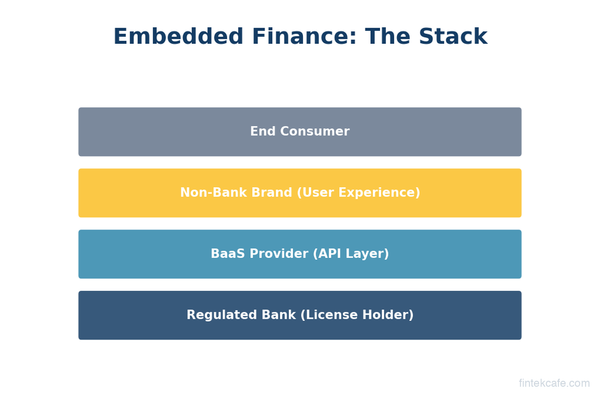
What Is Embedded Finance? How Non-Banks Are Becoming Banks
What is embedded finance and why are non-banks offering financial services? A complete guide to embedded payments, lending, insurance, and banking as a service.