
BNPL Explained: How Buy Now Pay Later Actually Works
BNPL Explained: How Buy Now Pay Later Actually Works
Buy Now Pay Later, or BNPL, processed over $300 billion in global transaction volume in 2023 — and yet most people who use it at checkout don't understand how it actually works. When you click "Pay in 4" on a Klarna pop-up, who is lending you the money? Who pays Klarna? Why does the merchant let you do this? And if it's "interest-free," how does anyone make money?
BNPL is one of the most disruptive fintech business models of the past decade. Understanding how it works — the mechanics of credit, the merchant economics, the underwriting logic, and the regulatory pressure it now faces — is essential context for anyone in fintech, retail, lending, or consumer finance.
What Is BNPL and How Does It Differ From Credit Cards?
BNPL is a short-term financing product offered at the point of sale. It allows consumers to split a purchase into installments — typically four equal payments over six weeks (the "Pay in 4" model) or longer-term monthly installments — either interest-free or at a stated interest rate.
The major BNPL providers are:
- Affirm (US, public — AFRM)
- Klarna (Swedish, private, ~$14B valuation as of 2023)
- Afterpay (Australian, acquired by Block/Square in 2022)
- PayPal Pay Later (embedded in the PayPal checkout)
- Zip (formerly Quadpay, Australian)
- Sezzle, Splitit, Paidy (Japan, acquired by PayPal)
BNPL vs. Credit Cards: Key Differences
| Feature | BNPL (Pay in 4) | Credit Card |
|---|---|---|
| Credit check | Soft pull or none | Hard pull |
| Approval speed | Instant | Minutes to days |
| Interest (short-term) | Zero on Pay in 4 | 20-28% APR if balance carried |
| Repayment structure | Fixed installments | Minimum payment flexibility |
| Reporting to credit bureaus | Inconsistent (changing in 2024+) | Yes, full history |
| Who pays the lender | Merchant pays MDR (3-8%) | Consumer pays interest + fees |
| Debt visibility | Often not on credit report | Always on credit report |
The most important difference: the primary revenue for short-term BNPL comes from merchants, not consumers. This inverts the credit card model, where consumers (through interest charges) subsidize the rewards and zero-APR introductory offers that merchants accept.
The Major BNPL Players
Affirm
Affirm (founded by Max Levchin, PayPal co-founder) targets higher-value purchases with longer terms. While it offers Pay in 4, its differentiated product is longer-term installment loans (6–36 months) for purchases like Peloton bikes, Walmart groceries, and Shopify merchants.
Affirm does charge interest on most of its longer-term products (0–36% APR). Its underwriting is more credit-intensive than pure Pay in 4 players. Affirm is publicly traded and operates under more rigorous financial disclosure requirements.
Klarna
The Swedish giant of BNPL. Klarna offers Pay in 4 (interest-free), Pay in 30 days, and longer-term financing. It's integrated with over 450,000 merchants globally and has 150 million consumers. Klarna also operates a shopping app that aggregates deals and merchant offers, attempting to become a commerce destination, not just a checkout widget.
Klarna went through a dramatic valuation cut — from $45B in 2021 to ~$6.7B in 2022 — before recovering to ~$14B by 2023. Its path to profitability has been closely watched.
Afterpay (now Block)
Afterpay was the pioneer of the Pay in 4 model. Acquired by Block (formerly Square) for $29B in 2022, it's now deeply integrated with Cash App and Square merchants. Afterpay's model is strictly no-interest Pay in 4; it relies almost entirely on merchant fees and late fees for revenue.
PayPal Pay Later
PayPal's embedded BNPL product has scale advantages: it's available to hundreds of millions of existing PayPal accounts without a separate application. "Pay Later" shows up automatically at checkout across PayPal's merchant network. Its integration depth makes it a formidable competitor without the dedicated app that Klarna and Afterpay have built.
Step-by-Step: What Happens When You Click "Pay in 4"
Here's the full transaction flow when a consumer selects BNPL at checkout:
Step 1: Checkout selection
The consumer selects the BNPL option (e.g., "Klarna – Pay in 4") at checkout. The merchant's e-commerce platform (Shopify, WooCommerce, Magento) calls Klarna's API with the cart total, consumer email, and order details.
Step 2: Instant underwriting
Klarna runs an instant credit assessment — typically a soft credit inquiry (which doesn't affect the consumer's credit score) plus proprietary behavioral and payment history data from Klarna's own network. This takes milliseconds. The consumer is approved or declined before the checkout experience breaks.
Step 3: Consumer authorization
The consumer sees the repayment schedule: "4 payments of $25, every 2 weeks." They confirm.
Step 4: Klarna pays the merchant
Klarna pays the merchant the full purchase amount, minus the merchant discount rate (MDR) — typically 3–8% of the transaction value. The merchant receives the money within 1–3 business days, just like a card transaction. The merchant's commercial risk ends here.
Step 5: Consumer repayment
Klarna collects 4 payments from the consumer's linked debit card, credit card, or bank account (via ACH or card-on-file). The first payment is often due immediately or at the time of first installment (2 weeks after purchase). Late payments trigger late fees (typically $7–$10, capped at 25% of the order value in most BNPL programs).
Step 6: Credit risk sits with BNPL provider
If the consumer defaults — never pays the remaining installments — Klarna absorbs the loss. The merchant already has their money (minus MDR). This is why BNPL providers spend enormous resources on underwriting and collections.
The Business Model: Who Pays, Who Earns
Merchant Fees: The Primary Revenue Source
BNPL providers charge merchants a Merchant Discount Rate (MDR) of roughly:
- Klarna Pay in 4: ~3.29% + $0.30 per transaction
- Afterpay: ~4–6% depending on merchant volume
- Affirm: ~2–8% depending on the financing program offered
This is significantly higher than card interchange (~1.5–2.5% for Visa/Mastercard consumer cards). Merchants accept this because BNPL demonstrably increases conversion and average order value (AOV). Studies show BNPL can increase conversion by 20–30% and AOV by 30–50% — the incremental revenue from BNPL transactions exceeds the higher MDR.
Consumer Late Fees
Afterpay charges a flat late fee ($10, capped at 25% of order value). Klarna charges up to $7 per missed payment. These are secondary revenue but material at scale — Afterpay generated ~$170M in late fees in FY2021.
Importantly, BNPL late fees are typically much less than credit card late fees (which can reach $30+) and do not carry revolving interest in the Pay in 4 model. This is a genuine consumer benefit for disciplined users.
Interest Income on Longer-Term Products
Affirm and Klarna's longer-term financing products carry interest rates of 0–36% APR. This is where BNPL starts to look more like traditional consumer lending. Affirm's loans are structured as simple interest installment loans — the total interest cost is disclosed upfront, unlike revolving credit cards where the total cost depends on payment behavior.
Underwriting: How BNPL Companies Assess Risk
BNPL underwriting is faster and lighter than traditional credit — and that's both its appeal and its risk.
What They Check
Traditional credit bureau data: Some BNPL providers run soft inquiries against Experian, TransUnion, or Equifax. This provides FICO scores and derogatory marks without a hard pull.
BNPL-internal data: Klarna, Afterpay, and Affirm have extensive proprietary data on consumer behavior — past payment history within their network, return rates, device fingerprints, and more. A consumer who has repaid 10 Klarna orders successfully gets approved for more, faster.
Behavioral signals: Order size relative to apparent income, shipping address history, email age, and device fingerprints all feed into real-time risk models. BNPL providers won't publish their model inputs, but they clearly use far more than credit score.
Income verification: Most Pay in 4 BNPL products do not verify income. A person with no income can be approved for BNPL if their credit history looks clean. This is a significant consumer protection concern.
The "Invisible Debt" Problem
Because Pay in 4 BNPL transactions are often not reported to credit bureaus, a consumer can have four simultaneous BNPL installment commitments totaling $800/month without that appearing on their credit report — making them appear creditworthy to a mortgage lender or auto loan underwriter.
This is changing. The Consumer Financial Protection Bureau (CFPB) issued guidance in 2022 classifying BNPL as a credit product, and credit bureaus (Experian, TransUnion) have developed "BNPL payment history" reporting categories. Several BNPL providers now report to credit bureaus, though adoption is uneven.
The Regulatory Landscape
BNPL grew rapidly in a regulatory gray zone. Pay in 4 products were structured to avoid the definition of "credit" under the Truth in Lending Act (TILA) because they had fewer than 5 payments and no finance charge. This let BNPL providers skip required disclosures and interest rate regulations.
CFPB Scrutiny
The CFPB published a major BNPL report in September 2022, identifying five consumer risks:
- Loan stacking (multiple BNPL commitments simultaneously)
- Inconsistent consumer protections compared to credit cards
- Data harvesting (BNPL apps collecting extensive shopping data)
- Dispute and refund processes inferior to card chargebacks
- Credit bureau reporting inconsistency
The CFPB subsequently issued interpretive rules treating BNPL products as credit cards under TILA, requiring disclosures and dispute resolution processes comparable to credit cards. Legal challenges from the industry are ongoing.
State Regulations
Several US states have pursued BNPL-specific regulation:
- California: DFPI examined BNPL providers in 2021–2022 under a broad "Debt Collection Licensing Act" sweep
- Colorado, Utah, Connecticut: Various licensing requirements that capture BNPL under consumer lender frameworks
EU Rules
The EU's revised Consumer Credit Directive (effective 2025) extended consumer credit regulations to short-term BNPL products — requiring affordability assessments, right of withdrawal, and interest rate disclosures. EU BNPL providers must now run proper creditworthiness checks before issuing BNPL.
Impact on Consumer Credit and Financial Health
When BNPL Works Well
For consumers who would otherwise put a $200 purchase on a 22% APR credit card and carry the balance for three months, a free Pay in 4 BNPL installment is strictly better. The total cost is lower, the repayment structure is clearer, and the debt is extinguished faster.
BNPL also serves thin-file consumers — people with limited credit history who can't access credit cards — allowing them to build a positive payment track record.
When BNPL Creates Problems
Impulse buying: The friction of paying $200 upfront is significantly higher than paying $50 today. BNPL is deliberately designed to reduce purchase hesitation — which can lead to buying things people can't afford.
Loan stacking: With no cross-provider visibility and inconsistent credit bureau reporting, consumers can take on multiple simultaneous BNPL commitments beyond their ability to pay. A 2022 CFPB survey found that 10.5% of BNPL users had been charged a late fee in the previous 12 months.
Returns complexity: Returning an item purchased with BNPL can be confusing — the merchant processes the refund, but the BNPL provider may continue charging installments until the refund is reconciled. This is a documented consumer pain point.
Key Takeaways
- BNPL splits purchases into installments — typically 4 equal payments over 6 weeks, interest-free. The business model relies primarily on merchant fees (3–8%), not consumer interest.
- The flow: Consumer selects BNPL → BNPL provider runs instant underwriting → merchant gets paid in full (minus MDR) → BNPL provider collects from consumer in installments. Credit risk sits entirely with the BNPL provider.
- Major players: Affirm (interest-bearing longer terms), Klarna (European leader, shopping app), Afterpay/Block (Pay in 4 pioneer), PayPal Pay Later (scale play).
- BNPL increases merchant conversion 20–30% and average order value 30–50% — this is why merchants pay higher MDRs than card interchange.
- Underwriting is fast and light — soft credit pulls, behavioral data, BNPL-internal history. Income rarely verified for Pay in 4 products.
- Regulatory reckoning is underway: The CFPB has moved to classify BNPL as credit cards under TILA. EU Consumer Credit Directive now covers BNPL. Affordability checks and credit reporting are being mandated.
- Consumer risk is real: Loan stacking, impulse buying, and return complexity are documented problems. BNPL is neither inherently good nor bad — it depends on how the consumer uses it.
Related Reading
- How Payment Networks Work: Visa, Mastercard, UPI, and More — The payment rails that BNPL products route through at checkout
- How ACH Payments Work — ACH is often used for BNPL installment collection from bank accounts
- Real-Time Payments (RTP) Explained — The emerging rails that could disrupt BNPL by enabling instant A2A payments at checkout
- 2026 Fintech Salary Guide — Compensation data for roles at BNPL companies including Affirm, Klarna, and Block
Stay Current on BNPL and Fintech Lending
BNPL regulation is evolving rapidly — CFPB rulemakings, EU implementation, and credit bureau policy changes are all in motion. Sign up for FinTekCafe's free newsletter for weekly fintech insights and analysis of the lending and payments developments that matter.
Related Articles
Open Banking Failed Its Promise — Here's What Actually Works
Open Banking promised a revolution. Adoption is low and APIs are fragmented. But the real winners are emerging in unexpected places.
How Central Bank Digital Currencies Will Change Finance
What are CBDCs and how will they change banking? A complete guide to central bank digital currencies, from China's digital yuan to the EU's digital euro.
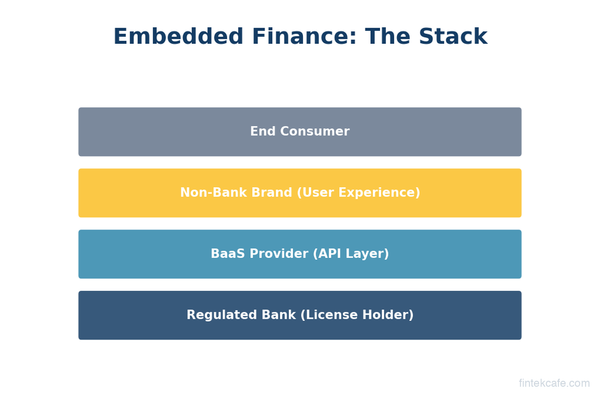
What Is Embedded Finance? How Non-Banks Are Becoming Banks
What is embedded finance and why are non-banks offering financial services? A complete guide to embedded payments, lending, insurance, and banking as a service.