
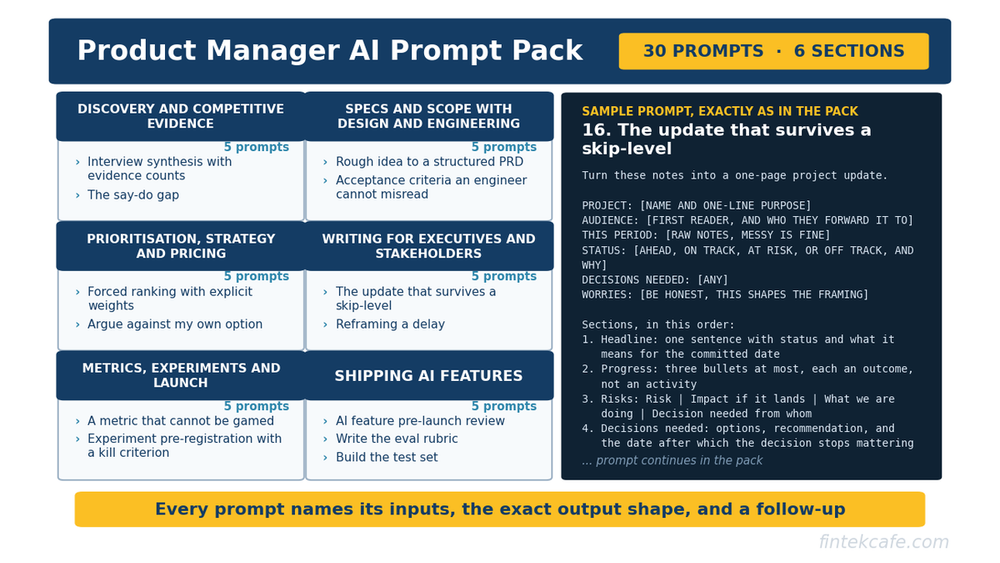
The Product Manager AI Prompt Pack: 30 Prompts for the Work You Actually Do
Thirty prompts that turn a chat window into the analyst, the sceptic, and the editor you do not have. In the next hour you can turn a week of interviews into a theme table with evidence counts, walk into spec review already holding the questions engineering will ask, and decide with stated thresholds whether an AI feature is good enough to ship.
Want all four? Get all 4 packs, 120 prompts, for 19.99 dollars
One-time payment, no subscription. Read it here on fintekcafe.com the moment you pay, and keep access to every future revision of the pack. Pro members already have it.
What is inside: 30 prompts in 6 sections
- Discovery and Competitive Evidence (5 prompts): Interview synthesis with evidence counts; The say-do gap; Support tickets to a ranked problem list; Jobs behind the feature requests; Competitive teardown by job
- Specs and Scope with Design and Engineering (5 prompts): Rough idea to a structured PRD; Acceptance criteria an engineer cannot misread; The engineering question bank; The scope cut ladder; The three-way scope negotiation
- Prioritisation, Strategy and Pricing (5 prompts): Forced ranking with explicit weights; Argue against my own option; What would have to be true; Packaging tiers that fence the right buyers; The price change stress test
- Writing for Executives and Stakeholders (5 prompts): The update that survives a skip-level; Reframing a delay; One roadmap, three audiences; Executive rewrite, before and after; The decision pre-read
- Metrics, Experiments and Launch (5 prompts): A metric that cannot be gamed; Experiment pre-registration with a kill criterion; Reading a flat result honestly; Launch readiness checklist; The post-mortem that names causes
- Shipping AI Features (5 prompts): AI feature pre-launch review; Write the eval rubric; Build the test set; Red-team the AI feature; Good enough to ship
Every prompt comes with when to use it, the copy-paste prompt with bracketed placeholders, what good output looks like, and a follow-up that pushes it further.
Try three of them free
These are the three prompts to start with, exactly as they appear in the pack. The other 27 are below, for buyers.
16. The update that survives a skip-level
When to use it: A weekly or monthly written update that will be forwarded to people who have none of your context.
Turn these notes into a one-page project update.

PROJECT: [NAME AND ONE-LINE PURPOSE]
AUDIENCE: [FIRST READER, AND WHO THEY FORWARD IT TO]
THIS PERIOD: [RAW NOTES, MESSY IS FINE]
STATUS: [AHEAD, ON TRACK, AT RISK, OR OFF TRACK, AND WHY]
DECISIONS NEEDED: [ANY]
WORRIES: [BE HONEST, THIS SHAPES THE FRAMING]

Sections, in this order:
1. Headline: one sentence with status and what it means for the
   committed date
2. Progress: three bullets at most, each an outcome, not an activity
3. Risks: Risk | Impact if it lands | What we are doing | Decision
   needed from whom
4. Decisions needed: options, recommendation, and the date after
   which the decision stops mattering
5. Next period: three bullets at most

Rules: no adjectives about effort, no "we continue to", and enough
context for a second reader who has never heard of the project.

If status or notes are missing, ask for them and stop.

Self-check: the headline works if the reader stops there, every
progress bullet names a result, every worry appears as a risk or is
deliberately left out with a note to me explaining why, and the page
stays under 350 words.
What good output looks like: A headline that stands alone. Progress bullets stating outcomes with numbers. Decisions with a date after which they stop mattering.
Example: Headline in good output: "At risk: bank-feed import slips one week to 14 March because the second bank's API rate limit was lower than documented; launch date holds if the fallback batch import is approved by Friday." Progress bullet: "Import live for 40 pilot accounts, 3 reconciliation errors in 2,100 transactions."
Push it further: "Compress this to the five lines I would send as a chat message."
8. The engineering question bank
When to use it: Before spec review, so the meeting is spent on decisions rather than on discovering gaps.
Read this spec from the position of the engineer who must estimate
and build it and has been burned by specs that looked complete.

SPEC: [PASTE THE SPEC]
SYSTEM CONTEXT: [STACK, EXISTING SERVICES, KNOWN CONSTRAINTS, OR
"UNKNOWN"]

Return a question bank grouped under these headings: Data model and
state; Integrations and dependencies; Failure modes and recovery;
Scale and performance; Permissions and security; Migration and
existing data; Testing; Observability; Unstated assumptions.

Under each heading, questions as bullets, each followed by one line
starting "If guessed wrong:" that names the consequence.

Then a ranked top five: the questions most likely to move the
estimate by more than half, each with the direction (bigger or
smaller).

Finally, list anything the spec states as a decision that is really
a preference engineering should be free to challenge.

No spec pasted? Ask for it and stop.

Self-check: every heading has at least one question or the note
"Covered in spec, section [N]", every top-five item appears in the
bank above, and no question is answered elsewhere in the spec.
What good output looks like: Migration and observability questions you had not considered. At least two questions that expose a decision you made without noticing it was a decision.
Push it further: "Answer the top five in the way that produces the smallest scope, and show what the spec becomes."
30. Good enough to ship
When to use it: The evals are in, the numbers are not perfect, and the team needs a decision instead of another week of tuning.
Decide whether this AI feature ships, using a decision tree rather
than a gut call.

EVAL RESULTS: [SCORES BY CRITERION AND STRATUM, SAMPLE SIZES, AND
THE AUTOMATIC-FAIL RATE ON CRITICAL CASES]
CURRENT BASELINE: [HOW WELL THE TASK IS DONE TODAY, BY PEOPLE OR THE
OLD SYSTEM, WITH ANY ERROR RATE]
COST OF A WRONG OUTPUT: [TO THE USER, THE BUSINESS, AND WHETHER IT IS
REVERSIBLE]
VOLUME: [EXPECTED USES PER DAY OR WEEK]
REVIEW CAPACITY: [WHETHER A HUMAN CAN CHECK OUTPUTS, AND HOW MANY]

Walk this tree and show the path taken:
Q1. Is any automatic fail rate above zero on Critical cases?
    Yes: HOLD.
Q2. Is a wrong output costly and irreversible?
    Yes: go to Q3. No: go to Q4.
Q3. Can a human review every output within REVIEW CAPACITY?
    Yes: SHIP WITH REVIEW. No: LIMITED BETA.
Q4. Does quality match or beat CURRENT BASELINE on the Common stratum?
    Yes: SHIP. No: go to Q5.
Q5. Is the gap limited to identifiable inputs that can be routed
    away? Yes: SHIP WITH ROUTING. No: LIMITED BETA.

Then: the verdict, the numbers that decided each branch, and the
metric and threshold that would reverse it after launch.

If the baseline is missing, ask for it and stop: good enough means
better than today, not perfect.

Self-check: every branch cites a number from the inputs, the verdict
is a leaf of the path shown, and the reversal threshold trips before
production quality falls below CURRENT BASELINE.
What good output looks like: A path through the tree with the deciding number at every branch. A comparison against today's baseline, not against perfection. A reversal threshold set before launch.
Push it further: "If the verdict is LIMITED BETA, define the beta cohort, its size, and the exit criteria for full launch."
Want all four? Get all 4 packs, 120 prompts, for 19.99 dollars