
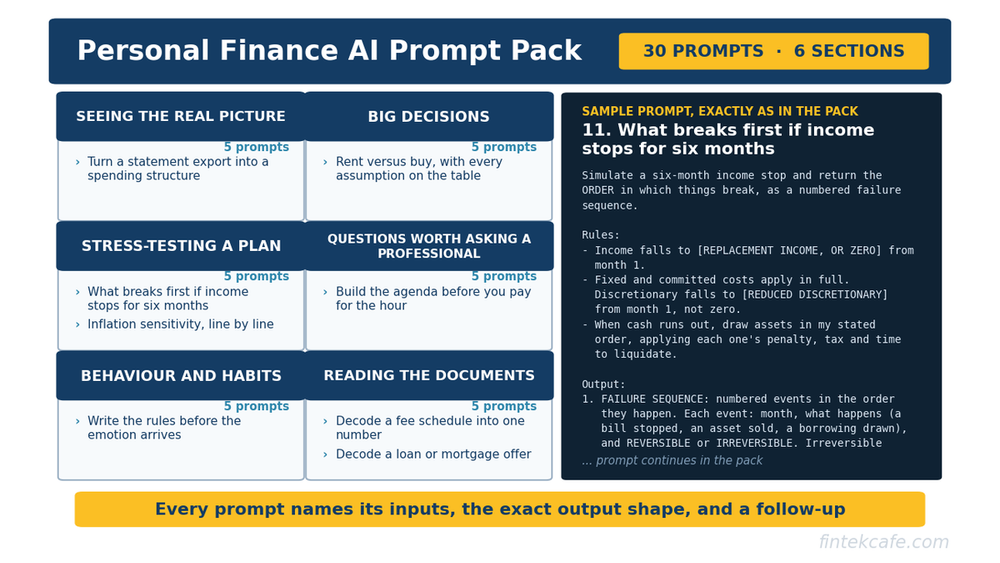
The Personal Finance AI Prompt Pack: 30 Prompts for Decisions With Real Money On Them
Thirty prompts that turn a chat model into the analyst who makes you show your work. In the next hour you can find the month your finances would actually break if income stopped, turn a fee schedule into one all-in number you can check line by line, and walk into a paid adviser meeting with the questions already written.
Want all four? Get all 4 packs, 120 prompts, for 19.99 dollars
One-time payment, no subscription. Read it here on fintekcafe.com the moment you pay, and keep access to every future revision of the pack. Pro members already have it.
What is inside: 30 prompts in 6 sections
- Seeing the Real Picture (5 prompts): Turn a statement export into a spending structure; Find the fixed costs disguised as variable ones; Build the net worth statement people actually leave out; Convert irregular bills into a true monthly run rate; Compare where the money went against what you said mattered
- Big Decisions (5 prompts): Rent versus buy, with every assumption on the table; Pay down debt or invest, argued both ways; The true cost of a car over the period you will own it; The real cost of a move or a relocation; Evaluate an offer that includes equity
- Stress-Testing a Plan (5 prompts): What breaks first if income stops for six months; Sequence-of-returns risk, explained against your own numbers; Inflation sensitivity, line by line; Find the concentration you cannot see; Pre-mortem: what would have to be true for this plan to fail
- Questions Worth Asking a Professional (5 prompts): Build the agenda before you pay for the hour; Understand a term properly before the meeting; Surface the timing-sensitive items before a deadline; Interrogate how your adviser is paid; Flag what needs a specialist when more than one country is involved
- Behaviour and Habits (5 prompts): Write the rules before the emotion arrives; A one-page investment policy statement; A decision journal entry that will be useful later; The reversibility check before a large purchase; The annual review that takes one hour
- Reading the Documents (5 prompts): Decode a fee schedule into one number; Compare two funds on the terms that actually differ; Compare two policies on exclusions rather than headline cover; Decode a loan or mortgage offer; Scan terms and conditions for the clauses that cost money later
Every prompt comes with when to use it, the copy-paste prompt with bracketed placeholders, what good output looks like, and a follow-up that pushes it further.
Try three of them free
These are the three prompts to start with, exactly as they appear in the pack. The other 27 are below, for buyers.
11. What breaks first if income stops for six months
When to use it: Once, properly, before you need to know. Again after any major change.
Simulate a six-month income stop and return the ORDER in which things
break, as a numbered failure sequence.

Rules:
- Income falls to [REPLACEMENT INCOME, OR ZERO] from month 1.
- Fixed and committed costs apply in full. Discretionary falls to
  [REDUCED DISCRETIONARY] from month 1, not zero.
- When cash runs out, draw assets in my stated order, applying each
  one's penalty, tax and time to liquidate.

Output:
1. FAILURE SEQUENCE: numbered events in the order they happen. Each
   event: month, what happens (a bill stopped, an asset sold, a
   borrowing drawn), and REVERSIBLE or IRREVERSIBLE. Irreversible
   means a missed payment that marks a credit record, a forced sale of
   a long-term asset, or an insurance lapse.
2. WORKING TABLE: Month | Opening cash | Income | Costs | Draws |
   Closing cash.
3. Two numbers: the month cash runs out, and the month of the first
   irreversible event.

Position: [CASH, MONTHLY FIXED, COMMITTED, DISCRETIONARY, ASSETS IN
DRAW ORDER WITH PENALTIES AND DAYS TO CASH, SEVERANCE OR INCOME
PROTECTION]

If the cash figure or cost lines are missing, list them and ask
first.

Before answering, check: each month's closing cash equals the next
month's opening cash, draws follow my stated order, and nothing
advises what to cut.
What good output looks like: Two different months, a named first irreversible event, and a working table where each month's closing cash carries forward. A runway number alone is the easy half.
Example: Cash 18,000, fixed 2,400, committed 900, discretionary cut to 500. Cash runs out in month 5. But event 3, in month 4, is irreversible: the annual premium on income protection falls due and cannot be paid without selling the long-term fund at a 10 percent exit charge.
Push it further: "What single change this month would push the first irreversible event furthest out, and by how many months?"
26. Decode a fee schedule into one number
When to use it: Any time a fee table is easier to skim than to total.
Turn the fee schedule below into a cost waterfall, from the headline
fee to the all-in annual cost at my balance.

Waterfall steps, one row each, in this order: headline fee, then each
further charge: fees in basis points, percentages of something other
than my balance, flat admin charges, transaction charges at
[TRANSACTIONS PER YEAR] a year, entry and exit charges annualised
over [YEARS HELD] years, and underlying product costs.

Row format: Step | Charge | How it is expressed | Formula at my balance
of [BALANCE] | Annual amount | Running total.

Final row: ALL-IN ANNUAL COST as an amount and as a percent of
balance.

Then:
- MULTI-YEAR COST: total fees over [YEARS HELD] years with the
  balance growing at [ASSUMED GROWTH] percent, as an amount and as a
  percent of the ending balance, with year 1 and year 2 shown in full.
- AMBIGUITIES: every charge the document mentions but does not
  quantify, each with the exact question to send the provider.

Fee schedule: [PASTE]

If the schedule or balance is missing, ask for it before building the
waterfall.

Before answering, check: the running total equals the sum of the
rows, the final percent equals the amount divided by the balance, and
nothing compares this provider favourably or unfavourably with others.
What good output looks like: One all-in percentage and amount, a running total you can re-add, and an ambiguity list you can send to the provider as it stands.
Example: Balance 100,000. Headline 0.25 percent, 250. Fund costs 0.20 percent, running total 450. Platform flat fee 120, running total 570. Twelve trades at 10, running total 690. All-in: 690, or 0.69 percent, nearly triple the headline.
Push it further: "Rewrite the ambiguities as one numbered message to the provider, where each question requires a number in reply."
16. Build the agenda before you pay for the hour
When to use it: Before any meeting you are paying for with an adviser, accountant or broker.
Prepare a briefing memo for my [DURATION] meeting with a
[PROFESSIONAL TYPE], so the time goes on answers, not background.

Memo sections:
1. SITUATION IN NINETY SECONDS: household, income structure, assets
   and liabilities by category, horizons, and the decisions open.
   Neutral and factual.
2. QUESTIONS, in three groups: only a professional can answer for my
   jurisdiction; I want their judgement, not a fact; I should know
   this but do not. Within each group, order by how much a surprising
   answer would change things.
3. DOCUMENTS TO BRING, as a checklist.
4. THREE QUESTIONS I HAVE NOT THOUGHT TO ASK, each with one line on
   why it matters for this situation.
5. CLARIFICATIONS THEY WILL NEED: anything in my description a
   professional will stop to ask about.

Country: [COUNTRY].

Situation: [HOUSEHOLD, INCOME, ASSETS AND DEBTS IN CATEGORIES, OPEN
DECISIONS, WHAT I ALREADY KNOW]

If the professional type, country or open decisions are missing, ask
for them in one list first.

Before answering, check: section 1 fits in about 150 words, every
question is specific enough to answer in a sentence or two, and the
memo contains no recommendation of your own.
What good output looks like: A summary you could hand over unedited, and at least one question in section four that genuinely had not occurred to you.
Example: Section 4 might read: "Does the pension transfer you are considering lose any guaranteed benefit, and has anyone valued it?" with the reason: "guarantees are often worth more than the headline pot and cannot be restored after a transfer."
Push it further: "Write the three follow-up questions to use if the answer to my first question is anything other than a clear yes."
Want all four? Get all 4 packs, 120 prompts, for 19.99 dollars