
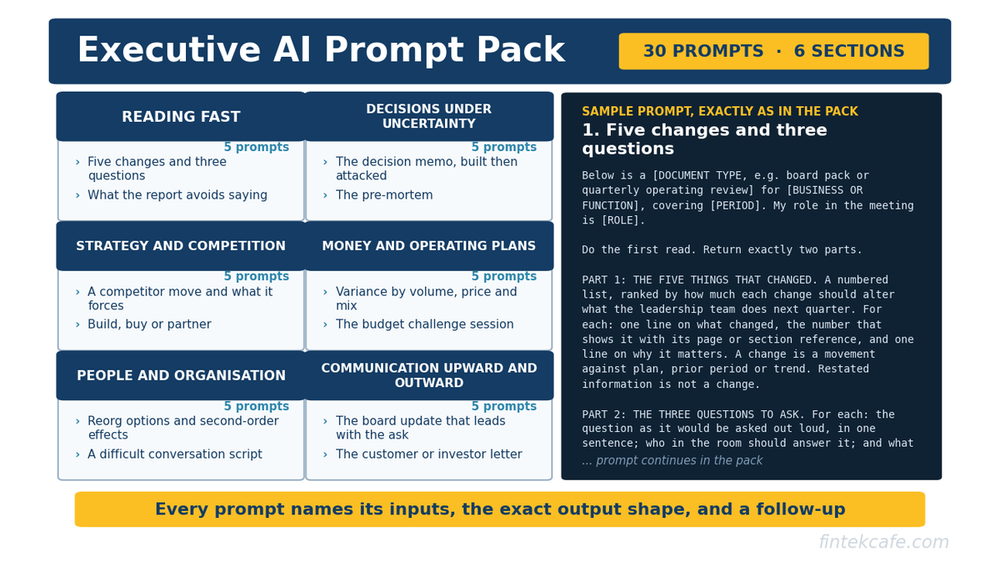
The Executive AI Prompt Pack: 30 Prompts for Decisions, Boards and Operating Reviews
Thirty prompts that do the analyst's first pass and the sceptic's review, so your time goes on the decision. By the end of today you can turn a sixty-page board pack into the five things that changed and the three questions to ask, run a pre-mortem on a decision before it is announced, and write a board update that gets its answer in the first paragraph.
Want all four? Get all 4 packs, 120 prompts, for 19.99 dollars
One-time payment, no subscription. Read it here on fintekcafe.com the moment you pay, and keep access to every future revision of the pack. Pro members already have it.
What is inside: 30 prompts in 6 sections
- Reading Fast (5 prompts): Five changes and three questions; The number that does not reconcile; What the report avoids saying; Claims against evidence; The ninety-second pre-read
- Decisions Under Uncertainty (5 prompts): The decision memo, built then attacked; The pre-mortem; What would have to be true; One-way door or two-way door; The decision tree and what to learn first
- Strategy and Competition (5 prompts): A competitor move and what it forces; Build, buy or partner; The market-sizing sanity check; The competitive war game; Strategy or goal list
- Money and Operating Plans (5 prompts): Variance by volume, price and mix; The budget challenge session; The business case stress test; Headcount plan against output; The forecaster's track record
- People and Organisation (5 prompts): Reorg options and second-order effects; A difficult conversation script; Scorecard for a senior hire; A performance narrative that is fair; Key-person risk map
- Communication Upward and Outward (5 prompts): The board update that leads with the ask; The all-hands message about bad news; The customer or investor letter; The one-page strategy narrative; The hostile-reader edit
Every prompt comes with when to use it, the copy-paste prompt with bracketed placeholders, what good output looks like, and a follow-up that pushes it further.
Try three of them free
These are the three prompts to start with, exactly as they appear in the pack. The other 27 are below, for buyers.
1. Five changes and three questions
When to use it: A board pack or operating review arrives the night before and there is no time to read all of it.
Below is a [DOCUMENT TYPE, e.g. board pack or quarterly operating
review] for [BUSINESS OR FUNCTION], covering [PERIOD]. My role in
the meeting is [ROLE].

Do the first read. Return exactly two parts.

PART 1: THE FIVE THINGS THAT CHANGED. A numbered list, ranked by how
much each change should alter what the leadership team does next
quarter. For each: one line on what changed, the number that shows
it with its page or section reference, and one line on why it
matters. A change is a movement against plan, prior period or
trend. Restated information is not a change.

PART 2: THE THREE QUESTIONS TO ASK. For each: the question as it
would be asked out loud, in one sentence; who in the room should
answer it; and what a weak answer would sound like.

Do not summarise the sections in order and do not give an overall
verdict on performance.

If any bracketed input is missing or still reads as a placeholder,
ask for it in one short list before starting.

Before returning, check that every number cited appears in the
document at the reference given, and that no change is listed twice
under different wording.

[PASTE OR ATTACH THE DOCUMENT]
What good output looks like: Five changes you could defend if challenged, each pinned to a page. At least one change found in an appendix or footnote rather than the summary. Questions short enough to ask out loud.
Example: "3. Enterprise churn rose to 4.1 percent against a 2.5 percent plan (page 14, retention table), while the summary page describes retention as stable. Matters because next quarter's renewal cohort is twice the size." Question: "How much of the churn increase came from the three accounts named in the appendix, and was any of it known at the last review?"
Push it further: "List the two things in this pack that did not change but should have, given the plan agreed last quarter."
7. The pre-mortem
When to use it: Before announcing or funding a decision, while changing course is still cheap.
Run a pre-mortem. It is [PERIOD, e.g. eighteen months] from now and
the following decision has clearly failed. Work backwards from the
failure.

Decision: [DESCRIBE IT]. What success was supposed to look like:
[TARGETS]. Context: [MARKET, TEAM, DEPENDENCIES, HISTORY WITH
SIMILAR DECISIONS].

Write eight distinct failure stories of three sentences each: what
went wrong, why nobody stopped it, and the first visible sign that
appeared months before the failure. Cover at least four kinds of
cause from: execution, market or customer, people and incentives,
dependencies on others, and assumptions that were never true.

Rank the eight by likelihood multiplied by damage, scoring each 1 to
5 on both and showing the scores. For the top three, give the early
warning signal to track, the threshold that should trigger a
rethink, and the role that should own watching it.

Do not reassure. Leave out any failure story that could apply to
any decision anywhere.

If the success targets are missing, ask for them, because failure
can only be written against a definition of success.

Before returning, confirm the eight stories are genuinely different
causes rather than one cause reworded, and that each product score
is correct.
What good output looks like: Stories specific enough that someone on the team recognises one. Warning signals that can be measured this quarter. A top three that is not simply a copy of the existing risk register.
Push it further: "Rewrite the plan so the top-ranked failure would become visible within sixty days rather than twelve months."
26. The board update that leads with the ask
When to use it: A board update is due and you need a decision, an approval or real input, not applause.
Write a board update whose first paragraph is the ask.

What I need from the board: [DECISION, APPROVAL OR INPUT, AND BY
WHEN]. Performance since the last meeting: [KEY NUMBERS AGAINST
PLAN]. Going well: [LIST]. Not going well: [LIST]. Changes to the
outlook: [LIST]. Risks the board should know about: [LIST].

Main update, maximum 400 words, in five sections:
1. THE ASK: one paragraph. What is needed, by when, and what happens
   if it is not given.
2. WHY NOW: two or three sentences.
3. HOW WE ARE DOING: performance against plan in three to five lines
   with numbers, bad news given the same prominence as good.
4. WHAT HAS CHANGED: the outlook changes that bear on the ask.
5. WHAT WE ARE WATCHING: two or three risks, each with its trigger.

Then, separately, an appendix of the six questions the board is most
likely to ask, each with a one-line answer drawn only from what I
supplied. Flag any question my material cannot answer.

No adjectives the numbers do not support. No "we are pleased to
report".

If the ask is missing, ask me for it before writing anything.

Before returning, check the main update is 400 words or fewer and
every "not going well" item appears in section 3.
What good output looks like: An ask that could be approved from paragraph one alone. Bad news given the same space as good. An appendix that includes at least one question you hoped nobody would ask.
Example: "THE ASK: Approval at the March meeting to extend the platform migration by one quarter and release a further 2.4 million from contingency. Without it, the legacy system's support contract lapses in June with the migration unfinished."
Push it further: "Rewrite section 3 for a board member who reads only numbers, as a five-row table against plan."
Want all four? Get all 4 packs, 120 prompts, for 19.99 dollars