
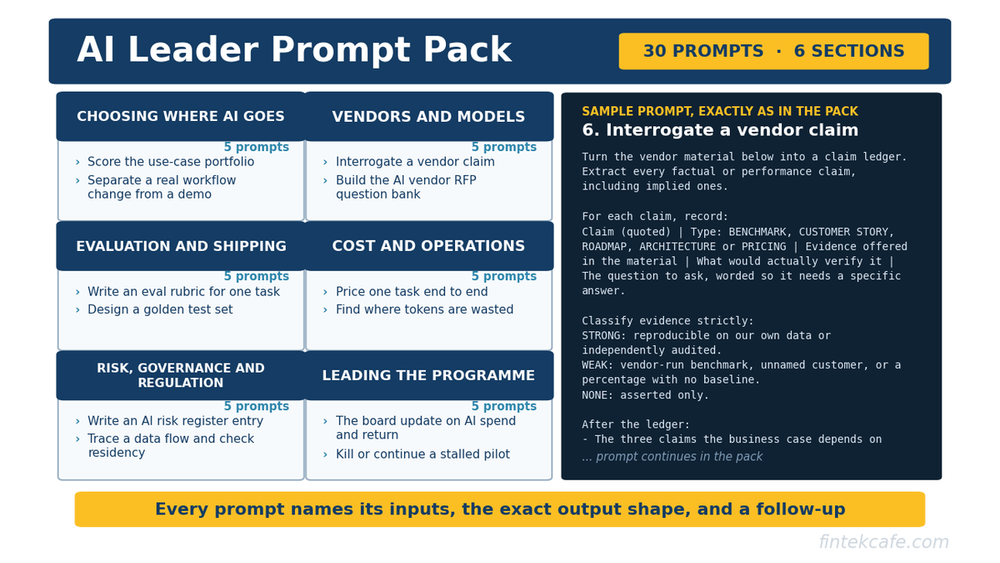
The AI Leader Prompt Pack: 30 Prompts for Choosing, Shipping and Governing AI
Thirty prompts for the leader who signs off AI spend and answers for AI risk. In the next hour you can turn a vendor's pitch into a ledger of claims and the evidence behind each, price a use case per successful task instead of per token, and walk into a board meeting with an AI update that shows spend against return.
Want all four? Get all 4 packs, 120 prompts, for 19.99 dollars
One-time payment, no subscription. Read it here on fintekcafe.com the moment you pay, and keep access to every future revision of the pack. Pro members already have it.
What is inside: 30 prompts in 6 sections
- Choosing Where AI Goes (5 prompts): Score the use-case portfolio; Separate a real workflow change from a demo; Make the build, buy or wait call for one use case; Decide how autonomous it should be; Check data readiness before promising a date
- Vendors and Models (5 prompts): Interrogate a vendor claim; Build the AI vendor RFP question bank; Compare two models or vendors on cost, speed, quality and lock-in; Read a model or system card for what it omits; Redline the AI terms in a vendor contract
- Evaluation and Shipping (5 prompts): Write an eval rubric for one task; Design a golden test set; Set the ship threshold and the rollback trigger; Plan a red-team exercise for an agent or assistant; Write the production monitoring runbook
- Cost and Operations (5 prompts): Price one task end to end; Find where tokens are wasted; Plan capacity and rate limits for launch; Run an incident review for a model failure; Stress-test unit economics against provider changes
- Risk, Governance and Regulation (5 prompts): Write an AI risk register entry; Trace a data flow and check residency; Write the staff policy for using AI tools; Map a use case to a risk-tier regulation, without false certainty; Survey the AI you already bought without knowing it
- Leading the Programme (5 prompts): The board update on AI spend and return; The business case that survives a CFO; An adoption plan that measures usage honestly; Kill or continue a stalled pilot; The all-hands talk track on what AI means for roles
Every prompt comes with when to use it, the copy-paste prompt with bracketed placeholders, what good output looks like, and a follow-up that pushes it further.
Try three of them free
These are the three prompts to start with, exactly as they appear in the pack. The other 27 are below, for buyers.
6. Interrogate a vendor claim
When to use it: After a pitch, before the second meeting, while the claims are fresh and untested.
Turn the vendor material below into a claim ledger. Extract every
factual or performance claim, including implied ones.

For each claim, record:
Claim (quoted) | Type: BENCHMARK, CUSTOMER STORY, ROADMAP, ARCHITECTURE
or PRICING | Evidence offered in the material | What would actually
verify it | The question to ask, worded so it needs a specific answer.

Classify evidence strictly:
STRONG: reproducible on our own data or independently audited.
WEAK: vendor-run benchmark, unnamed customer, or a percentage with no
baseline.
NONE: asserted only.

After the ledger:
- The three claims the business case depends on most, and their
  evidence grade.
- ROADMAP items presented as current capability.
- A proof-of-concept design: the smallest test on our own data that
  would confirm or kill the top claim, with a pass threshold we set
  in advance.

Vendor material: [PASTE DECK, CALL NOTES OR PROPOSAL]
Our use case in one line: [USE CASE]

If no vendor material is pasted, ask for it and stop.

Before answering, check: every claim is quoted verbatim, no claim is
graded STRONG without independent or own-data evidence, and nothing
says whether to buy.
What good output looks like: A ledger where most claims grade WEAK or NONE, which is normal, and a proof-of-concept tied to the one claim that matters most. The quoted claims make the follow-up email easy.
Example: "Reduces handling time by 60 percent" graded WEAK: vendor-run, no baseline stated, customer unnamed. Question: "What was the baseline handling time, over how many tickets, and can we speak to that customer?"
Push it further: "Write the follow-up email asking the five most important questions, polite and specific, with a reply deadline."
16. Price one task end to end
When to use it: Before approving a budget, because per-token prices say nothing about per-task cost.
Build a unit cost for one [TASK] and scale it to per user and per
month. Show every multiplication.

Cost build-up, one row per component: model calls per task; input
tokens per call (system prompt, context, user input); output tokens
per call; price per million input and output tokens; retrieval or
tool call costs; retries and failed attempts; human review share and
cost per review.

Output:
1. BUILD-UP TABLE: Component | Quantity | Unit price | Formula | Cost
   per attempt.
2. COST PER SUCCESSFUL TASK = cost per attempt x attempts per task,
   divided by success rate, plus review cost per task.
3. SCALE: tasks per user per month, cost per user per month, total
   monthly cost at [USERS] users.
4. SENSITIVITY: the total at plus and minus 50 percent on the three
   inputs that move it most, as a small table.
5. The share of cost that is context re-sent on every call.

Inputs: [CALLS PER TASK, TOKEN COUNTS, PRICES, SUCCESS RATE, REVIEW
RATE AND COST, TASKS PER USER, USERS]

If a price or token count is missing, ask for it; never assume a
provider's list price.

Before answering, check: every row recomputes, cost per successful
task includes failed attempts and review, and the monthly total
equals per-user cost times users.
What good output looks like: A cost per successful task noticeably above the naive per-call cost, and a sensitivity table that shows whether success rate or context size is the real driver.
Example: 3 calls a task, 6,000 input and 500 output tokens a call, prices of 1 per million input tokens and 4 per million output tokens, success rate 80 percent. Cost per attempt 3 x (0.006 + 0.002) = 0.024; per successful task 0.024 / 0.8 = 0.030. Review of 5 percent of tasks at 1.50 each adds 0.075, for 0.105 in total. Review, not tokens, is over two thirds of the unit cost.
Push it further: "Recompute assuming context is cached and billed at a tenth of the input price after the first call. What is the new unit cost?"
29. Kill or continue a stalled pilot
When to use it: When a pilot has passed its planned end date and nobody has called it.
Prepare a three-option decision sheet for the stalled pilot below:
CONTINUE, PIVOT or STOP. Present the evidence for each; the sponsor
decides.

Part 1, SCORECARD AGAINST THE ORIGINAL CRITERIA: Criterion (as
originally written) | Target | Actual | Met, partly met, not met |
Evidence. If the original criteria were never written down, say so
first; that is a finding.

Part 2, THE THREE OPTIONS, each with: the case for it in its
strongest form, what it would cost over the next quarter, what must
be true for it to succeed, and the measured result that would prove
it wrong within 60 days.

Part 3, SUNK COST CHECK: the reasons for continuing that rely only on
money or effort already spent, listed and set aside.

Part 4, WHAT STOPPING KEEPS: data, evaluations, integrations or
lessons worth preserving if the answer is STOP.

Pilot material: [ORIGINAL PROPOSAL AND CRITERIA, RESULTS TO DATE,
SPEND, TEAM VIEWS, USER FEEDBACK]

If the results to date are missing, ask for them before building the
sheet.

Before answering, check: each scorecard row quotes the original
criterion, all three options are argued at comparable strength, and
the sheet does not choose an option.
What good output looks like: A scorecard against criteria written before the pilot began, a sunk-cost list set aside explicitly, and three options argued evenly enough that the sponsor has to decide.
Push it further: "Draft the announcement for whichever option the sponsor picks, one version for each, factual and free of spin."
Want all four? Get all 4 packs, 120 prompts, for 19.99 dollars